

Commentary
While the EU and European governments are embracing the much-lauded middle-power moment, this entails three difficult conundrums.
Richard Youngs
{
  "authors": [
    "Wang Tao",
    "Yang Yifang"
  ],
  "type": "legacyinthemedia",
  "centerAffiliationAll": "",
  "centers": [
    "Carnegie Endowment for International Peace",
    "Carnegie China"
  ],
  "collections": [],
  "englishNewsletterAll": "",
  "nonEnglishNewsletterAll": "",
  "primaryCenter": "Carnegie China",
  "programAffiliation": "",
  "programs": [],
  "projects": [
    "Carnegie Oil Initiative"
  ],
  "regions": [
    "East Asia",
    "China"
  ],
  "topics": []
}
Source: Getty
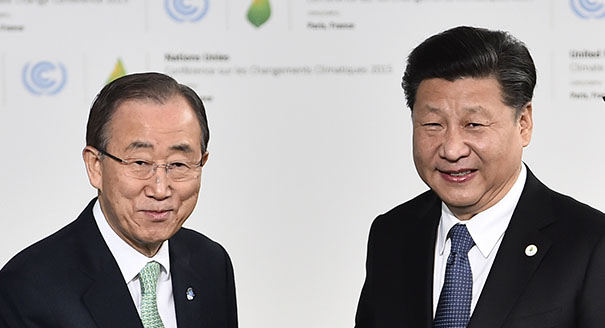
China hopes that the UN Climate Change Conference in Paris will help the country deepen reforms in its energy sector.
Source: CBN Research Institute
Although the recent Paris attack and conflict between Russia and Turkey have dominated the news headlines, COP 21—which opened in late November—is still the most important and historical international issue that the world faces at present. Six years after the greatly disappointing Copenhagen Climate Change Conference (COP 15), the ongoing Climate Change Conference in Paris epitomizes the combined efforts that participating countries are arduously undertaking within the UN framework to combat this global challenge. The world is facing another do-or-die moment, and it may very well be the last chance to seize the moment. Can the international community achieve a legally binding agreement to cope with the effects of climate change, a crisis that will shape the future of the human race? The two-week conference underway in Paris will tell us.
With the whole world watching, China has taken on an unwavering sense of responsibility on the issue of climate change. The course of action to which China is committing itself at the UN Climate Change Conference in Paris will also help the country deepen reforms in its energy sector based on the Third Plenary Session of Eighteenth Chinese People’s Congress (CPC) Central Committee in November 2013.
More than 160 countries have submitted intended nationally determined contributions (INDCs), which collectively cover more than 90 percent of global greenhouse gas emissions. More than 140 heads of state or government are making appearances at COP 21, a reflection of the international community’s strong determination to reach a climate agreement.
China, as the world’s second-largest economy and largest emitter of greenhouse gases, obviously attaches great importance to COP 21. Whereas then premier Wen Jiabao attended the Copenhagen Conference in 2009, President Xi Jinping visited Paris himself—a sign of greater commitment this time around. This past July, China submitted its INDC in a document entitled Enhanced Actions on Climate Change. Beijing also announced joint presidential statements with the United States and France over the past few months, further indications that China is determined to respond to climate change.
With its share of the global economy and energy markets increasing, China is taking a more proactive attitude in international governance of energy and environmental issues. By launching the AIIB and implementing the Belt and Road initiative, China has expressed willingness to playing a greater role on the international stage. The international community also has greater demands and expectations of China during these climate change negotiations. After the Chinese government proposed in 2009 to lower the carbon intensity of GDP by 40 to 45 percent below 2005 levels by 2030, the November 2014 China-U.S. Joint Announcement on Climate Change declared that China would peak its CO2 emissions before 2030. This goal was considered radical even by academics in 2009, but it has now become a pledge made by the government itself.
Even more unexpectedly, between 2009 and 2015 China and the United States swapped places in terms of economic prospects. The U.S. economy fell into a tailspin due to the 2008 economic crisis, while China performed well after implementing a 4 trillion renminbi stimulus plan. This explains, to some degree, why the United States rejected emissions targets proposed by the EU in Copenhagen, due to fears that such an outcome may cause economic harm. But today China is faced with a slower rate of economic growth than it has experienced for the past several decades while the United States is in the midst of a robust economic recovery and prosperity stemming from the shale gas industry. Moreover, the U.S. Federal Reserve is planning to raise interest rates after years of quantitative easing. This raises the question: will the Chinese government restrict its efforts to cope with climate change because of the country’s domestic economic downturn?
However, this should not cause China’s determination on climate change to waver. On the contrary, China should use its pledge to implement gas and oil sector reforms that have proceeded slowly up until now. A leading cause of China’s economic downturn is the pervasive influence of an economic model centered on coal consumption and subsequent overcapacity among high-pollutant, energy-hungry industries. This trend, in concert with ever more robust domestic environmental standards and the growing proportional size of the service sector relative to China’s overall economy, has ushered in an era of economic structural adjustments known as the New Normal. Coal has been the first of the three fossil fuels to decline in use. After China’s year-over-year coal consumption fell 2.9 percent in 2014, China’s coal use is almost certainly predicted to keep falling in 2015. As the Chinese economy’s carbon intensity decreases, there is no longer a strong correlation between the country’s economic growth and its energy consumption. Economic growth has become less dependent on energy consumption since China’s twelfth five-year plan took effect (2011–2015). Consequently, in 2014 the elasticity ratio of Chinese energy consumption was only 0.30, its lowest level in several years.
Deeper reforms are needed in the gas and oil sectors, especially in terms of encouraging the use of natural gas instead of coal, given that natural gas produces far fewer air pollutants and 50 percent fewer carbon emissions. Currently natural gas accounts for only 6 percent of China’s energy consumption. With low prices and adequate supplies, natural gas is a clean energy source that should take on a greater role in domestic energy consumption. However, due to the relatively slow pace of reforms in the gas and oil sectors, not only is improved efficiency in these industries constrained, some heavy industries have stopped using natural gas and switched back to coal. Anemic growth in natural gas consumption would also hold back domestic industrial upgrades, which may hinder the transformation affecting China’s energy and economic landscape.
If the severe air pollution of 2013 prompted Chinese efforts to reduce coal consumption over the short term, China should use its response to climate change as a push to continue its energy transition, especially by sustaining momentum for domestic natural gas and oil reforms. During the Fifth Plenary Session of the Eighteenth Central Committee of the CPC in October 2015, China listed green development as a strategy in its next five-year plan. The State Council unequivocally aims to advance energy reform in China’s Thirteenth Five-Year Plan (2016–2020). These oil and gas reforms will aim to free up and increase competition in industries dominated by monopolies with the goal of introducing market forces into these sectors of the economy.
China must combine its commitment to combat climate change and its need for domestic reforms. The government must undertake a series of reforms to improve the efficiency of the country’s natural gas industry and increase its size relative to the rest of the energy sector. This will require further legislative reforms on mineral rights, oil and gas pipeline networks, state-owned enterprises, taxation, and government spending. In addition, China must introduce effective mechanisms to allow greater market competition and also strengthen the management of its natural gas industry.
Deeping reforms in the gas and oil sectors will not only help China respond to climate change. It could also advance China’s ongoing economic and energy transition, providing a long-term basis for high-quality economic growth.
Yang Yifang is a researcher at the CBN Research Institute.
This article was originally published by the CBN Research Institute.

Former Nonresident Scholar, Carnegie-Tsinghua Center for Global Policy
Wang Tao was a nonresident scholar in the Energy and Climate Program based at the Carnegie–Tsinghua Center for Global Policy.
Yang Yifang

While the EU and European governments are embracing the much-lauded middle-power moment, this entails three difficult conundrums.

Richard Youngs

Europe is facing rising populism internally as well as external pressures from Russia, China, Turkey, and the United States.

Dimitar Bechev

The European Commissioner for Trade is headed to China. But after President Xi’s bridge-building visit to Washington, can a more isolated EU overcome Beijing’s stranglehold on critical raw materials? Who will blink first?

Rym Momtaz, ed.

The hybrid warfare landscape is evolving rapidly, leaving policymakers without clear strategies. To better inform their work in addressing emerging challenges, governments must dig deeper into the underlying dynamics at play.


Raluca Csernatoni, Alicia Wanless
As geopolitical rivalry weaponizes global supply chains, the EU’s true vulnerability lies in emerging-risk imports. For these goods, suppliers are growing more concentrated, substitution more difficult, and political risk is looming.

Sinan Ülgen