

Article
Radical-right parties are expected to do well in upcoming elections in four of the EU's biggest member states. If successful, they could prevent the union from addressing key challenges ahead.
Stefan Lehne
{
  "authors": [
    "Richard Sokolsky",
    "Paul Stronski"
  ],
  "type": "legacyinthemedia",
  "centerAffiliationAll": "dc",
  "centers": [
    "Carnegie Endowment for International Peace"
  ],
  "collections": [],
  "englishNewsletterAll": "ctw",
  "nonEnglishNewsletterAll": "",
  "primaryCenter": "Carnegie Endowment for International Peace",
  "programAffiliation": "russia",
  "programs": [
    "Russia and Eurasia"
  ],
  "projects": [
    "Changing Geopolitics of Eurasia"
  ],
  "regions": [
    "North America",
    "United States",
    "Central Asia",
    "South Asia",
    "Pakistan",
    "East Asia",
    "China",
    "Kazakhstan"
  ],
  "topics": [
    "Political Reform",
    "Foreign Policy"
  ]
}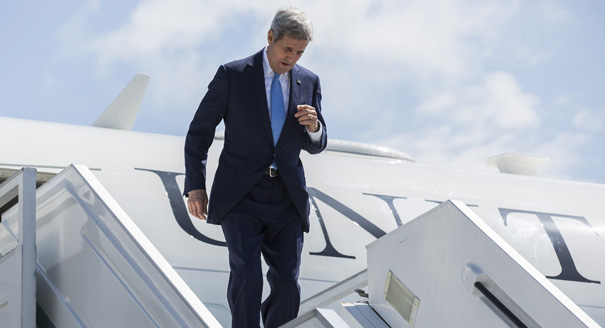
Source: Getty
Central Asian states have a strong interest in maintaining friendly ties with the United States. This geopolitical desire creates meaningful opportunities for U.S. engagement in the near term, and for advancing more modest interests in the years ahead.
Source: EurasiaNet
The United States has struggled in the post-Soviet era to define a durable framework for its relations with Central Asian states. Initially, securing the Soviet Union’s nuclear legacy was the main focus of US policy. Then, after 9/11, policy was shaped by Washington’s need for Central Asian support for US military operations in Afghanistan. But as Washington redefines its global priorities, what should guide its policy toward Central Asia?
It is perhaps easier to determine what should not be a guiding factor: not the region’s energy reserves at a time of falling oil prices; not visions of democracy that are not shared by Central Asian governments; not Afghanistan, as Washington tries to disengage from 15 years of war there.The only thing that is clear is the United States needs to adjust its relations with Central Asian states to a new set of realities.
Before pondering the future, it is worth taking a moment to consider the past. US engagement in Central Asia has paid off: nuclear weapons have been removed and Kazakhstan has emerged as a champion of global non-proliferation. Central Asian states served as valuable partners in the US military campaign in Afghanistan. Washington helped the Central Asian states establish their sovereignty, territorial integrity and political independence. No single country has established its hegemony over the region, and Russia no longer has a monopoly on the flow of Central Asian oil and gas. Ultimately, America has fulfilled its promise of partnership.
But many of America’s hopes for the region have not materialized. Central Asia has made little progress toward democratic, open societies based on free markets, the rule of law, and respect for human rights. The US project to connect Central Asia to Afghanistan and Pakistan via a “New Silk Road” has failed to take off. And China, not the West, is the prime beneficiary of Russia’s lost monopoly on the region’s energy resources.
Looking ahead, it is unrealistic to believe that Washington can fulfill its transformational goals in the region, especially as it is looking to downsize its commitment there and focus on other, pressing challenges in the Asia-Pacific and Middle East. As the United States continues on a glide path toward a substantially smaller military footprint in Afghanistan, Central Asia’s role as the gateway to Afghanistan has declined in America’s strategic calculus—and that means less US time, energy, and resources will be devoted to the region.
More importantly, Central Asia is now on a different trajectory. The region is in the midst of a geopolitical shift that will diminish the ability of Western states to influence developments there. China and Russia are emerging as the region’s principal economic, political, and security partners due to Moscow’s residual presence and Beijing’s preeminent economic position as Central Asia’s trading partner and lender of choice. These shifting dynamics will make Central Asia less hospitable to the projection of US influence, to efforts at state building, to regional economic integration, and to the promotion of Western values.Advancing Washington’s priorities now requires rebooting American policy. Four changes are critical. First, the United States should prioritize its engagement with Kazakhstan and Uzbekistan, the regional powerhouses. With aging leaders sitting atop authoritarian-minded political systems, both countries are facing challenging, potentially unsettling political transitions. Second, Washington should recognize it shares some interests with Russia and China, and try to harness their actions to advance US interests. These common interests include political stability in the region and long-term economic development through the construction of regional infrastructure. Third, instead of promoting democracy across the board, the United States should focus its reform agenda on improving social and economic conditions to create more hospitable conditions for change down the road. Finally, Washington should avoid militarizing US policy by overreacting to the threat of Islamic extremism, which regional governments perennially hype to support authoritarian policies and garner security assistance from outside partners.
Washington has often set ambitious but unrealistic goals for the region. This has led to mutual frustration, cynicism, and disappointment among the Central Asian five states, as well as in Washington. If the United States fails to adapt to the changes sweeping the region, the gap between America’s ambitions and its capacity to achieve them will only continue to grow and could very well emerge as an irritant in relations not only with Central Asia, but also with Russia and China. A policy grounded in a realistic view of the region, and which takes into account the limited resources the United States is willing to commit to the region, better serves everyone’s interests.
This is not an argument for neglect or disengagement—it is a call for prudence, and for focusing on outcomes that the United States can reasonably attain. Central Asian states have a strong interest in maintaining friendly ties with the United States, if only to balance the influence of China and Russia. This geopolitical desire creates meaningful opportunities for US engagement in the near term, and for advancing more modest interests in the years ahead.

Nonresident Senior Fellow, Russia and Eurasia Program
Richard Sokolsky is a nonresident senior fellow in Carnegie’s Russia and Eurasia Program. His work focuses on U.S. policy toward Russia in the wake of the Ukraine crisis.

Former Senior Fellow, Russia and Eurasia Program
Paul Stronski was a senior fellow in Carnegie’s Russia and Eurasia Program, where his research focuses on the relationship between Russia and neighboring countries in Central Asia and the South Caucasus.
Carnegie does not take institutional positions on public policy issues; the views represented herein are those of the author(s) and do not necessarily reflect the views of Carnegie, its staff, or its trustees.

Radical-right parties are expected to do well in upcoming elections in four of the EU's biggest member states. If successful, they could prevent the union from addressing key challenges ahead.

Stefan Lehne

The aftermath of the Ceuta crisis shows Europe has drawn the wrong lessons. Rather than doubling down on failed migration policies, the EU needs to address the underlying roots of such episodes.

Richard Youngs

Canadian Prime Minister Mark Carney has twice inspired praise for standing up to U.S. President Donald Trump: at the 2026 World Economic Forum in Davos and on Canada-U.S. trade negotiations. Is Carney showing a third way better than the EU has in dealing with the Trump administration?

Rym Momtaz, ed.

The EU’s responses to two recent incidents expose the gulf between European perceptions and capabilities. Unless the union can bridge that gap, it will never become a real geostrategic power.
Rym Momtaz

European states control several Overseas Countries and Territories around the world that carry strategic, economic, and environmental weight. As great powers challenge the rules-based order, defending them is a geopolitical imperative for Europe.

Marc Pierini