

Commentary
Marc Pierini
{
  "authors": [
    "Marc Pierini"
  ],
  "type": "commentary",
  "centerAffiliationAll": "",
  "centers": [
    "Carnegie Endowment for International Peace",
    "Carnegie Europe"
  ],
  "collections": [
    "The Iran War’s Global Reach"
  ],
  "englishNewsletterAll": "",
  "nonEnglishNewsletterAll": "",
  "primaryCenter": "Carnegie Europe",
  "programAffiliation": "",
  "regions": [
    "Europe",
    "Iran",
    "United States",
    "Israel"
  ],
  "topics": [
    "EU",
    "Foreign Policy",
    "Security",
    "Defense"
  ]
}
Source: Getty
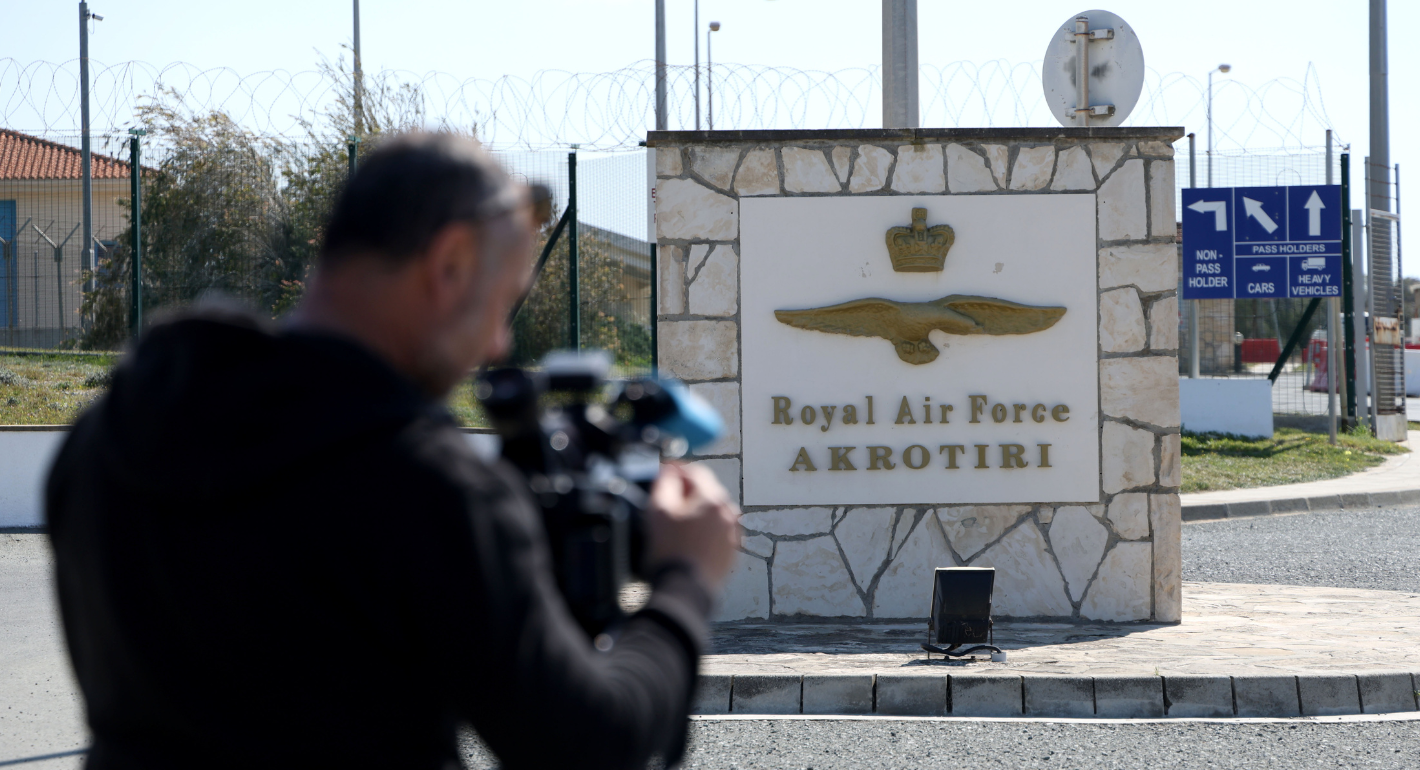
The drone strike on the British air base in Akrotiri brings Europe’s proximity to the conflict in Iran into sharp relief. In the fog of war, old tensions in the Eastern Mediterranean risk being reignited, and regional stakeholders must avoid escalation.
Two weeks into the massive U.S. and Israeli military campaign against Iran, Tehran continues to launch retaliations—not only against Israeli territory, U.S. military and diplomatic assets, U.S. allies in the Gulf, the Strait of Hormuz, and Azerbaijan but also in the Eastern Mediterranean with missile and drone attacks.
In so doing, by mistake or by design, Iran has involved European countries and the EU in its military calculus. New dangers are looming.
In principle, Europe is an actor of no significance for either Israel or the United States in the ongoing war against Iran: Both disagree with European positions on Iran and Palestine, and both try to limit Europe’s political and diplomatic influence in the Middle East. More importantly, neither Israel nor the United States really needs a European contribution in terms of military hardware or intelligence.
What’s more, the White House of U.S. President Donald Trump in 2025 launched a hostile ideological war against the EU and actively supports hard-right political parties in Europe in an attempt to reduce the union’s political influence. Long gone are the days when the EU was a trusted intermediary in discussions between the United States and Iran on nuclear issues. The Joint Comprehensive Plan of Action, a deal reached in 2015 on Iran’s nuclear program, has become a piece of diplomatic archeology.
But on day three of the current war, things changed. On March 2, at least one drone hit the British military base of Akrotiri on the island of Cyprus. For Tehran, the attack struck three birds with one stone: first, British forces, which are a strong component of NATO, as Akrotiri was a major asset in past wars and remains instrumental in the fight against the so-called Islamic State; second, the Republic of Cyprus, a member of the EU but not of NATO; and, third, Turkey, a NATO member that occupies the Turkish-speaking north of the island, where it controls the self-proclaimed Turkish Republic of Northern Cyprus—an entity recognized only by Ankara and a label rejected by the EU.
A few days later, on March 4 and 9, NATO intercepted Iranian missiles heading west over Syria and Turkey, with debris falling in the Turkish provinces of Hatay and Gaziantep, prompting a stern warning from Ankara. Publicly available information has not disclosed the intended targets of the two launches; guesses include Cyprus (again); Crete, where the United States uses the Souda Bay naval station and the Chania air base; Turkey’s İncirlik Air Base, where the U.S. Air Force maintains important assets and personnel; or possibly the Turkish oil terminal at Ceyhan in the Gulf of İskenderun.
In light of this unexpected threat to an EU member, Cyprus witnessed a spectacular deployment of naval- and air-defense assets by France, Greece, Italy, the Netherlands, and Spain, with British naval assets expected soon. On March 9, Turkey, in turn, announced the deployment to Northern Cyprus of six F-16 aircraft and air-defense systems.
These two simultaneous military moves open a new chapter in the Eastern Mediterranean and potentially reignite a long-frozen conflict on Cyprus. Turkish forces have occupied the northern 40 percent of the island since 1974, following a pro-Greece military coup. In 1983, the illegal division of the island was formalized by the installation of the disputed Turkish Republic of Northern Cyprus. In 2004, the Republic of Cyprus acceded to the EU despite an expectation that reunification talks would be concluded beforehand. Since then, a stalemate has remained, poisoning the EU-Turkey relationship.
Over this period of seven days, which also included attacks on Azerbaijan’s Nakhchivan exclave on March 5, Iranian drones and missiles triggered a series of statements and military developments that create dangerous fallout for Europe in the Eastern Mediterranean.
Amid the fog of such a violent, multicountry war, it is difficult to unpack the various interests at stake and the possible consequences. But as far as the Eastern Mediterranean is concerned, some facts stand out.
First, the defensive military deployment by five EU countries was unavoidable, given the EU’s mutual-defense clause and the fact that, not being a NATO member, Cyprus could not invoke Article 5 of the North Atlantic Treaty, which declares that an attack on one ally is an attack on all.
Second, despite the lack of proof that the two Iranian missiles intercepted over Turkey were aimed at the country, Ankara could be expected to react strongly—even though both missiles were shot down by NATO assets.
Third, Turkey’s sizable deployment to Northern Cyprus is an opportunistic move, aimed at solidifying Ankara’s relatively new theory of a two-state solution on the island. In addition to an existing squadron of Turkish drones at the Geçitkale Air Base, the arrival of six F-16 aircraft, their support crews, and unspecified air-defense systems undeniably complicates the political standoff between Turkey and the EU over the island. It also creates the possibility of air and sea incidents, the likes of which have been witnessed in the recent past on the Aegean coast and in central Mediterranean waters.
Fourth, both the European deployment in and around the Republic of Cyprus and the Turkish move in Northern Cyprus are likely to be perceived as completely legitimate by public opinion on each respective side. This is particularly true in Turkey, where Ankara’s nationalistic posture is fueled not only by presence of the Nationalist Movement Party (MHP) in the governing coalition but also by the fact that the opposition social-democratic Republican People’s Party (CHP) is faring much better in opinion polls than the government.
Fifth, the resulting tensions are independent of developments in the Iran war, and they complicate considerably the political situation on Europe’s southeastern fringes.
A final complication lies in the way this situation has been assessed—at least informally—by Israeli security sources. A well-known commentator, who is also a vice president for external relations at Israel Aerospace Industries, asserted on social media that the Iranian missiles shot down in Turkish airspace were never aimed at Turkey but were used by Ankara as a pretext to solidify its military presence in Cyprus. This, it was maintained, raised the risks for Israel’s security, including for its natural-gas operations in the Eastern Mediterranean.
Overall, the fallout of the Iran war in the Eastern Mediterranean, while not a core part of the conflict, is clearly reigniting pre-existing tensions: between Greece and Turkey, between the EU and Turkey, and between Israel and Turkey.
Whether or not sowing chaos as widely as possible is part of a sophisticated Iranian strategy, these serious incidents—and the resulting military deployments and assessments—have the potential to engulf several countries at a time when the outcome of the war is far from predictable.
At a minimum, Turkey and the European forces protecting the Republic of Cyprus should establish a deconfliction mechanism to avoid incidents at sea or in the air, which are a real possibility.

Senior Fellow, Carnegie Europe
Marc Pierini is a senior fellow at Carnegie Europe, where his research focuses on developments in the Middle East and Turkey from a European perspective.
Recent Work
Marc Pierini
Marc Pierini
Carnegie does not take institutional positions on public policy issues; the views represented herein are those of the author(s) and do not necessarily reflect the views of Carnegie, its staff, or its trustees.

While the EU and European governments are embracing the much-lauded middle-power moment, this entails three difficult conundrums.

Richard Youngs

Europe is facing rising populism internally as well as external pressures from Russia, China, Turkey, and the United States.

Dimitar Bechev

A notable degree of participative democracy has firmly arrived in Europe. But to have more far-reaching impact, democratic deliberation needs to move into a radically new phase.
Richard Youngs

Much has been said of the changes Brussels is trying to make to the EU enlargement process. Here’s why gradual integration might—or might not—be the answer.
Dimitar Bechev

The European Commissioner for Trade is headed to China. But after President Xi’s bridge-building visit to Washington, can a more isolated EU overcome Beijing’s stranglehold on critical raw materials? Who will blink first?

Rym Momtaz, ed.