

Q&A
Darshana M. Baruah, Satyendra Prasad, Denghua Zhang
{
  "authors": [
    "Darshana M. Baruah"
  ],
  "type": "legacyinthemedia",
  "centerAffiliationAll": "",
  "centers": [
    "Carnegie Endowment for International Peace",
    "Carnegie India"
  ],
  "collections": [],
  "englishNewsletterAll": "",
  "nonEnglishNewsletterAll": "",
  "primaryCenter": "Carnegie Endowment for International Peace",
  "programAffiliation": "",
  "programs": [],
  "projects": [],
  "regions": [
    "Asia"
  ],
  "topics": [
    "Foreign Policy"
  ]
}
Source: Getty
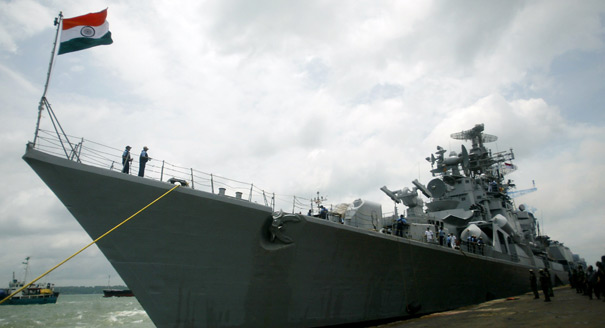
India's stance is not about China's rise or a reaction to Chinese actions, but a necessary step to lend its voice on a matter of principle critical to peace and stability in the region.
Source: Lowy Interpreter
The South China Sea dispute verdict has been delivered in favour of the Philippines, and the infamous 'nine dash line' now has no basis in international law.
Without taking sides on the dispute, India has chosen to take a stand on the principle and application of international law, issuing a statement that said: 'As a State Party to the United Nations Convention on the Law Of the Sea (UNCLOS), India urges all parties to show utmost respect for the UNCLOS, which establishes the international legal order of the seas and oceans.' The statement indicates that New Delhi recognises the ruling from the Permanent Court of Arbitration (PCA) and will uphold it.
In the days leading up to the ruling, there was much debate in New Delhi as to whether India should take a stand on this issue at all. Choosing to stay quiet on the matter was never an option, but India could have issued a statement to the effect of 'all parties should resolve the matter in a peaceful manner'. India's choice wasn't about picking sides, but about voicing concerns at a defining moment which could very well form the foundations of a new security architecture in the region. The course of China's subsequent actions and responses from around the region will set a precedent for future disputes.
India's decision to take a stand, and the tone of the message, was calculated. The statement focuses more on the need to respect international law; it is not a position on China or the Philippines, or on the South China Sea for that matter.
India is not a party to the disputes, but has higher stakes in this matter than most acknowledge. Apart from an economic interest (with approximately 55% of India's trade transiting through those waters), New Delhi's political and strategic interests are very much in play. If India remained silent on the matter, it would also have undermined its past decision to accept the Tribunal's award in favour of Bangladesh in a maritime dispute.
As an aspiring leading power, India should aim to shape the regional political discourse. It must lend its voice in creating the foundations of a new security architecture in the Asia Pacific. The Act East policy demands an increase in Indian presence in those waters, both economically and politically, and India has to deliver for its ASEAN friends, especially at defining moments like this. There is also the fact that in 2012 China ignored India's presence in an oil exploration block in Vietnam's EEZ and put it up for international bidding unilaterally, undermining both India's economic interests and Delhi's relationship with Vietnam. China has tried to create unilateral norms in waters that are critical to India's engagement with the entire region.
Given China's vow to disregard the ruling, subsequent developments could establish new norms and practices that would clearly affect India's strategic and political interests.
China refused to participate in the proceedings brought by the Philippines, claiming both the Philippines and the Tribunal have, by entertaining this dispute, 'abused' UNCLOS provisions. China is right in claiming that the PCA has no jurisdiction in deciding disputes concerning the issue of sovereignty, but the Philippine claims focus primarily on issues pertaining to the interpretation of UNCLOS and only incidentally touch upon questions of sovereignty. Notwithstanding the Tribunal's earlier award on the legality of its exercise of jurisdiction, China continues to mischaracterise the dispute as one involving questions of sovereignty. Though the award binds China, Beijing has called for the ruling to be ignored, fully aware the Tribunal has no independent enforcement mechanism or powers.
In its effort to render the judgment void, China has been working hard to convince the world the ruling is invalid. China's frantic campaign against the award is at odds with its public calm and disregard. This disregard toward an international tribunal makes a serious dent in its mantra emphasising a 'peaceful rise'.
China could very well feel pressured to react in a manner that will visibly strengthen its position on the invalidity of the award. Possible actions could be a withdrawal from UNCLOS (unlikely); establishing an Air Defence Identification Zone over the South China Sea (which would be disregarded by regional players); and drawing baselines around some of the islands or building new islands entirely (which would be met with legal and diplomatic protests from other claimants).
China is also likely to increase its presence (militarily and otherwise) on its artificial islands and disrupt movement of Vietnamese and Philippines military and civilian maritime vessels. It will, of course, continue to challenge every freedom of navigation operation in the area.
Whatever actions China takes, the developments following the verdict may very well set the stage for new norms and practices affecting India's engagements with the region. Not responding to the verdict could have been disastrous for New Delhi. India's stance is not about China's rise or a reaction to Chinese actions, but a necessary step to lend its voice on a matter of principle critical to peace and stability in the region, to uphold international law and appear a credible contributor to regional security.

Former Nonresident Scholar, South Asia Program
Darshana M. Baruah was a nonresident scholar with the South Asia Program at the Carnegie Endowment for International Peace where she directs the Indian Ocean Initiative.
Recent Work

Darshana M. Baruah, Satyendra Prasad, Denghua Zhang
Darshana M. Baruah
Carnegie does not take institutional positions on public policy issues; the views represented herein are those of the author(s) and do not necessarily reflect the views of Carnegie, its staff, or its trustees.

The EU can impose sanctions but struggles to enforce them without the United States. With Washington increasingly disinterested in backing European interests, the bloc must now fend for itself.


Nicu Popescu, Tiago Antunes

Russia is testing the waters of NATO’s mutual defense clause. What do strikes in Romanian territorial waters mean for the alliance’s posture toward Moscow?

Dimitar Bechev

With its public finances in shambles, the far right polling at 35 percent ahead of the 2027 presidential election, and a growing protest movement, is France’s crisis a threat to the EU’s geopolitical awakening?

Rym Momtaz, ed.

Ahead of a tough winter for Ukraine, Donald Trump’s swing back toward Russia bodes ill. But instead of panicking, Kyiv’s European allies are focusing on action.
Rym Momtaz

Funding Ukraine remains a priority for European leaders. As Russia’s war of aggression heads into another winter, two feasible options to mobilize support for Kyiv should be fast-tracked.


Vladyslav Rashkovan, Gregory P. Wilson