

Commentary
Rym Momtaz, ed.
{
  "authors": [
    "Rym Momtaz"
  ],
  "type": "commentary",
  "blog": "Strategic Europe",
  "centerAffiliationAll": "",
  "centers": [
    "Carnegie Endowment for International Peace",
    "Carnegie Europe"
  ],
  "englishNewsletterAll": "",
  "nonEnglishNewsletterAll": "",
  "primaryCenter": "Carnegie Europe",
  "programAffiliation": "",
  "regions": [
    "Europe",
    "Lebanon",
    "Israel",
    "Middle East"
  ],
  "topics": [
    "EU",
    "Foreign Policy",
    "United Nations"
  ]
}
Source: Getty
Europe seems to have accepted its sidelining in the Middle East. The EU must reassert its support for the international rules-based order and step up engagement.
Look no further than the German Development Minister’s plane turning back while en route to Beirut, because Israel had restarted its bombing campaign, for the embodiment of Europe’s irrelevance in the Middle East.
There was a time when such a blatant violation of an agreed ceasefire, not to mention international law, was motivation for some in Europe to get more involved, not less. But no more.
Through their meek action, Europeans seem to have largely accepted that they are no longer real powers in the Middle East, if one defines power as the ability to shape—or contribute to shaping—the strategic environment. And despite loudly disassociating themselves from U.S. President Donald Trump’s war on Iran, they seem willing to work with whatever America’s war and diplomacy will produce in a theater vital to Europe’s economic and energy security, as well as its migration flows.
At this stage, the best way to describe Europeans’ approach to the Middle East is resigned triage with two guiding principles: Limit blowback and keep the international rules-based system on life support. That’s why France, Italy, and Spain imposed certain limitations on U.S. use of military facilities in their territory in the conduct of the war. And that’s why they—and others—keep making statements and calling for UN Security Council (UNSC) meetings. They are in damage limitation mode.
Even France, the supposed champion of strategic autonomy, is increasingly in that category.
Despite initiating an emergency meeting of the UNSC to discuss Israel’s expanding invasion of Lebanon, French Foreign Minister Jean-Noël Barrot made a stunning admission in an interview over the weekend.
After a journalist pressed him on the efficacy of such a meeting, Barrot didn’t underline the continued importance of this classic tool of the rules-based system. He immediately pivoted to the United States: “It seems to me the agreement that is in the works between the United States and Iran includes a cessation of hostilities in Lebanon.”
Perhaps it wasn’t deliberate, but the result was the minister recognizing that the UNSC meeting was window dressing and that it was the U.S. negotiating track with Iran, from which France has been repeatedly excluded by both parties, that would be the determining forum. Paris was seemingly admitting it had no agency left in Lebanon, where it has 700 soldiers deployed on a UN peacekeeping mission. It was also accepting Iran’s power play for control over the Lebanese front, much like Trump has since the beginning of this war.
The strategic signal from that interview was clearly deleterious.
The Lebanese, and through them many across the world, no longer believe in the international system. Recent events have reinforced the sense that international law and accountability do not apply when they are being killed or invaded.
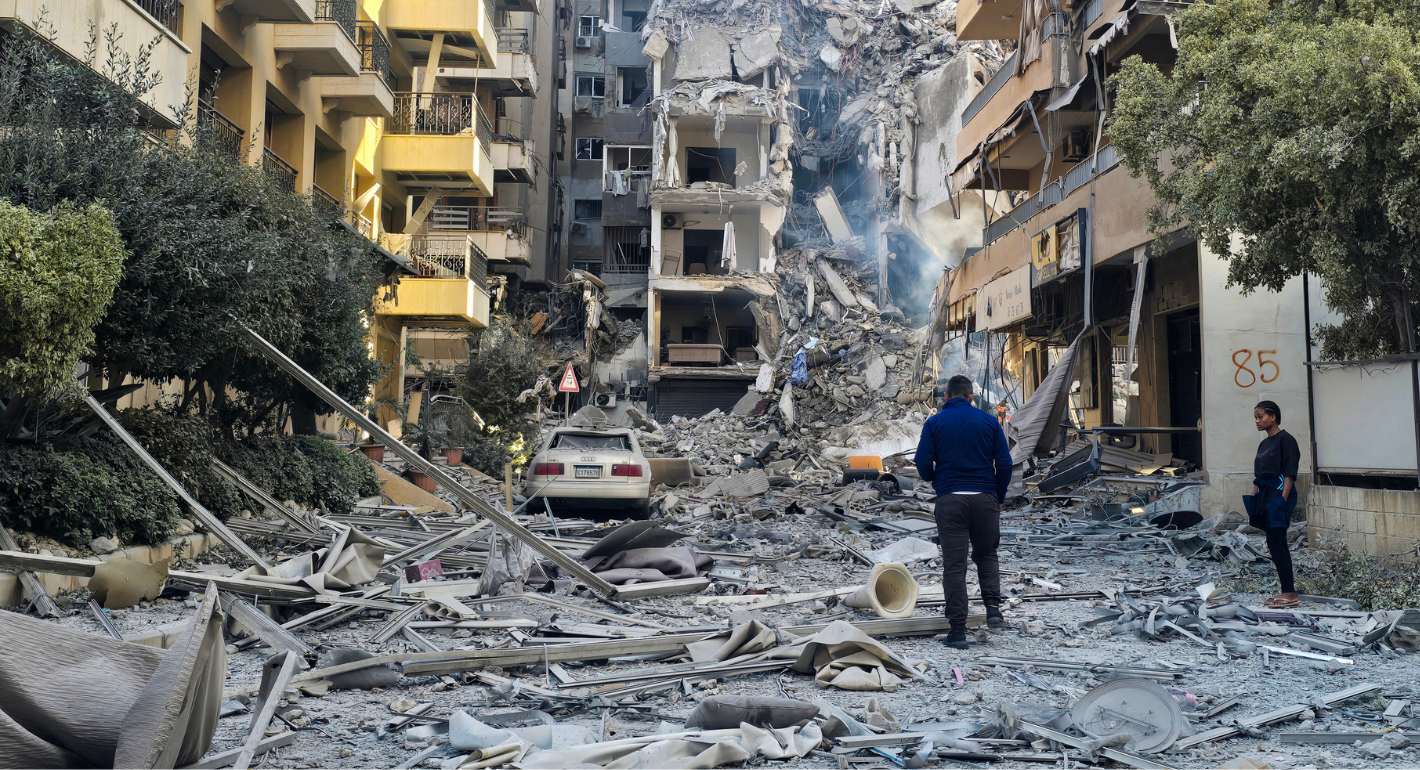
Save for a handful of statements from some Arab states, the existential threat Israel poses to Lebanon has garnered little global attention. The EU’s own foreign policy chief Kaja Kallas hasn’t issued a statement on Israel’s expanding and deepening invasion of Lebanon since April 9, 2026. Since then, Israel has killed 1,351 Lebanese, including more than one hundred women and children, according to the Lebanese Ministry of Health. Israeli forces have blown up multiple villages in the south of the country, including targeting Christian monuments, attacking the UNESCO World Heritage city of Tyre, and at least three sites on UNESCO’s enhanced protection sites list.
But despite the difficulty of retaining leverage as rules are being eroded and military power returns to the forefront, France and others shouldn’t back down. Every action—as weak as it might seem in comparison to war—in support of international law goes toward maintaining the one system that is still a global common good.
So, when France keeps Lebanon on the international agenda, initiates a UNSC meeting, or works with others to support the work of the International Criminal Court, it is not for naught.
Europeans should not shy away from naming things explicitly in their statements and marrying those statements with action. Otherwise, they are taking themselves off the global chessboard.
That is not a foregone conclusion, as they are proving on their own continent. Despite their slowness and some shortcomings, Europeans are stepping up in some significant ways. They have largely taken over providing material military support for Ukraine, which is saving lives even if it isn’t changing Russian President Vladimir Putin’s calculus quickly enough. They are going after Russia’s shadow fleet and confronting Moscow’s informational and asymmetric warfare. They are doing so while holding up the increasingly crumbling walls of the transatlantic alliance under the weight of Trump’s threats to the territorial integrity of allies like Denmark and Canada, and the trade war he is waging against the EU. They are also investing in their defense and quiet quitting—or reducing—some of their structural strategic dependencies on the United States in tech and defense, where possible. These are no small feats, especially in the current global economic context and in the face of China’s systemic rivalry.
But they cannot content themselves with only acting in the European theater. Every inch of foreign and security policy they give will be a mile to recover in the new world taking shape. This will be the case even more so in the Middle East, where American interests are deeply diverging from Europe’s, and where might is still right.
Subscribe to Strategic Europe, delivered every Tuesday and Thursday!

Editor in Chief, Strategic Europe
Rym Momtaz is the editor in chief of Carnegie Europe’s blog Strategic Europe. A multiple Emmy award-winning journalist-turned-analyst, she specializes in Europe and the Middle East and the interplay between those two spaces.
Recent Work
Rym Momtaz, ed.
Rym Momtaz
Carnegie does not take institutional positions on public policy issues; the views represented herein are those of the author(s) and do not necessarily reflect the views of Carnegie, its staff, or its trustees.

While the EU and European governments are embracing the much-lauded middle-power moment, this entails three difficult conundrums.

Richard Youngs

Much has been said of the changes Brussels is trying to make to the EU enlargement process. Here’s why gradual integration might—or might not—be the answer.

Dimitar Bechev

The European Commissioner for Trade is headed to China. But after President Xi’s bridge-building visit to Washington, can a more isolated EU overcome Beijing’s stranglehold on critical raw materials? Who will blink first?
Rym Momtaz, ed.

The domestic impacts of how long it is taking to end the war in Ukraine have pushed the French electorate to the political extremes and compromised the country’s diplomatic capacity.
Rym Momtaz

Before the next wave of EU enlargement takes place, the union needs to grapple with thorny questions of how power is distributed among its members.


Emil Sondaj Hansen, Ditte Brasso Sørensen