At first glance, Myanmar and Russia’s North Caucasus have very little in common, but the current crisis in the distant Southeast Asian country has raised an outburst of anger among Russian Muslims that is tricky for Moscow to manage.
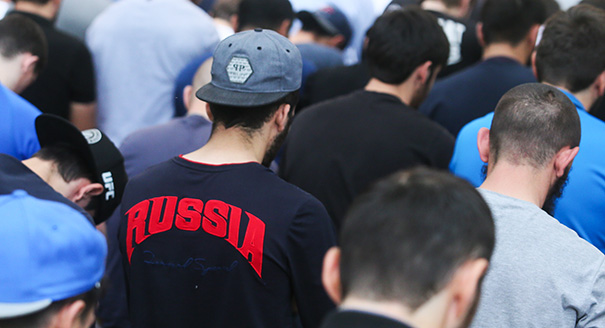
In recent days, tens of thousands of Muslims both in Moscow and in North Caucasian republics such as Chechnya and Dagestan have taken to the streets in support of Rohingya Muslims, who have fled persecution in Myanmar.
The Chechen leader Ramzan Kadyrov called the Myanmar crisis a “humanitarian disaster” and urged solidarity with Rohingya Muslims against the backdrop of what he characterized (inaccurately) as “the world’s silence.”
The conflict in Myanmar’s Rakhine (Arakan) state has lasted for years and is unlikely to be resolved soon. It has a confessional aspect, between a Buddhist majority and a Muslim minority. The latest exacerbation of the situation has come at a sensitive moment in Russia’s domestic politics, as Muslim leaders, with Kadyrov at the forefront, feel increasingly confident in voicing their views on what should be Russia’s foreign policy.
Over the last fifteen years, Russian federal policy for Chechnya, relying on two pro-Moscow rulers, Akhmad and Ramzan Kadyrov, has ensured not just that Moscow has come to Grozny but that Grozny has come to Moscow as well. The junior Kadyrov’s stance on Myanmar should not come as such a big surprise, when you consider the mechanism by which Moscow has restored jurisdiction over Chechnya. Under Kadyrov, the republic has been granted not just the autonomy to make its own local policy decisions but the freedom to make ideological and now even foreign policy choices as well.
Chechnya is often described as a totally closed region, but it is more correct to say that it is closed to Europe and much of Russia. Under Kadyrov, the republic remains strikingly open to contacts with influential Middle Eastern political and religious leaders. In 2015–2017, Kadyrov visited Saudi Arabia, the UAE, and Bahrein, and received prominent guests from abroad such as the famous Afghan politician, General Abdul Rashid Dostum.
In January 2015, Kadyrov also took a strong stand on an international issue when he convened a rally in central Grozny in the wake of the Charlie Hebdo killings in Paris to protest against the magazine’s alleged anti-Muslim cartoons and declare “We are not Charlie.”
Kadyrov has skillfully used his position as head of a large Muslim region of Russia to be a mouthpiece for the anti-Western views and the idea of Russia’s “special civilizational choice” held by a certain segment of Russian society.
To certain extent, Chechnya’s “special” status can benefit Russia. It gives Russia, a multiethnic and multireligious country, the opportunity to use channels outside of its Foreign Ministry to win the trust of partners in Afghanistan and the Middle East.
Yet the evolution of a separate regional religion-based foreign policy is also problematic. The phenomenon is much broader than Kadyrov’s Chechnya. Bloggers and activists from other Muslim North Caucasus republics have urged Russia to take a more active stand against Myanmar or blamed the government for blocking the UN Security Council resolution and pandering to China’s ambitions in Southeast Asia.
Dagestanis, who have no love lost for the head of the neighboring Chechnya, also protested about Myanmar. Many of these protestors criticized North Caucasian government officials for their passivity and urged fellow Dagestanis to go to Myanmar to defend the persecuted Rohingya there.
As the scholar Akhmet Yarlykapov points out, the North Caucasus is experiencing a process of “re-Islamization,” which is most noticeable in Dagestan but is also affecting parts of the region where religion has traditionally played a smaller role (Kabardino-Balkaria, Karachayevo-Cherkessia, Adygea, and the Stavropol region).
It is not just that religious identity in the region in its many forms has strengthened. This process has been accompanied by the decline of secular institutions (law enforcement agencies and courts), and by a deeper crisis in state ideology.
At the center of the problem is the fact that, despite declaring many times over the idea of a “Russian political nation,” Moscow has done very little to implement that idea in practice. The federal center prized loyalty above all else, a policy that has had a detrimental effect on the secular sphere in the North Caucasus. Members of the younger generation in the region have become much more integrated in the Islamic world than their fathers and grandfathers were, and show this in different ways. Some take an interest in theological disputes, others receive a high-quality Islamic education abroad, and others still go and fight in conflicts in the Middle East.
As a country that plays an active role in the post-Soviet space and in the Middle East, Russia needs to present itself not just as an embodiment of the Russian world but also as an actor in the Turkic and Islamic worlds.
But Russia is also home to other faiths, such as Buddhists, something which is now important in the context of Myanmar, whose majority population is also Buddhist. For example, the Russian Buddhist region of Kalmykia on the Black Sea adjoins Dagestan and has a Dagestani population, which makes it all the more disturbing when the slogan “Buddhists are terrorists” is voiced at a Moscow rally or when there are calls on social media for violence in Kalmykia in revenge for the events in Myanmar.
So far, we have heard no coherent statements from Russian officials about the possible ramifications of the Southeast Asian conflict and the Russian regions’ bid to be involved in it. But this is more than just about Myanmar. The political mobilization of Russian Muslims on a foreign policy issue should be a wake-up call for policymakers in Moscow.