

Commentary
With its public finances in shambles, the far right polling at 35 percent ahead of the 2027 presidential election, and a growing protest movement, is France’s crisis a threat to the EU’s geopolitical awakening?
Rym Momtaz, ed.
{
  "authors": [
    "Milan Vaishnav",
    "Neelanjan Sircar",
    "Devesh Kapur"
  ],
  "type": "legacyinthemedia",
  "centerAffiliationAll": "dc",
  "centers": [
    "Carnegie Endowment for International Peace"
  ],
  "collections": [],
  "englishNewsletterAll": "ctw",
  "nonEnglishNewsletterAll": "",
  "primaryCenter": "Carnegie Endowment for International Peace",
  "programAffiliation": "SAP",
  "programs": [
    "South Asia"
  ],
  "projects": [],
  "regions": [
    "South Asia",
    "India"
  ],
  "topics": [
    "Economy"
  ]
}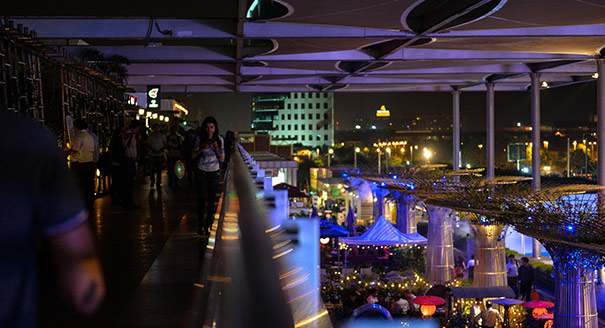
Source: Getty
The emergence of the Indian middle class has received much attention, but there’s no one authoritative way of defining what it means to be middle class.
Source: Print
One of the great tropes about rising India is its burgeoning middle class. For the private sector, a growing middle class means a large pool of Indians with increasing disposable incomes, or simply put, an exciting consumer market of the future.
The middle class is a vanguard of social change for some social scientists, creating new pressure points on politicians to usher in more accountable governance. For others, the middle-class is a risk-averse social force, constantly fearful of losing status, rendering it a conservative political voice backing more reactionary forces.
The emergence of the Indian middle class has received much attention, but there’s no one authoritative way of defining what it means to be ‘middle class’.
The most popular approach relies on income-based thresholds. According to the economist Nancy Birdsall, a daily income of $10(₹64.66) or above (in purchasing power terms) cut-off is the threshold for an ‘income-secure’ middle class. She estimated in 2015 that just 2.6 percent of all Indians would qualify under such a definition. Others believe income-based measures are too restrictive because they do not fully capture non-monetary dimensions of wellbeing.
For instance, one of us (Kapur) has previously proposed that the number of income tax payers or the share of Indians who have a college degree might serve as reasonable proxies for inclusion in the Indian middle class.
We propose a radically different measurement strategy in a recent paper published in a new volume on the middle class in Brazil and India: self-identification.
We simply asked Indians whether they consider themselves to be part of the middle class. After all, what matters most from a political economy standpoint is class-consciousness, not some arbitrary definition. Middle class self-identification, we argue, is a powerful predictor of an individual’s overall social and economic outlook.
Between January and May 2014, we conducted a survey (sponsored by the Lok Foundation and implemented by the Centre for Monitoring Indian Economy) of the social attitudes of 68,516 Indians across 24 states and union territories in India. To measure middle class identification, the survey asked respondents: ‘Do you consider your family to be a middle class family’?
The survey results revealed that nearly one in two respondents (49 percent) answered in the affirmative. As befits a country as diverse as India’s federation, there was a significant degree of variation across states. While 68 percent, or more than two-thirds of respondents in the southern state of Karnataka believed they belonged to the middle class, just 29 percent of respondents in the Hindi heartland state of Madhya Pradesh did so.

Historically, conventional descriptions of the middle class identify it as a product of urbanisation and education, creating a new social group that was neither part of the propertied classes (whether the rural landed elite or the capitalist class) nor labor (whether working on the fields or in factories), but instead occupied a place in the middle. But that was before the advent of mass media and consumerism.
Many rural residents self-identified as part of the middle-class, even though there was a 10 percent difference between urban and rural residents (56 percent versus 46 percent, respectively) when it came to middle class identification.

Where this is brought into starker relief is when one contrasts self-identification with objective income and education-based criteria.
Ironically, the wealthier and more educated you are, the more likely it is that you share a sense of middle class belonging. 45 percent of lower-income respondents self-identified as ‘middle class’, while half of middle income and 54 per cent of upper middle-income respondents did so. This difference between urban and rural respondents persists even within income categories. For every category of income, the share of urban respondents who self-identify as middle class is noticeably larger compared to their rural counterparts. The lone exception is the poorest category (lower) where the differences are very small.

But does this large share of respondents who self-identify as middle class hold distinct worldviews? Do they possess coherent views on the state of the country and the direction in which it is travelling? Are they more aspirational and optimistic about the future or fearful and pessimistic? To answer these queries, the survey posed five questions regarding respondents’ social attitudes on issues ranging from children’s social mobility, improvements in family social status, the country’s progress overall, India’s economic situation, and respondents’ household economic situation.
Across each of these measures, those who self-identify as middle class were more optimistic about the status of their lives today as well as the outlook for the future. When compared to those who believe they are not middle class, larger proportions of the self-identified middle class respondents believed that their children will have a higher standard of living than they currently enjoy, that their family’s social status has improved in a generation, and that India is progressing.
When it came to assessments of the economy, both in terms of the overall macro picture as well as the situation of their household, self-proclaimed middle class respondents were similarly bullish.

More rigorous statistical analyses of this data suggest two important takeaways.
First, middle class self-identification picks up a lot of the variation in economic optimism and social aspiration that is not accounted for by either wealth or human capital. Second, the association between middle class affinity and aspiration are comparatively larger in urban (than rural) parts of India.
A measure of ‘middle class’ identity that relies not on income, distributional or human capital measures, but on an individual’s subjective beliefs, has enormous significance for both data analysis and policymaking.
India’s aspirational middle class may be less ideologically driven and more focused on gaining social and economic status – a key shift for a tremendously status-conscious country where long-held markers of social status are weakening under the pressure of economic and political transformations.
As urbanisation picks up pace and incomes and human capital continue to rise, we can expect the size of the aspirational middle class to continue to expand, even as its political consequences remain to be seen.

Director and Senior Fellow, South Asia Program
Milan Vaishnav is a senior fellow and director of the South Asia Program and the host of the Grand Tamasha podcast at the Carnegie Endowment for International Peace. His primary research focus is the political economy of India, and he examines issues such as corruption and governance, state capacity, federalism, and electoral behavior. He also conducts research on the Indian diaspora.
Neelanjan Sircar
Associate Professor, Ahmedabad University
Neelanjan Sircar is an associate professor at Ahmedabad University and one of the country’s leading scholars of Indian politics. He has spent years studying party organizations, welfare politics, and electoral change across states—including West Bengal and Assam.
Devesh Kapur
Starr Foundation Professor, Johns Hopkins (SAIS)
Devesh Kapur is the Starr Foundation Professor of South Asian studies at the Johns Hopkins School of Advanced International Studies (SAIS). He is the author of three books on migration, including The Other One Percent: Indians in America (with Sanjoy Chakravorty and Nirvikar Singh).
Carnegie does not take institutional positions on public policy issues; the views represented herein are those of the author(s) and do not necessarily reflect the views of Carnegie, its staff, or its trustees.

With its public finances in shambles, the far right polling at 35 percent ahead of the 2027 presidential election, and a growing protest movement, is France’s crisis a threat to the EU’s geopolitical awakening?

Rym Momtaz, ed.

The European Commissioner for Trade is headed to China. But after President Xi’s bridge-building visit to Washington, can a more isolated EU overcome Beijing’s stranglehold on critical raw materials? Who will blink first?
Rym Momtaz, ed.

The domestic impacts of how long it is taking to end the war in Ukraine have pushed the French electorate to the political extremes and compromised the country’s diplomatic capacity.
Rym Momtaz

A summer of escalation in the Black Sea has hurt Ukraine economically and is exacerbating world food security. A truce is needed—as is a broader reframing of Europe’s Ukraine strategy.

Thomas de Waal
As geopolitical rivalry weaponizes global supply chains, the EU’s true vulnerability lies in emerging-risk imports. For these goods, suppliers are growing more concentrated, substitution more difficult, and political risk is looming.

Sinan Ülgen