

Paper
Renée DiResta, Rachel Kleinfeld, Margot Treadwell
{
  "authors": [
    "Rachel Kleinfeld"
  ],
  "type": "legacyinthemedia",
  "centerAffiliationAll": "dc",
  "centers": [
    "Carnegie Endowment for International Peace"
  ],
  "collections": [
    "U.S. Democracy in Comparative Perspective"
  ],
  "englishNewsletterAll": "democracy",
  "nonEnglishNewsletterAll": "",
  "primaryCenter": "Carnegie Endowment for International Peace",
  "programAffiliation": "DCG",
  "programs": [
    "Democracy, Conflict, and Governance"
  ],
  "projects": [],
  "regions": [
    "North America",
    "United States"
  ],
  "topics": [
    "Democracy"
  ]
}
Source: Getty
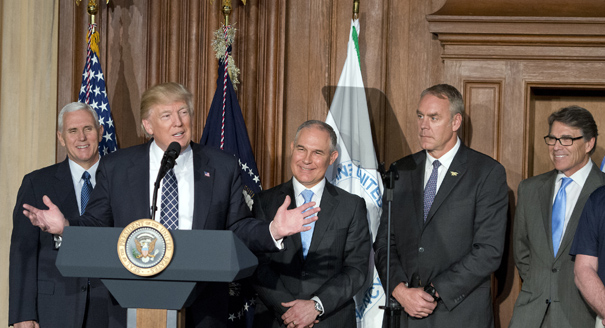
The United States has become a plutocracy, where wealth buys political power. This threatens to erode U.S. democratic institutions and U.S. global influence.
Source: Mark News
In the year since President Donald Trump took office, cries of kleptocracy have grown louder.
Consider the evidence: Lobbyists buy $100,000 memberships at his golf clubs for face time. Foreign regimes redirect business to his hotels, such as the $270,000 spending spree by Saudi Arabia at Trump’s DC outpost. Business deals in endemically corrupt countries, such as the Philippines, bind his empire (held not in a blind trust, but by his sons) to questionable foreign entanglements.
Despite this, the United States is not a kleptocracy – literally, a rule by thieves – but rather, it has become a plutocracy, where wealth buys political power. That trend began before Trump, but the phenomenon is now on steroids. It threatens to erode U.S. democratic institutions and U.S. global influence.
One percent of American citizens now control more wealth than the bottom 90 percent combined. Since 2012, the majority of congressional members are millionaires. Those who don’t start out rich can easily become so. The lobbying industry that began to grow in the 1970s now welcomes 38 percent of all Republican senators and 25 percent of Democratic senators after they retire, as well as over a quarter of the most powerful members of the House.
With an average Senate campaign now costing almost $20 million and even House seats averaging about $1.5 million, personal wealth and rich friends are important. But the need to spend vast amounts of their time cultivating donors affects who law makers spend their time with, whose concerns they hear, and whose problems actually resonate. As the recent tax bill and bipartisan Senate effort to deregulate the banking industry show, those relationships also affect who the laws benefit, creating a vicious cycle of concentrating wealth.
Growing up in Reagan-era America, I was taught that inequality was fine. As long as the rising tide helped all boats, it didn’t matter that some were lifted higher than others.
To a point, that may be true.
But according to the Organization for Economic Cooperation and Development, when the gap begins to leave behind not just the few, but the bottom 40 percent of society, inequality begins to harm growth by leaving so many citizens so uneducated and unskilled they can’t even contribute to productivity.
Unsurprisingly, this not only leads to deaths of despair among the working class and their waning belief that hard work will be rewarded, it also affects politics . Pew polling from 2014 showed that only a third of voters believed the status quo was fair. More than two-thirds of those polled thought America’s political and economic system was rigged against them.
Backlash against plutocracy birthed Trump’s presidency. Many despairing voters enthusiastically backed his calls to “drain the swamp” and assumed a man so rich just couldn’t be bought. Instead, his brazen mixing of personal and private interests has produced policies that further enrich the global elite. Trump has personally declared the Foreign Corrupt Practices Act a “bad law” implying it disadvantages U.S. businesses by denying them the chance to do business with corrupt regimes. His administration wants to pull out of the Extractive Industries Transparency Initiative, while simultaneously weakening the bureaucratic tools that target world leaders whose wealth is built upon impoverishing their citizens.
Trump’s administration’s has also normalized practices of nepotism and self-dealing previously only seen in authoritarian plutocracies; handing a rhetorical shield to all governments that enrich a small, intertwined political and business class. Sixty-nine lobbyists now work for the agencies that they used to lobby. Trump’s frequent use of his own golf courses and hotels to conduct business is only matched by his former National Security Advisor’s willingness to profit from his policy work, campaign adviser Paul Manafort’s oligarch-fueled empire, Cabinet members’ frequent travel on chartered jets at taxpayer expense, and a billionaire Education Secretary’s million-dollar-a-month security detail.
But the problem goes beyond the money: It’s the fact that these extremely wealthy, newly public figures clearly see no problem with the appearance of their activities. The U.S. now shares with other plutocracies a class of ultra-high net worth individuals who believe that their wealth is deserved, that failure economically is a result of moral failure and that the rich owe nothing to members of their own society who are less fortunate. Not only does this global elite – regardless of partisan stripe – no longer inhabit the same moral universe as the citizens of their country, but private jet travel suggests that, when possible, they also opt out of the same physical universe.
Democracy relies on separating power and wealth, and ensuring that each person has an equal vote. The brazenness of the Trump administration has catalyzed a death spiral in America’s ability to uphold and reinforce democracy. For ordinary Americans, the constant bombardment of scandal is numbing. “You have so many, one coming right after the other,” as Norman Ornstein of the conservative American Enterprise Institute declared, “that it dilutes the impact of all of them.”
Today, more people live in democratic societies than at any previous time in history. But the quality of democracy is eroding.
Far from a beacon of freedom, the United States now stands alongside many other nations in the challenges posed to its institutions by a self-serving class uniting wealth and power. America escaped this death spiral once before, during the Gilded Age of the late 19th century. It is again up to its citizens to unite and ensure that this democracy of, by, and for the people does not going silently into the night.

Senior Fellow, Democracy, Conflict, and Governance Program
Rachel Kleinfeld is a senior fellow in Carnegie’s Democracy, Conflict, and Governance Program, where she focuses on issues of rule of law, security, and governance in democracies experiencing polarization, violence, and other governance problems.
Recent Work
Renée DiResta, Rachel Kleinfeld, Margot Treadwell
Political Violence Researchers, Rachel Kleinfeld, ed., Dalya Berkowitz, ed.
Carnegie does not take institutional positions on public policy issues; the views represented herein are those of the author(s) and do not necessarily reflect the views of Carnegie, its staff, or its trustees.

European Commission President Ursula von der Leyen is about to give her annual address on the state of the EU. Here’s what she won’t—but should—say.

Rym Momtaz

Radical-right parties are expected to do well in upcoming elections in four of the EU's biggest member states. If successful, they could prevent the union from addressing key challenges ahead.

Stefan Lehne

An overwhelming victory by a far-right-wing party in a small state in eastern Germany will have major repercussions for Chancellor Friedrich Merz’s coalition.

Judy Dempsey

Canadian Prime Minister Mark Carney has twice inspired praise for standing up to U.S. President Donald Trump: at the 2026 World Economic Forum in Davos and on Canada-U.S. trade negotiations. Is Carney showing a third way better than the EU has in dealing with the Trump administration?
Rym Momtaz, ed.

European states control several Overseas Countries and Territories around the world that carry strategic, economic, and environmental weight. As great powers challenge the rules-based order, defending them is a geopolitical imperative for Europe.

Marc Pierini