

Article
C. Raja Mohan, Darshana M. Baruah
{
  "authors": [
    "C. Raja Mohan"
  ],
  "type": "legacyinthemedia",
  "centerAffiliationAll": "dc",
  "centers": [
    "Carnegie Endowment for International Peace",
    "Carnegie China",
    "Carnegie India"
  ],
  "collections": [
    "China’s Foreign Relations"
  ],
  "englishNewsletterAll": "ctw",
  "nonEnglishNewsletterAll": "",
  "primaryCenter": "Carnegie India",
  "programAffiliation": "SAP",
  "programs": [
    "South Asia"
  ],
  "projects": [],
  "regions": [
    "Asia",
    "South Asia",
    "India",
    "East Asia",
    "China"
  ],
  "topics": [
    "Foreign Policy"
  ]
}
Source: Getty
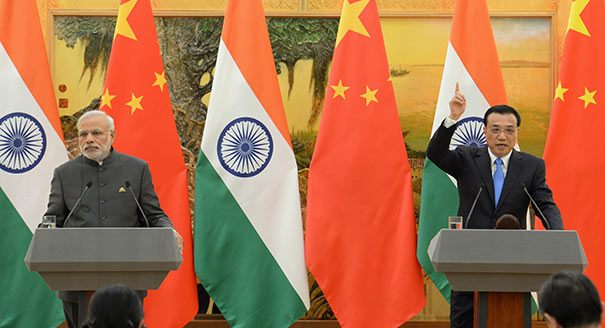
Without a return to genuine bilateralism that takes into account the interests of both parties, Beijing will find that the chasm with New Delhi continues to deepen.
Source: Indian Express
That Sino-Indian relations are in a state of disrepair at the end of 2017 is not news. If 2016 was marked by China’s decision to block India’s entry into the Nuclear Suppliers Group, 2017 was defined by an extended military confrontation in the Doklam plateau.
What’s new, though, is the fact that Beijing and Delhi are finally acknowledging the deeply problematic nature of the relationship. This public admission of trouble is a welcome departure from the entrenched habit of sweeping differences under the carpet and masking problems with grandiose rhetoric on “building a new Asian century” and “promoting multipolar world”.
After last week’s talks in Delhi between the two foreign ministers — Sushma Swaraj and Wang Yi — the two sides noted that the developments in Doklam “severely tested” bilateral relations in 2017. They also patted themselves on the back for the peaceful resolution of the crisis that compelled Delhi and Beijing to stare down an abyss. For Doklam could have easily turned into a disastrous war.
Swaraj and Wang were also truthful about a critical issue in bilateral relations — the absence of mutual trust. In the two decades that followed Prime Minister Rajiv Gandhi’s visit to China at the end of 1988, there was a slow but certain improvement in bilateral relations. But since 2008, there has been a steady accumulation of problems — tensions on the boundary, imbalance in trade, strategic competition in the region and the divergence on international issues.
These problems, in turn, deepened distrust. How to restore mutual trust is the big question for the talks this week between the Special Representatives — national security adviser Ajit Doval and state councillor Yang Jiechi.
The original directive for the Special Representatives (SRs) was to find a solution to the long-standing boundary dispute. But the negotiations on the boundary dispute were stalled many years ago, and the SRs focused on maintaining peace and tranquillity on the border. The SRs set up multiple mechanisms to maintain peace and tranquillity, but stabilising the border has become hard as the frequency and intensity of the incidents has grown.
The idea that the two sides must “turn to a new page” has been articulated frequently, in recent times by the Chinese ambassador to India, Luo Zhaohui. One of his proposals is to sign a “treaty of good neighbourliness and friendly cooperation”. India and China have had a tradition of hoary declarations that created an illusion of mutual understanding but deepened mutual distrust. The declaratory approach was of no help in addressing the real disputes over territorial sovereignty.
Consider, for example, the idea “five principles of peaceful coexistence” that Delhi and Beijing claim to be their unique contribution to modern international relations. For all its rhetorical flourish, the Panchsheel agreement signed in 1954 was of no help in resolving the difficulties over Tibet and the boundary that emerged in the late 1950s. What we need now is not another declaration but steps that address the core problems in the relationship that generate the mistrust.
Two areas of action present themselves to Doval and Yang. First is the urgent need to distil lessons from the Doklam crisis and prevent the recurrence of another such incident. Reports on Chinese military build-up in the Doklam region and India’s new commitment for vigorous responses suggest that the two sides may not be as lucky the next time.
One of the main lessons from Doklam is that more confidence building measures on the border are not going to guarantee stability. For, the context in which the CBMs were put since the 1990s has fundamentally changed.
As Beijing’s comprehensive national power has grown, it has become more assertive on territorial disputes and its appetite for risk taking has increased. India, which took peace on the border for granted until recently, is ready to throw everything it has to prevent any further weakening of its position. That was the real story about Doklam. Without a renewed effort to resolve the boundary dispute, the Sino-Indian frontier is unlikely to remain tranquil.
The second area of focus is on President Xi Jinping’s Belt and Road Initiative. If the Chinese leadership has invested much personal and political capital on the BRI, India’s concerns have been so deep that Delhi took the unusual step of publicly criticising the BRI and staying away from it. China insists that the BRI is a win-win for both; Delhi fears it might just mean two wins for Beijing.
Delhi, however, has also said it is open to a dialogue with Beijing on the BRI. China is yet to respond. Unconditional bilateral discussions on the BRI make good sense. After all, both Delhi and Beijing say they are eager to promote connectivity in their shared neighbourhood.
Talks between them could help address Delhi’s apprehensions — for example, on the implications of the China-Pakistan Economic Corridor for India’s territorial sovereignty over Jammu and Kashmir. With political will, it should not be too difficult to disentangle the disputes over sovereignty among India, Pakistan and China in pursuit of trans-border connectivity in Jammu and Kashmir.
As the stronger power today, China might think it can afford to be unilateral — on the frontier as well regional economic initiatives. Without a return to genuine bilateralism that takes into account the interests of both parties, Beijing will find the chasm with Delhi continues to deepen.
This article was originally published in the Indian Express.
Former Nonresident Senior Fellow, Carnegie India
A leading analyst of India’s foreign policy, Mohan is also an expert on South Asian security, great-power relations in Asia, and arms control.
Recent Work

C. Raja Mohan, Darshana M. Baruah


Alexander Gabuev, Paul Haenle, C. Raja Mohan, …
Carnegie does not take institutional positions on public policy issues; the views represented herein are those of the author(s) and do not necessarily reflect the views of Carnegie, its staff, or its trustees.

The EU can impose sanctions but struggles to enforce them without the United States. With Washington increasingly disinterested in backing European interests, the bloc must now fend for itself.


Nicu Popescu, Tiago Antunes

Russia is testing the waters of NATO’s mutual defense clause. What do strikes in Romanian territorial waters mean for the alliance’s posture toward Moscow?

Dimitar Bechev

With its public finances in shambles, the far right polling at 35 percent ahead of the 2027 presidential election, and a growing protest movement, is France’s crisis a threat to the EU’s geopolitical awakening?

Rym Momtaz, ed.

Ahead of a tough winter for Ukraine, Donald Trump’s swing back toward Russia bodes ill. But instead of panicking, Kyiv’s European allies are focusing on action.
Rym Momtaz

Funding Ukraine remains a priority for European leaders. As Russia’s war of aggression heads into another winter, two feasible options to mobilize support for Kyiv should be fast-tracked.


Vladyslav Rashkovan, Gregory P. Wilson