

Commentary
European Commission President Ursula von der Leyen is about to give her annual address on the state of the EU. Here’s what she won’t—but should—say.
Rym Momtaz
{
  "authors": [
    "Richard Sokolsky",
    "Aaron David Miller"
  ],
  "type": "legacyinthemedia",
  "centerAffiliationAll": "",
  "centers": [
    "Carnegie Endowment for International Peace"
  ],
  "collections": [],
  "englishNewsletterAll": "",
  "nonEnglishNewsletterAll": "",
  "primaryCenter": "Carnegie Endowment for International Peace",
  "programAffiliation": "",
  "programs": [],
  "projects": [],
  "regions": [
    "North America",
    "United States"
  ],
  "topics": [
    "Foreign Policy"
  ]
}
Source: Getty
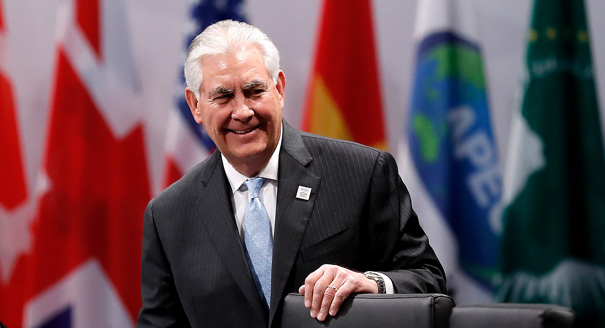
Secretary of State Rex Tillerson’s interview with CNN was a well-orchestrated statement of his intention to remain in his job—at least until the end of 2018. What does the interview tell us about what to expect from him—and the administration—in 2018?
Source: CNN
On Friday, Secretary of State Rex Tillerson gave an exclusive interview to CNN's global affairs correspondent Elise Labott. What might have well been his exit interview instead turned into a well-orchestrated statement of his intention to remain in his job -- at least until the end of 2018.
So now that the nation's top diplomat is staying, what does the interview tell us about what to expect from him -- and the administration -- in 2018? Here are the takeaways. And they aren't particularly pretty.
Perhaps the most stunning and revealing takeaway from the Tillerson interview is his admission -- disingenuous though it might be -- that "I would tell you on all of the major policy areas the President has made the right decision on every one of those."
This is quite a curious statement from a guy who disagreed and advised against most of these decisions, from decertifying Iran's compliance with the nuclear deal and recognition of Jerusalem as Israel's capital to withdrawal from the Trans-Pacific Partnership (TPP), and who was publicly undercut by the President on pushing for diplomacy with North Korea.
Tillerson has either undergone a dramatic conversion and been convinced of Trump's superior policy instincts, or he's made his peace and subordinated his views to the President. Hopefully neither is the case, and Tillerson will continue to speak out and offer his independent counsel even though his voice seems rarely heeded.
What a difference a presidential knee-capping can make. Less than a month ago, in a speech delivered at a Washington think tank, Tillerson said it was unrealistic for the US to say it would only talk to North Korea if it comes to the table ready to give up its nuclear weapons program. He also said the US was ready to meet with North Korea without pre-conditions. A day later, the White House publicly walked back Tillerson's comments.
Tillerson was back on the reservation in his CNN interview, declaring that the goal of US policy is North Korea's complete, verifiable, irreversible denuclearization, and that the US needs a clear signal from North Korea that it understands that this is the purpose of these talks.
Waiting for this signal is like waiting for Godot: The North sees its nuclear weapons as essential to the survival of the regime against what it calls the hostile US policy toward North Korea. As long as the US clings to this fantastical goal, there won't be any diplomatic settlement of the conflict over North Korea's nuclear weapons in 2018.
Tillerson's views on Iran -- the other key foreign policy challenge confronting the administration -- follows the Trump approach of widening the aperture of US policy beyond just the nuclear accord. It now includes Iran's behavior in the region and Iran's repressive policies at home -- what Tillerson refers to as "the totality of Iran's actions and behaviors."
It's still unclear whether the administration has a coherent policy. Other than enabling a disastrous Saudi campaign in Yemen against Iranian-backed Houthi rebels through refueling, logistical support and intelligence sharing and training, the administration has not done much to confront Tehran in Syria, Iraq or Lebanon. They've toughened the rhetoric on Iran's repressive approach to the protests that have rocked the country, but done little else.
As for the nuclear accord, the administration can't seem to decide whether to walk away or strengthen its terms. During the interview, Tillerson all but guarantees more sanctions "unless Iran alters its behavior." But intriguingly, particularly in view of decisions the President faces beginning next week on whether to waive sanctions related to the nuclear accord, Tillerson dropped a hint that Trump may maintain the nuclear accord by focusing not on sanctions related to the nuclear deal but by imposing human rights-related penalties on the Iranian regime.
For most of the past year, Tillerson's public communications strategy borrowed a page from President Calvin Coolidge, who was known as "Silent Cal." Compared to his voluble predecessor at State -- John Kerry -- he barely communicated with Congress, the media, the foreign policy community and the professional diplomats who work for him at the State Department.
Asked in the interview what he has learned about himself and what he might do differently this year, Tillerson said he was going to "build on his ability to communicate with others better." This is a good thing.
Tillerson has committed his fair share of verbal gaffes. But his job mandates that he consistently articulate US foreign policy at home and abroad -- in order to build understanding and support for those policies.
Of course, at this point it is fair to ask how much people pay attention to what Tillerson says with a President who believes he is the only one who matters.
More than likely, 2018 isn't going to be a much better for the secretary of state than 2017. But then again it probably couldn't be much worse. He was never empowered by Trump, and it seems pretty clear that the two can't stand each other. His public profile was barely visible and he could not, unlike Trump, brag about significant diplomatic accomplishments abroad. He was the architect-in chief of a blueprint to redesign the State Department that's led to deep morale problems and faced congressional opposition to his proposal for drastic reductions in State's budget and staffing.
What would change his fortunes -- an important diplomatic success and an improved relationship with a President who would not just listen to but take his advice -- seem like long shots at best. Maybe some unforeseen crisis will provide Tillerson with an opportunity to play an influential role. But right now, he seems trapped between his desire to soldier on and a President who is reluctant or unwilling to fire him -- and who has no respect for the State Department and little enthusiasm for the man who runs it.
Nonresident Senior Fellow, Russia and Eurasia Program
Richard Sokolsky is a nonresident senior fellow in Carnegie’s Russia and Eurasia Program. His work focuses on U.S. policy toward Russia in the wake of the Ukraine crisis.

Senior Fellow, American Statecraft Program
Aaron David Miller is a senior fellow at the Carnegie Endowment for International Peace, focusing on U.S. foreign policy.
Carnegie does not take institutional positions on public policy issues; the views represented herein are those of the author(s) and do not necessarily reflect the views of Carnegie, its staff, or its trustees.

European Commission President Ursula von der Leyen is about to give her annual address on the state of the EU. Here’s what she won’t—but should—say.

Rym Momtaz

Radical-right parties are expected to do well in upcoming elections in four of the EU's biggest member states. If successful, they could prevent the union from addressing key challenges ahead.

Stefan Lehne

The aftermath of the Ceuta crisis shows Europe has drawn the wrong lessons. Rather than doubling down on failed migration policies, the EU needs to address the underlying roots of such episodes.

Richard Youngs

Canadian Prime Minister Mark Carney has twice inspired praise for standing up to U.S. President Donald Trump: at the 2026 World Economic Forum in Davos and on Canada-U.S. trade negotiations. Is Carney showing a third way better than the EU has in dealing with the Trump administration?
Rym Momtaz, ed.

The EU’s responses to two recent incidents expose the gulf between European perceptions and capabilities. Unless the union can bridge that gap, it will never become a real geostrategic power.
Rym Momtaz