

Article
- +1
Toby Dalton, Mark Hibbs, Nicole Grajewski, …
{
  "authors": [
    "Mark Hibbs"
  ],
  "type": "legacyinthemedia",
  "centerAffiliationAll": "dc",
  "centers": [
    "Carnegie Endowment for International Peace",
    "Malcolm H. Kerr Carnegie Middle East Center"
  ],
  "collections": [
    "Iranian Proliferation",
    "U.S. Nuclear Policy"
  ],
  "englishNewsletterAll": "ctw",
  "nonEnglishNewsletterAll": "",
  "primaryCenter": "Carnegie Endowment for International Peace",
  "programAffiliation": "NPP",
  "programs": [
    "Nuclear Policy"
  ],
  "projects": [],
  "regions": [
    "North America",
    "United States",
    "Middle East",
    "Iran"
  ],
  "topics": [
    "Political Reform",
    "Security",
    "Foreign Policy",
    "Nuclear Policy"
  ]
}
Source: Getty
U.S President Donald Trump may have Israel and Saudi Arabia on his side. But without a hint of any strategic contingency planning by the White House, it would appear that the United States can expect to pay for the Iran decision in spades—from western Europe to the Pacific.
Source: Bulletin of the Atomic Scientists
Six decades before the Russian revolution, Karl Marx wrote prophetically that the ghost of communism haunted Europe. In decades to come, the United States and the world might be haunted by a different specter: an anti-American Eurasia reaching from western Europe to the Pacific coast, encompassing China, Russia, and the Shiite Middle East. The powers along this geostrategic trajectory will have very different singular interests, but they will find common ground in their aspiration to reduce America’s influence.
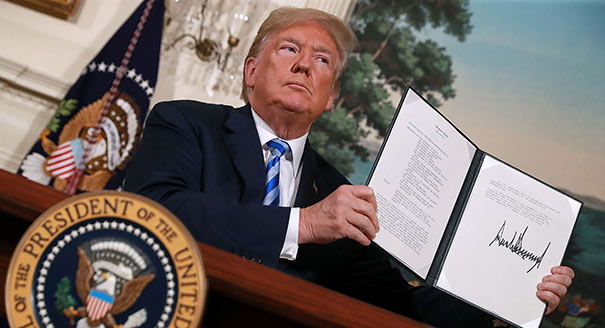
This vision is perhaps extreme, but it came a step closer to reality when President Donald Trump announced that the United States would walk away from the Joint Comprehensive Plan of Action (JCPOA). With one oversized signature Trump dramatically isolated the United States, pitting it against most of the countries on the map from the Atlantic to the Pacific and then some.
The president did this by brushing off and then uniting in opposition nearly all of America’s allies, at a precarious time when a US leadership vacuum is already encouraging its partners to hedge their bets. This week, for instance, leaders of South Korea and Japan are huddling with China to consider a collective defense against Trump’s overtures toward a trade war. On May 8, Trump threw caution to the winds on an issue with enormous strategic gravity. He did this without an apparent Plan B. The first trial will come when European countries ponder how to defend themselves against renewed US secondary sanctions. They may ultimately challenge the United States’ leadership in global financing governance. Iran will have many cards to play, and it will play them while Washington is preoccupied with the task of limiting damage among its partners in NATO, in the European Union, at the IAEA, in the Nuclear Nonproliferation Treaty, and elsewhere.
Make no mistake: This has not happened because Trump suddenly descended on Washington like a dark meteor. Former Obama administration officials bitterly resent that the JCPOA had became hostage to “Trump’s base.” But the current President’s election was an epiphenomenon that followed from decades of slow-motion cultural, economic, and political decay and disarray in America. This process generated two polarized and increasingly self-referential and intolerant factions that are embroiled in a culture war.
The polarization factored hugely in Trump’s decision to pull out of the Iran nuclear deal. Beginning in 2013, the Obama administration carried out a secret negotiation to put an end to the crisis over the Iranian nuclear program. Republicans fought tooth and nail to deny him congressional support. They also counted on the Pavlovian response of lawmakers who for years had unanimously and repeatedly passed sanctions against Tehran that carried no political risk because the US had no relations with Iran.
Especially in light of uncertain prospects that the JCPOA would lead to desired results and outcomes—rigorous implementation by Iran of a legally-binding International Atomic Energy Agency Additional Protocol, the establishment of a solid verification base line, and détente in the region that included long-term Iranian nuclear restraint—expectations for the JCPOA should have been carefully managed. That didn’t happen. Instead, right off the bat cheerleaders for the Iran deal following negotiators’ optimistic talking points, awarded it an A grade, and naïve and disingenuous demonizers just as promptly gave it an F.
Into this breach the president stepped on May 8. Trump may have Israel and Saudi Arabia on his side. But without the hint of any strategic contingency planning by the White House, it would appear that the United States can expect to pay for the Iran decision in spades—from western Europe to the Pacific, including especially in Iran, where strategic adversaries aiming to pare US influence will seek and may find new opportunities to do so.
This article was originally published in the Bulletin of the Atomic Scientists.
Nonresident Senior Fellow, Nuclear Policy Program
Hibbs is a Germany-based nonresident senior fellow in Carnegie’s Nuclear Policy Program. His areas of expertise are nuclear verification and safeguards, multilateral nuclear trade policy, international nuclear cooperation, and nonproliferation arrangements.
Recent Work


Toby Dalton, Mark Hibbs, Nicole Grajewski, …
Mark Hibbs
Carnegie does not take institutional positions on public policy issues; the views represented herein are those of the author(s) and do not necessarily reflect the views of Carnegie, its staff, or its trustees.

Before the next wave of EU enlargement takes place, the union needs to grapple with thorny questions of how power is distributed among its members.


Emil Sondaj Hansen, Ditte Brasso Sørensen

The new U.S.–Denmark–Greenland agreement will help Washington exert political, economic, and financial dominance under the guise of security. Yet, it acknowledged Copenhagen’s and Nuuk’s sovereignty on the island.

Marc Pierini

A summer of escalation in the Black Sea has hurt Ukraine economically and is exacerbating world food security. A truce is needed—as is a broader reframing of Europe’s Ukraine strategy.

Thomas de Waal

Are Germany’s economic, industrial, and political struggles becoming a liability for the EU’s ability to rise to the geopolitical moment?

Rym Momtaz, ed.

European Commission President Ursula von der Leyen is about to give her annual address on the state of the EU. Here’s what she won’t—but should—say.
Rym Momtaz