

Commentary
Are Germany’s economic, industrial, and political struggles becoming a liability for the EU’s ability to rise to the geopolitical moment?
Rym Momtaz, ed.
{
  "authors": [
    "Richard Sokolsky",
    "Aaron David Miller"
  ],
  "type": "legacyinthemedia",
  "centerAffiliationAll": "",
  "centers": [
    "Carnegie Endowment for International Peace"
  ],
  "collections": [],
  "englishNewsletterAll": "",
  "nonEnglishNewsletterAll": "",
  "primaryCenter": "Carnegie Endowment for International Peace",
  "programAffiliation": "",
  "programs": [],
  "projects": [],
  "regions": [
    "North America",
    "United States",
    "Russia"
  ],
  "topics": [
    "Political Reform",
    "Foreign Policy"
  ]
}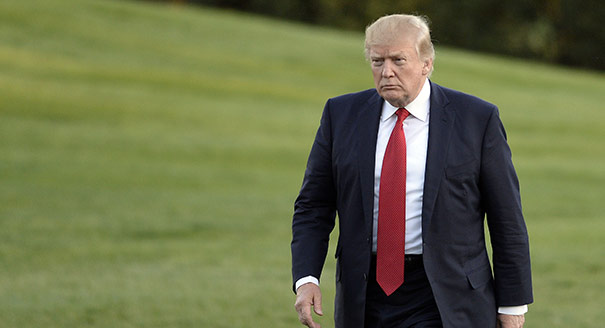
Source: Getty
There are several takeaways from Helsinki that may go well beyond temporary headlines in the 24/7 news cycle.
Source: CNN
You know you're not in Kansas anymore when a US President is willing to consider allowing Russia to interrogate a former American ambassador about fabricated crimes. This is only one of the head-spinning developments that made the Helsinki summit alarmingly unique in the annals of US diplomacy.
Whether President Donald Trump's head-exploding press conference Monday with Vladimir Putin is just another episode in the bizarre reality show called the Trump presidency -- or a more consequential tipping point in his political fortunes -- remains to be seen.
Still, there are several takeaways from Helsinki that may go well beyond temporary headlines in the 24/7 news cycle.
Trump and the White House made a half-hearted and pathetic attempt to put out the firestorm he ignited at his shameful press conference with Putin. But the wordplay cannot change what we witnessed on the stage at Helsinki: unadulterated Trump. It was choreography he stage-managed himself: a high-visibility, high-stakes summit with his favorite authoritarian leader.
What poured forth was classic Trumpian froth. Much of what he said was not new to an American audience long used to his incessant mantra of "no collusion." But in Helsinki he was, for all the world to see, a weak and feckless President kowtowing to a ruthless and manipulative adversary. What stood out was his failure to defend his own intelligence community or hold Putin accountable for any of Russia's transgressions, be it interference in American elections, his annexation of Crimea and aggression in eastern Ukraine, Russia's support for Bashar al-Assad's murderous policies in Syria, or suspected assassination attempts using a nerve agent against Russian operatives in the UK.
One can only imagine the laughter and joy during Putin's plane ride back to Moscow. The meeting drove a stake through the heart of Washington's efforts to isolate Russia, and it gave Putin airtime as an equal to the United States. The campaign to intervene in America's political system continues at alarming proportions -- that's according to Dan Coats, Trump's director of national intelligence.
Stunningly, Trump's generosity continued back in Washington, where he praised Putin and the summit, raised questions about the US commitment to defend Montenegro, a member of NATO, and seemingly denied that Russia is continuing to target America's political system. Trump is the gift that keeps on giving for Putin.
That Trump actually was willing to consider a trade-off giving special counsel Robert Mueller access to the 12 Russians the Justice Department indicted in exchange for allowing Russia access to William Browder and perhaps Mike McFaul, former US ambassador to Moscow, must be head spinning even for Putin.
On substance, the Helsinki summit, like the hit TV sitcom "Seinfeld," was a show about nothing.
At their joint press conference, Trump described his meeting with Putin as productive and spoke of a new era of cooperation with Russia. Normally, the President, preternaturally given to hyperbole, "alternative facts" and self-adulation, would have used more bombastic rhetoric to laud the results. The fact that Trump used boilerplate suggests that he can't put lipstick on a pig and make it fly.
The United States and Russia have an adversarial relationship. Their differences -- over Ukraine, Syria, NATO operations, election interference in Europe and America -- are profound; they can be managed but are not susceptible to easy and permanent solutions. Trying to curry favor with Putin, as Trump has clearly done, only encourages him to engage in hostile acts against the United States and the West.
The apparent decision to follow up the summit with more regular contacts and dialogues on a variety of issues, including Ukraine, Syria and even possibly extending the New START strategic arms control treaty, are positive steps.
But don't hold your breath waiting for breakthroughs on the other issues that divide the two sides.
Trump's shameful behavior at Helsinki has inflicted even greater damage to America's already-tarnished reputation and moral authority abroad, prompting Germany's foreign minister to proclaim that Europe can no longer count on the United States.
Why does this matter? Because in spite of Trump's go-it-alone policies, there isn't a single major international problem -- climate change, proliferation of weapons of mass destruction, trade -- that can be effectively addressed without the support of allies.
Trump believes he can get away with doing whatever he wants. But leaders in democratic countries hold themselves accountable to their parliaments and publics. Trump is highly unpopular in many of these countries. Every time he does something to tarnish America's reputation further and undermine the values it has historically embodied -- rule of law, democracy, freedom -- he makes it more difficult for our democratic allies to accept US leadership and support its policies.
The summit is unlikely to do much to change the political balance in Washington. At the moment, Trump's performance has empowered the Democrats and increased worry even among conservative Republicans that Trump has gone too far with Putin.
Congress plans to hold hearings on the Trump-Putin meeting, and Sens. Chris Van Hollen, D-Maryland, and Marco Rubio, R-Florida, have already introduced the Deter Act to ramp up more pressure against Putin by mandating sanctions if the director of national intelligence confirms that any foreign government is interfering in our elections.
Although Trump's performance at Helsinki is unlikely to create enough concern among Republicans to erode their support for him seriously, it might provide further insurance against his firing of Mueller and energize tougher congressional action against Russia.
Just as he did in the wake of violence last year in Charlottesville, Virginia, when he defended some of the white nationalist demonstrators, Trump crossed a line in Helsinki in kneeling before an American adversary. How costly these transgressions have been will only become clear at the polls in midterm elections in November and the general election in 2020.

Nonresident Senior Fellow, Russia and Eurasia Program
Richard Sokolsky is a nonresident senior fellow in Carnegie’s Russia and Eurasia Program. His work focuses on U.S. policy toward Russia in the wake of the Ukraine crisis.

Senior Fellow, American Statecraft Program
Aaron David Miller is a senior fellow at the Carnegie Endowment for International Peace, focusing on U.S. foreign policy.
Carnegie does not take institutional positions on public policy issues; the views represented herein are those of the author(s) and do not necessarily reflect the views of Carnegie, its staff, or its trustees.

Are Germany’s economic, industrial, and political struggles becoming a liability for the EU’s ability to rise to the geopolitical moment?

Rym Momtaz, ed.

European Commission President Ursula von der Leyen is about to give her annual address on the state of the EU. Here’s what she won’t—but should—say.
Rym Momtaz

Radical-right parties are expected to do well in upcoming elections in four of the EU's biggest member states. If successful, they could prevent the union from addressing key challenges ahead.

Stefan Lehne

The aftermath of the Ceuta crisis shows Europe has drawn the wrong lessons. Rather than doubling down on failed migration policies, the EU needs to address the underlying roots of such episodes.

Richard Youngs

Canadian Prime Minister Mark Carney has twice inspired praise for standing up to U.S. President Donald Trump: at the 2026 World Economic Forum in Davos and on Canada-U.S. trade negotiations. Is Carney showing a third way better than the EU has in dealing with the Trump administration?
Rym Momtaz, ed.