

Commentary
Russia is testing the waters of NATO’s mutual defense clause. What do strikes in Romanian territorial waters mean for the alliance’s posture toward Moscow?
Dimitar Bechev
{
  "authors": [
    "Michele Dunne",
    "Andrew Miller"
  ],
  "type": "commentary",
  "centerAffiliationAll": "dc",
  "centers": [
    "Carnegie Endowment for International Peace",
    "Malcolm H. Kerr Carnegie Middle East Center"
  ],
  "collections": [],
  "englishNewsletterAll": "menaTransitions",
  "nonEnglishNewsletterAll": "",
  "primaryCenter": "Carnegie Endowment for International Peace",
  "programAffiliation": "MEP",
  "programs": [
    "Middle East"
  ],
  "projects": [],
  "regions": [
    "North America",
    "United States",
    "Middle East",
    "Iran",
    "North Africa",
    "Egypt",
    "Syria",
    "Gulf",
    "Levant"
  ],
  "topics": [
    "Political Reform",
    "Security",
    "Foreign Policy"
  ]
}
Source: Getty
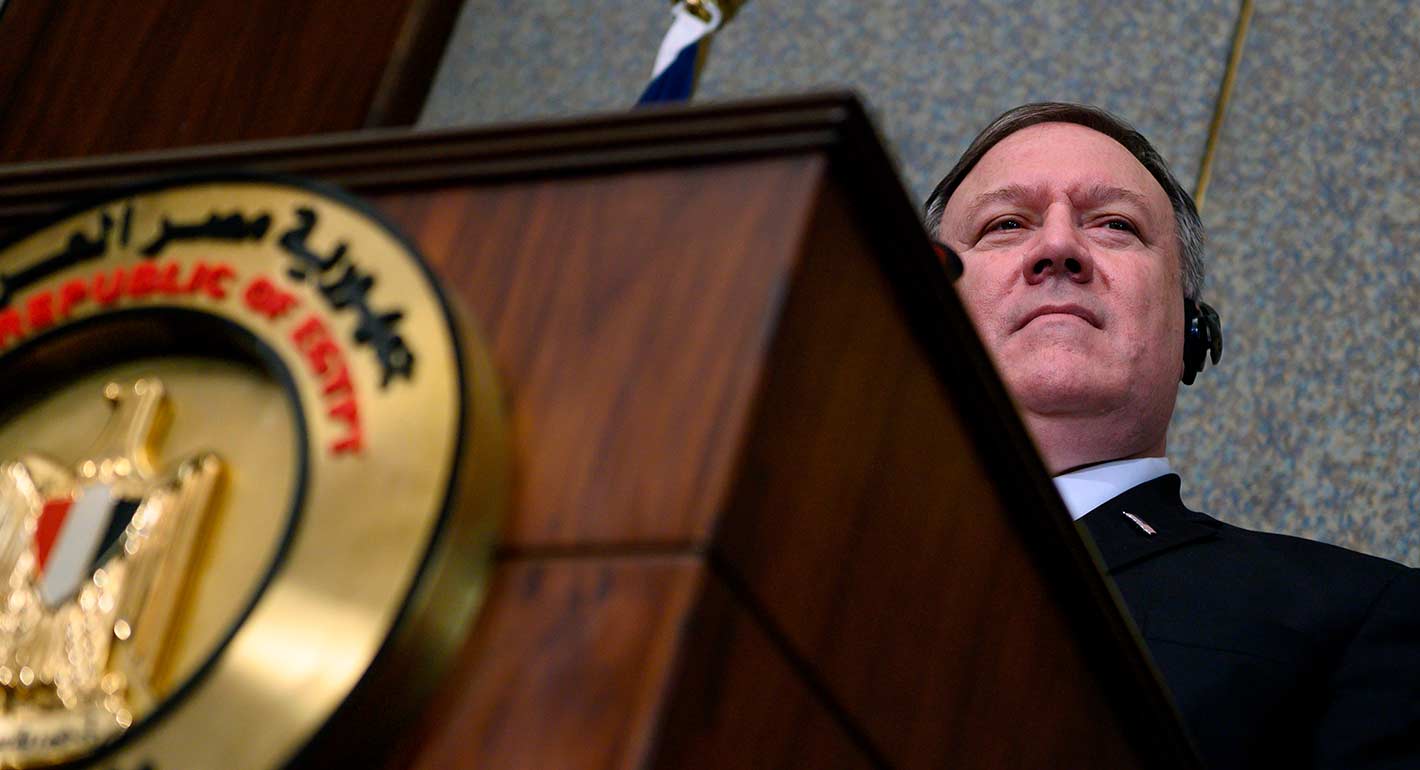
The secretary of state tried to establish a new vision. But it was neither as different from Obama’s as he intended, nor fully in sync with the U.S. president’s views.
U.S. Secretary of State Mike Pompeo may have intended that his January 10 speech in Cairo would clearly differentiate what President Donald Trump plans to do in the Middle East, from what former president Barack Obama said in the same city ten years ago.
Reacting to Obama’s perceived apology for U.S. actions and his overtures to Muslims and Iran, Pompeo insisted that the United States “is a force for good.” He went on to group Shiite Iran and Sunni extremist groups such as the Islamic State—deadly rivals—into a common category of enemies.
But while Pompeo undoubtedly meant his speech to be a direct rebuttal to Obama, the approach he laid out had more in common with Obama’s than might be apparent.
Both approaches place Iran, Islam, and Israel at center stage. This has the effect of instrumentalizing Arab countries according to their usefulness to the United States in dealing with these three issues. Such a perspective not only leads to mistaken policy calculations about what Arab leaders can actually do to help but also absolves them of responsibility for the region’s ills, ignoring the ways that poor governance, repression, and venality have created conditions in which instability and extremism thrive.
Obama, however, acknowledged the importance of Palestinian national aspirations and recognized that the greatest threat to Arab states came “from dissatisfaction inside their own countries.”
In contrast, Pompeo completely externalized the source of regional security threats. His assertion that "the nations of the Middle East will never enjoy security, achieve economic stability, or advance the dreams of their peoples if Iran’s revolutionary regime persists on its current course" showed an astonishing degree of ignorance of the broader region. In fact, Iran plays a role in only a few Arab countries (Iraq, Syria, Lebanon, and Yemen).
Another puzzling solution posed by Pompeo was that “strengthening the nation state” was the proper response to the 2009 Iran uprising and the Arab uprisings of 2011, as opposed to the Obama administration’s response to them – which was, in our view, fairly criticized as inadequate. We would argue that the Obama response to the Arab spring was tentative and excessively deferential to transitional leaderships, whose democratic bona fides were still highly uncertain.
Yet citizens in those uprisings were not asking for stronger (meaning, in this region, more coercive) states. Rather, they wanted the opposite—states that treat citizens with greater respect and respond to their needs. By echoing regional strongmen’s obsession with the state, Pompeo relegates local people to the sidelines.
Regarding the U.S. use of military force in Syria and elsewhere, Pompeo’s speech and his other remarks on the trip so far will confuse more than clarify matters. His full-throated characterization of the United States as a force for good was clearly framed as a defense of military force. He was not referring to other kinds of engagement, such as diplomacy or development assistance. The primacy he accords to U.S. military force is not only in tension with what is, at best, a mixed record of U.S. military intervention over the last twenty years. It is also out of step with Trump himself, who, despite his penchant for saber rattling, has not shown much appetite for indefinite military deployments.
Compared to past Middle East speeches—Obama in 2009, as well as former secretaries of state Hillary Clinton in 2010 and Condoleezza Rice in 2005—Pompeo was the only American who did not mention at all the need for greater democracy and respect for human rights in the Middle East. He did, however, allude obliquely to such issues when it comes to Egypt itself, calling on President Abdel Fattah el-Sisi “to unleash the creative energy of Egypt’s people, unfetter the economy, and promote a free and open exchange of ideas.”
Pompeo’s speech also hinted at which issues he and Trump might believe are most ripe for progress. He mentioned only briefly the hottest conflicts—Yemen, which has shown some minor progress lately , as well as Libya and Syria—and predictably paid only minimal lip service to Israeli-Palestinian peace.
What he did single out for airtime was the prospect of warmer relations between Israel and the Gulf states. But he did not mention the one rumored to be at the center of Trump administration ambitions: an Israeli-Saudi rapprochement.

Former Nonresident Scholar, Middle East Program
Michele Dunne was a nonresident scholar in Carnegie’s Middle East Program, where her research focuses on political and economic change in Arab countries, particularly Egypt, as well as U.S. policy in the Middle East.
Former Nonresident Scholar, Middle East Program
Andrew Miller was a nonresident scholar in Carnegie’s Middle East Program.
Carnegie does not take institutional positions on public policy issues; the views represented herein are those of the author(s) and do not necessarily reflect the views of Carnegie, its staff, or its trustees.

Russia is testing the waters of NATO’s mutual defense clause. What do strikes in Romanian territorial waters mean for the alliance’s posture toward Moscow?

Dimitar Bechev

With its public finances in shambles, the far right polling at 35 percent ahead of the 2027 presidential election, and a growing protest movement, is France’s crisis a threat to the EU’s geopolitical awakening?

Rym Momtaz, ed.

Ahead of a tough winter for Ukraine, Donald Trump’s swing back toward Russia bodes ill. But instead of panicking, Kyiv’s European allies are focusing on action.
Rym Momtaz

Funding Ukraine remains a priority for European leaders. As Russia’s war of aggression heads into another winter, two feasible options to mobilize support for Kyiv should be fast-tracked.


Vladyslav Rashkovan, Gregory P. Wilson

While the EU and European governments are embracing the much-lauded middle-power moment, this entails three difficult conundrums.

Richard Youngs