Carnegie.ru sought the opinions of Denis Cenusa, a Moldovan analyst with the Expert-Grup, based in Germany at the University of Giessen, and Vladimir Solovyov of Kommersant in Moscow, who worked in Moldova from 2012 to 2017.
Why are these elections important?
Cenusa: They are important in two ways. They will test the strength of the mono-oligarchic-centered political system that the Democratic Party has crafted since 2015. The vote is a sort of stress test that will determine how deeply the oligarchic regime has penetrated the state institutions and public sector and whether the state can stand up against the Democratic Party’s oligarchic leadership. It will also tell us whether Moldova’s democratic institutions can regain their strength after years of decline.
The elections will affect Moldova’s European integration process and provide an opportunity to restart a fully fledged dialogue with Brussels—or not. The EU will base a decision on resuming financial assistance on the quality of the election process itself, after a period in which its trust in Moldovan decisionmakers has fallen sharply. Moreover, the results will be a referendum on President Igor Dodon’s initiative to make the country align with Russia’s Eurasian Union.
Solovyov: We can’t really call what is happening in Moldova an “election.” Yes, there is a campaign. On February 24, polling stations will open and people will cast their ballots. But there is no real competition. A force called the Democratic Party headed by the oligarch Vladimir Plahotniuc currently controls all state institutions. He sits at the top of a rigid power vertical and the elections will run according to his script. He wants both to maintain power and to create a picture of legitimacy.
The Democrats began to run the country unimpeded in 2015 after they bought themselves the number of parliamentary deputies they needed. This damaged their legitimacy, and they hope to restore it with the help of these elections. This is why the Democrats altered the electoral system despite the objections of the EU and the Council of Europe. This is what the election is all about.
What are the main issues motivating Moldovan voters?
Cenusa: The topics that most motivate the voters are corruption in all its forms, poverty, low standards of living, and emigration. One part of the electorate is increasingly vocal about corruption and is demanding higher-quality public services. However, the majority of the population is stuck in survival mode, which makes them very susceptible to the lavish populist offers made by different political competitors in the election.
Citizens are poor, and they are being manipulated both by television and by online media. That makes them confused about what their real individual needs are and what are the public priorities. Moldova’s diaspora settled in the West, estimated to number 300,000, is also an important variable that can help change the elections. The ruling party is not so capable of influencing this part of the diaspora through “electoral bribes.” That makes this group a more unpredictable, rational, and independent electoral actor than the voters at home.
Solovyov: Poverty, corruption, geopolitics. These are the three main issues that take people to the polls. Since 2009, the country has been degrading and getting poorer. That makes it much easier for those forces that have money to motivate voters: the Democratic Party, the Socialists, and the Shor Party [headed by Ilan Shor, who was accused in the $1 billion banking fraud scandal of 2015]. They are literally buying voters’ loyalty. Those who need more than a shopping bag of buckwheat and who think that their vote will decide something will go and vote against the status quo. Whatever happens, geopolitics will also play its part. As the country is more or less evenly divided between those who support the EU and those who look to Russia, Moldova’s geopolitical disputes will always stir voters to action.
What is Russia's role?
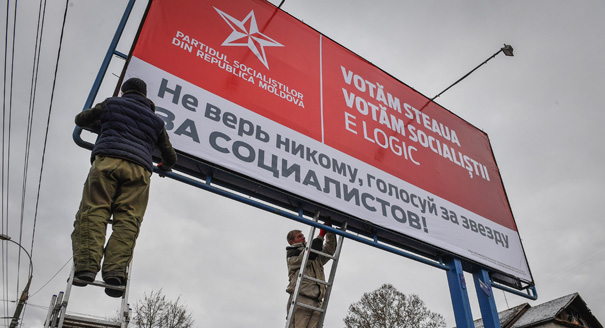
Cenusa: Traditionally, Moldovan political parties use the Russia factor as an instrument to mobilize votes. In this election, the Socialists have been unable to achieve anything significant through domestic politics, so now they are the only pro-Russian force that is relying for success on foreign policy deals with the Kremlin. Vladimir Putin has personally agreed to temporary concessions to Moldova in trade and migration issues, and that indicates Russia’s interest in enhancing its presence in Moldovan politics after the elections. Even if the Socialists are unable to score a victory that produces an eastward-leaning government, Russia can still benefit. There may be deepening antagonism between the EU forces that are opposed to oligarchic rule and those that are oligarch-led, which will feed rising “Moldova fatigue” in Brussels.
Solovyov: Russia has invested politically, financially, and in terms of information in the project named Igor Dodon and continues to support him. As Moldova is a parliamentary republic, President Dodon has no powers to influence events inside the country, but he has been able to pay frequent visits to the Kremlin. Vladimir Putin has basically become the Moldovan president’s key domestic political resource. Putin is honoring Dodon’s promises by opening the Russian market for Moldovan wine and fruit, and resolving the problems of Moldovan migrants in Russia. This is being done in the hope that Dodon’s party, the Socialists, will win the election on February 24 and take power. In that case Moscow would acquire a force in Chisinau that would deliver something on its behalf. But, given the state of the country, there is little guarantee that this will happen.