

Article
C. Raja Mohan, Darshana M. Baruah
{
  "authors": [
    "C. Raja Mohan"
  ],
  "type": "legacyinthemedia",
  "centerAffiliationAll": "",
  "centers": [
    "Carnegie Endowment for International Peace",
    "Carnegie India"
  ],
  "collections": [],
  "englishNewsletterAll": "",
  "nonEnglishNewsletterAll": "",
  "primaryCenter": "Carnegie India",
  "programAffiliation": "",
  "programs": [],
  "projects": [],
  "regions": [
    "Asia",
    "South Asia",
    "Pakistan",
    "India",
    "Middle East"
  ],
  "topics": [
    "Foreign Policy"
  ]
}
Source: Getty
For the emerging forces of political moderation and social modernization in the Middle East, India is a more attractive partner than Pakistan.
Source: Indian Express
On the face of it, India getting an invite to address the gathering of the foreign ministers from the Organisation of Islamic Cooperation may not look like a big deal. Sceptics have long argued that the OIC has the distinction of competing with the Non Aligned Movement and the League of Arab Nations for the unflattering tag of the world’s most ineffective international organisation.
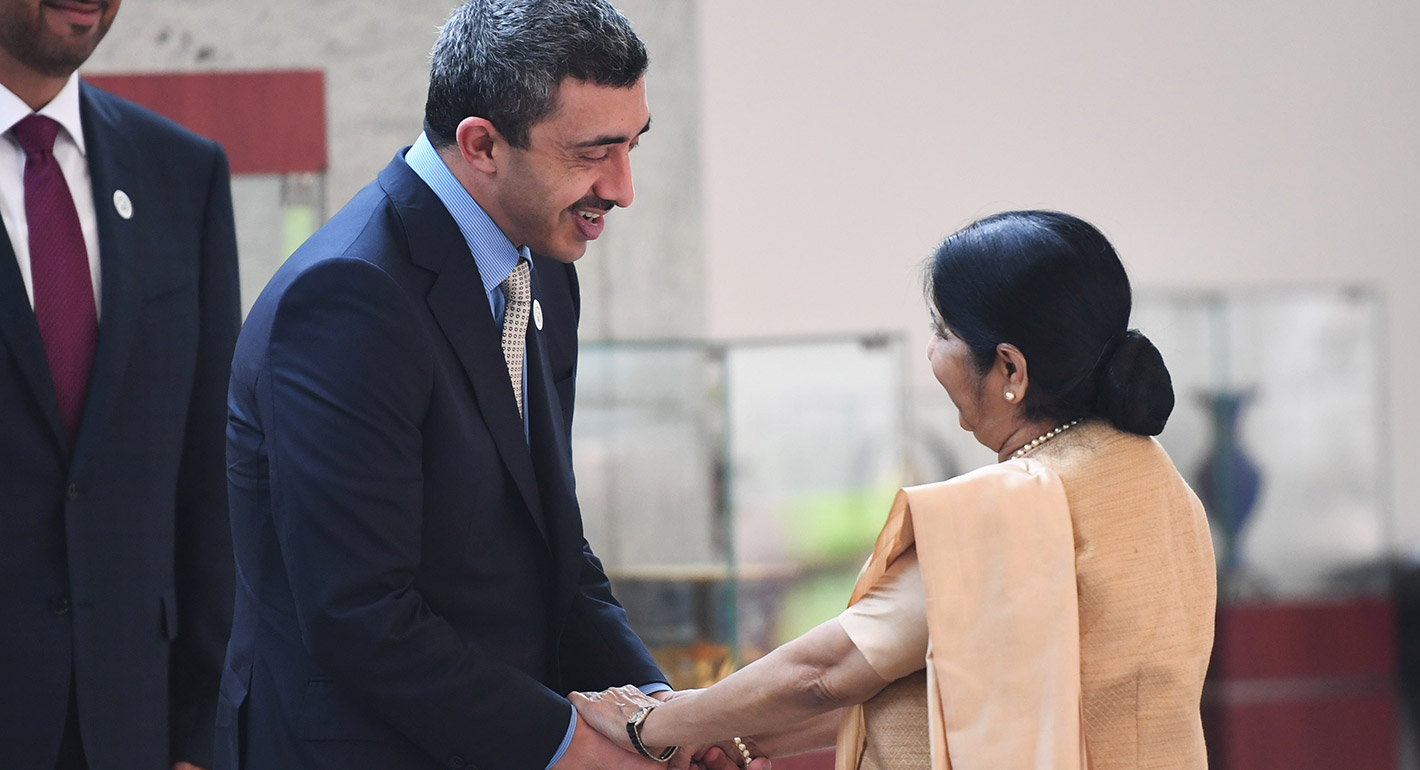
Yet, there is no question that External Affairs Minister Sushma Swaraj’s participation at the meeting in Abu Dhabi is a significant discontinuity in India’s engagement with the Muslim world. It also caps one of the least understood but most successful endeavours of Prime Minister Narendra Modi’s foreign policy — its recasting India’s relations with the Middle East.
To be sure, analysts around the world have noted Modi’s felicity to be befriend apparent adversaries — Saudi Arabia and Iran, the United Arab Emirates and Qatar, Egypt and Turkey as well as Israel and Palestine. Observers are also impressed by Modi’s success in bringing the special relationship with Israel out of the closet.
But the real breakthrough under Modi is the transformation of India’s engagement with the conservative Arab monarchies, especially the UAE and Saudi Arabia. These two Muslim states have long been Pakistan’s closest international partners. Islamabad has flaunted ties to the UAE and Saudi Arabia as reflecting its special religious connect to the Middle East.
Although India’s expanding political ties with the UAE and the House of Saud go back a number of years, they have acquired a special strategic character under Modi. The increasingly productive nature of this engagement comes from an unprecedented level of personal political comfort between Modi and the key leaders of the Arab world. It is also rooted in the shared interest between India and the Arab conservatives in blunting the edge of religious extremism and terrorism.
In the past, the conservative Arab monarchies were happy to turn a blind eye to the dangers of encouraging political Islam and condoning the Pakistan army’s support for terror and religious extremism in South Asia. Today, no governments are more threatened by forces of religious destabilisation than the Arab monarchies like Saudi Arabia and the UAE. Sharing that threat with them are traditional republics like Egypt. This has created a new framework for India’s engagement with the Muslim world and the Middle East.
Equally important has been the region’s growing economic and energy interdependence with India, which is emerging as the world’s third-largest economy and one of the biggest hydrocarbon importers and labour exporters. As the region’s geopolitics enters a turbulent period, the potential for India as a military partner is also coming into view. That India has one of the world’s largest Muslim populations, of course, is the immediate explanation of the surprising invite for Swaraj to address the OIC.
But one swallow does not a summer make. The invitation from the UAE is a specific one — to address the OIC foreign ministers conclave that it is hosting. India’s observer status at the OIC does not appear to be round the corner. Swaraj’s participation in the Abu Dhabi ministerial, therefore, must be viewed as a diplomatic opening for a sustained and long-term political engagement of the Islamic world as a collective.
Delhi has no reason to believe that Pakistan will stop shooting at India from the shoulders of the OIC. Having blocked India at the OIC for so long, the Pakistani establishment must be expected to redouble the effort to poison India’s ties with the OIC. It will not miss any opportunity to use the OIC to criticise India’s Kashmir policy.
Delhi should, however, should avoid taking these statements literally. Like in the NAM, all delegations come with paragraphs of their own to be inserted into the final statement of the OIC gatherings. As the laundry list gets compiled, criticisms against non-members get easily passed.
Few member states have the time and energy to argue with Islamabad over the merits of the formulations on India that it brings to the OIC table. Media reports in the last few days suggest that things are beginning to change. Some of Delhi’s friends are trying to block some of Pakistan’s anti-India excesses at the OIC. Like NAM again, the OIC is a toothless tiger when it comes to dealing with squabbles among member states. Since everyone has a veto on what is said, nothing serious can be said, let alone done, about the many serious disputes between the member states that are now shaping the Middle East.
If Third Worldism in the case of NAM and pan-Arabism in the case of the League did not bind them into a cohesive force, Islamic identity was never going to be too strong a glue for the OIC. Like the NAM and the Arab League, OIC has always struggled to overcome the multiple political contradictions within it. While the OIC raises concerns about Muslim minorities in non-member states, it could never take up the problems that Shia or Sunni minorities face in countries across the Middle East.
Why then has Delhi been so jumpy about Pakistan’s long-standing play at the OIC? The story goes back nearly two-and-a-half centuries. As Britain consolidated its territorial control over the Subcontinent, London’s European rivals were repeatedly tempted by the idea of fomenting revolt by the dispossessed Muslim rulers and masses against the East India Company and later the Raj. As France, Russia (both Czarist and Leninist) and Germany tried this out, Calcutta and Delhi were on permanent guard against the potential threat from outsiders meddling in the Subcontinent’s Muslim question.
The problem endured after Partition and Independence, as Pakistan claimed the right to speak for Indian Muslims and sought to severely constrain India’s engagement with the Islamic world.
The invitation to Swaraj, coming 50 years after Pakistan compelled the OIC to disinvite India from the founding session, marks the emerging possibilities for India to break out this unfortunate legacy. A non-ideological and interest-based relationship suits both India and the conservative Islamic states in the Middle East. Moving towards this new framework has allowed both sides to stop being defensive about engaging with each other.
India has good reason to be pleased that Pakistan can no longer veto India’s engagement with critical states of the Middle East. For the emerging forces of political moderation and social modernisation in the Middle East, India is a more attractive partner than Pakistan. But here is a paradox: In embracing OIC, an overtly religion-based organisation, Delhi reduces the salience of faith in India’s strategy towards the Islamic world.
This article was originally published in the Indian Express.
Former Nonresident Senior Fellow, Carnegie India
A leading analyst of India’s foreign policy, Mohan is also an expert on South Asian security, great-power relations in Asia, and arms control.
Recent Work

C. Raja Mohan, Darshana M. Baruah


Alexander Gabuev, Paul Haenle, C. Raja Mohan, …
Carnegie does not take institutional positions on public policy issues; the views represented herein are those of the author(s) and do not necessarily reflect the views of Carnegie, its staff, or its trustees.

The EU can impose sanctions but struggles to enforce them without the United States. With Washington increasingly disinterested in backing European interests, the bloc must now fend for itself.


Nicu Popescu, Tiago Antunes

Russia is testing the waters of NATO’s mutual defense clause. What do strikes in Romanian territorial waters mean for the alliance’s posture toward Moscow?

Dimitar Bechev

With its public finances in shambles, the far right polling at 35 percent ahead of the 2027 presidential election, and a growing protest movement, is France’s crisis a threat to the EU’s geopolitical awakening?

Rym Momtaz, ed.

Ahead of a tough winter for Ukraine, Donald Trump’s swing back toward Russia bodes ill. But instead of panicking, Kyiv’s European allies are focusing on action.
Rym Momtaz

Funding Ukraine remains a priority for European leaders. As Russia’s war of aggression heads into another winter, two feasible options to mobilize support for Kyiv should be fast-tracked.


Vladyslav Rashkovan, Gregory P. Wilson