

Commentary
Andrei Kolesnikov
{
  "authors": [
    "Andrei Kolesnikov"
  ],
  "type": "legacyinthemedia",
  "centerAffiliationAll": "",
  "centers": [
    "Carnegie Endowment for International Peace",
    "Carnegie Russia Eurasia Center"
  ],
  "collections": [],
  "englishNewsletterAll": "",
  "nonEnglishNewsletterAll": "",
  "primaryCenter": "Carnegie Endowment for International Peace",
  "programAffiliation": "",
  "programs": [],
  "projects": [],
  "regions": [
    "Russia"
  ],
  "topics": [
    "Political Reform"
  ]
}
Source: Getty
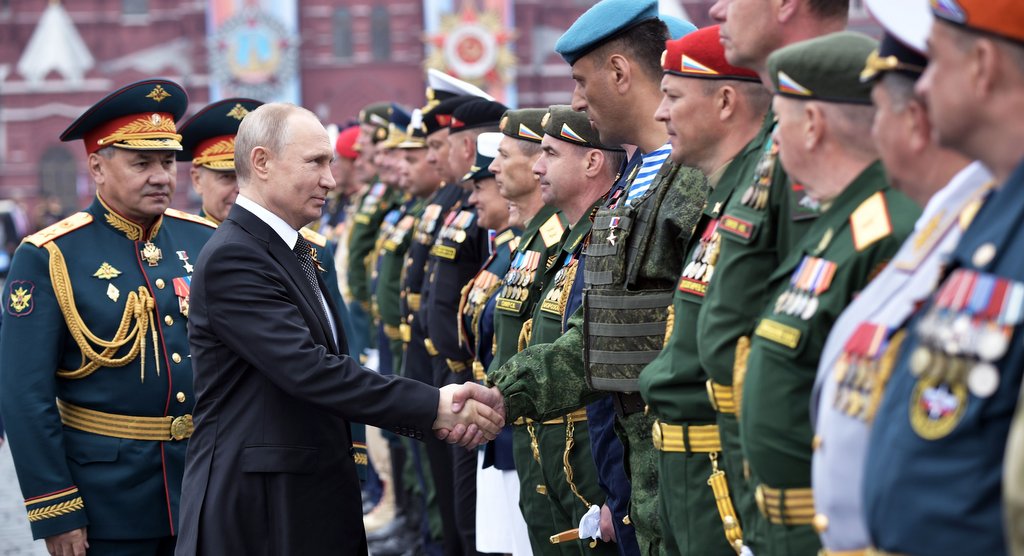
Military pomp is drowning out a meaningful reflection on the horrors of the war.
Source: Moscow Times
The national holiday, Victory Day, which takes place on May 9 every year, celebrating Soviet victory over Nazi Germany in World War II, isn’t just Russia’s most important holiday. The memory of victory, known in Russia as the Great Patriotic War, is the glue of the nation, binding together the most diverse of ages and social groups. It’s the single most important event in history that elicits such a strong feeling of pride among more than 80 percent of Russians (87 percent, to be precise, of those polled by the independent Levada Center in December 2018).
The holiday is also the main marketing tool employed to legitimize Russia’s current political regime in; the ostentatious rituals that have marked this holiday in recent years are designed to bridge the gap between what is considered to be a sacred victory and the main heir and exponent of this is President Vladimir Putin. He is the thread woven through time sustaining this glory. In turn, anyone who criticizes Putin is implicitly criticizing Russia’s great history and its heroic victory.
May 9 was also the cornerstone for legitimizing the Soviet regime under Leonid Brezhnev, who had fought in the war, imbuing him with some kind of moral right to shore up his authority in the rituals of commemoration. It was under Brezhnev after all that May 9 became a public holiday and was celebrated across the country with pomp and splendour. It hadn’t occurred to Nikita Khrushchev, his predecessor, to characterize the Soviet authorities as a band of frontline brothers, and Stalin, the country’s wartime leader, didn’t want the Russian people to remember the war.
Stalin saw popular military leaders as political rivals, and feared the wartime generation: they remembered the nightmare of 1941 and Stalin’s personal shame, who was caught off guard by the German attack. It’s only in today’s mass historical mythology that Stalin has been designated the role of the victor in the war.
The current political regime has reanimated the Brezhnev model of legitimacy without even bothering to update it; it has made it even more archaic, by adopting symbols such as the ribbon of St. George, which, with time, has come to stand for a sign of loyalty to the authorities, rather than a commemoration of the victims of the war. The ribbon has moreover been co-opted as a counterforce to the white ribbons that were a symbol of the 2011-2012 anti-Putin protests.
Another foolproof move made by Kremlin’s political strategists was nationalizing the grassroots initiative Immortal Regiment, an idea which had originated in 2011 in the Siberian city of Tomsk, when three journalists, descendants of soldiers who fought in World War II, on the home front, and were imprisoned in the Gulag, decided to commemorate them with a march. The authorities were quick to make use of this initiative, and by 2015, the march was led by none other than Putin himself. The original organization soon fell apart and was taken over by quasi-public pro-Kremlin structures. In many enterprises and schools across Russia, participation in the event even became compulsory.
In the wave of patriotism that rose up in 2014 following Russia’s annexation of Crimea, public perception of many historical events began to change, eventually even leading to the gradual justification of the Soviet-Afghan War of 1979-1989, which had cost the lives of so many soldiers.
Another event that began to be seen in a completely new light was the Soviet invasion of Czechoslovakia in 1968, in its mission to crush the Prague Spring. In 2018, 36 percent of Russian respondents said that the Soviet Union had done the right thing by sending in troops. The logic was roughly the same as that which was applied to the annexation of Crimea; if Russia hadn’t “incorporated” the peninsula, NATO would have sent in ships and troops there instead.
Today, the matrix of the Soviet mentality and mythology is being reproduced almost to the letter, even if many adherents of such notions weren’t even alive when the Soviet Union collapsed. Over the years, the proportion of respondents who believe that the Soviet Union’s enormous wartime losses were in part to Stalin’s reckless leadership has consistently fallen. In May 1991, 36 percent of people held that viewpoint; by May 2018, that figure decreased to just 9 percent.
That same year, 36 percent of people attributed the large number of fatalities to the surprise element of Germany’s attack, compared to 20 percent of people in 1991. In doing so, they proved Stalin’s mistake; he believed himself to be protected by the Molotov-Ribbentrop pact between the Soviet Union and Germany.
Because Victory Day is celebrated as a joyous occasion, the main commemoration of the war is no longer viewed as a tragedy, but rather, a stirring military parade which cries ‘‘We could do it again!’’
The Soviet poet Bulat Okudzhava, who served in World War II, did not consider the war “great”, but a “slaughterhouse.” He understood, however, that he would be left in the minority, writing: “Military bands will drown out my voice.”
When the military band drowns out one’s voice, it complicates one’s ability to think seriously about the meaning of the event, and nowadays there is no longer the desire to do so. The country’s main public holiday brings together not so much the nation, as much as the authorities’ power base.
Ultimately, everyone has the right to their own interpretation of the holiday.
Former Senior Fellow, Carnegie Russia Eurasia Center
Kolesnikov was a senior fellow at the Carnegie Russia Eurasia Center.
Recent Work
Andrei Kolesnikov
Andrei Kolesnikov
Carnegie does not take institutional positions on public policy issues; the views represented herein are those of the author(s) and do not necessarily reflect the views of Carnegie, its staff, or its trustees.

Europe is facing rising populism internally as well as external pressures from Russia, China, Turkey, and the United States.

Dimitar Bechev

A notable degree of participative democracy has firmly arrived in Europe. But to have more far-reaching impact, democratic deliberation needs to move into a radically new phase.

Richard Youngs

Before the next wave of EU enlargement takes place, the union needs to grapple with thorny questions of how power is distributed among its members.


Emil Sondaj Hansen, Ditte Brasso Sørensen

A summer of escalation in the Black Sea has hurt Ukraine economically and is exacerbating world food security. A truce is needed—as is a broader reframing of Europe’s Ukraine strategy.

Thomas de Waal

European Commission President Ursula von der Leyen is about to give her annual address on the state of the EU. Here’s what she won’t—but should—say.

Rym Momtaz