

Article
Paul Stronski
{
  "authors": [
    "Paul Stronski"
  ],
  "type": "commentary",
  "centerAffiliationAll": "dc",
  "centers": [
    "Carnegie Endowment for International Peace"
  ],
  "collections": [],
  "englishNewsletterAll": "ctw",
  "nonEnglishNewsletterAll": "",
  "primaryCenter": "Carnegie Endowment for International Peace",
  "programAffiliation": "russia",
  "programs": [
    "Russia and Eurasia"
  ],
  "projects": [
    "Changing Geopolitics of Eurasia"
  ],
  "regions": [
    "Central Asia",
    "Kazakhstan"
  ],
  "topics": [
    "Political Reform"
  ]
}
Source: Getty
Kazakhstanis will vote for a new president on June 9. The election was supposed to be a smooth transition to a handpicked, pliant successor, not an open contest. But things are not going as originally planned.
Former president Nursultan Nazarbayev resigned unexpectedly in March 2019. Nazarbayev, who will be seventy-nine in July, was the longest serving leader of a former Soviet country. He had ruled Kazakhstan since 1989, first as a late Soviet-era communist party boss and then as the country’s first president.
Succession plans have long been in the works, but Nazarbayev’s decision to leave when he did may have been prompted by rising socioeconomic problems and discontent.
In a carefully choreographed display, Nazarbayev handed power to Acting President Kassym-Jomart Tokayev, formerly the Senate speaker. The vote on Sunday will be neither free nor fair, and Tokayev will almost certainly be installed as the country’s full-fledged president.
But he will not be as powerful as his predecessor. Two years ago, Nazarbayev orchestrated changes to the country’s constitution to weaken the powers of the presidency and boost the power of the National Security Council, which he still leads. He remains head of the country’s ruling party, Nur Otan, and enjoys the honorific lifelong title of “leader of the nation.”
These positions allow him to influence politics behind the scenes, leaving Tokayev to handle the country’s problems day-to-day. As Kazakhstan’s economic troubles grow, Nazarbayev possibly believes this sort of controlled succession will protect his and his family’s power, wealth, and safety in the years to come.
Nazarbayev also has a back-up plan. His daughter, Dariga Nazarbayeva, who took Tokayev’s former position as Senate speaker, is waiting in the wings should the new president falter.
On paper, Tokayev looks like a safe bet. There are no real opposition parties and he has been in the public eye for years.
But that may be part of the problem. Like some of their U.S. and European counterparts, many Kazakhstanis are tired of the status quo. They believe that long-standing politicians govern to advance their own interests, not those of the people.
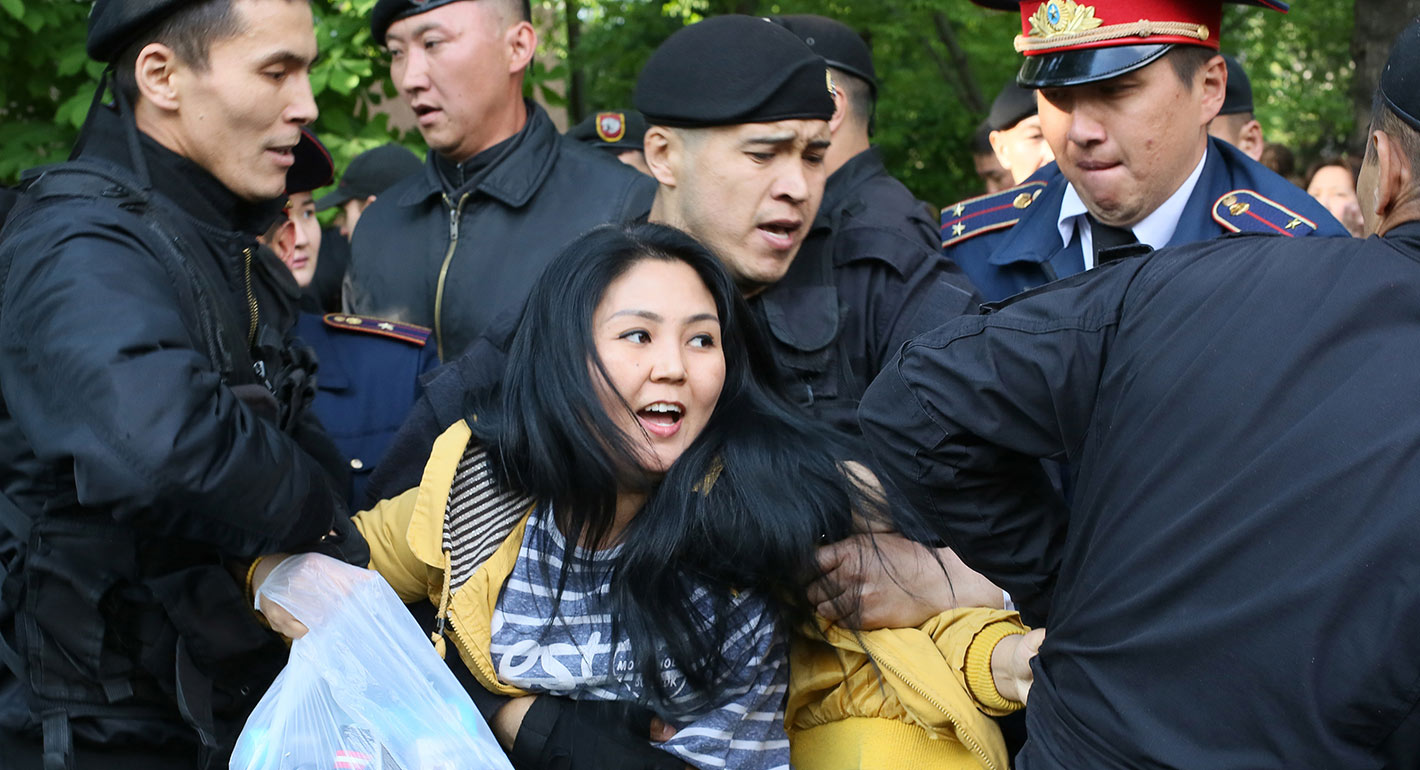
So, instead of welcoming Tokayev’s appointment, some Kazakhs are protesting. These protests are not organized by an opposition movement. They are grassroots expressions of anger over socioeconomic woes, unemployment, endemic corruption, poor social services, and a widening wealth gap.
Nazarbayev has long aspired to transform his country into the next Singapore. Both countries found independence unexpectedly thrust upon them, and Nazarbayev’s post-presidential positions appear to be modeled on the experience of former Singaporean leader Lee Kuan Yew.
But the similarities ends there. Singapore is in one of the most economically and technologically dynamic regions of the world. Kazakhstan is not. Neither country is a democracy, but Singapore’s legal system and business climate are more transparent, which enables it to attract a broad base of outside investors. The island nation also has invested far more in its people and a social safety net. Beyond lofty promises, Kazakhstan has done little to achieve any of that.
The protests seem to have caught Nazarbayev and Tokayev off guard. The government has shuttered some websites and rounded up protesters, including one man who simply held up a blank sign. Another protester cleverly quoted a line from Kazakhstan’s constitution to demand a free election: “The people shall be the only source of state power.” Police detained him too.
For years, Kazakhstan has presented itself as the softer face of Central Asian authoritarianism and a welcoming destination for foreign investment. These efforts to stifle dissent undermines that image.
Tokayev’s appointment was reassuring to Kazakhstan’s main partners. As a former foreign minister, he is well respected in China, Russia, and the United States.
Yet Tokayev faces a daunting geopolitical chessboard. Washington is disengaging from Central Asia, making it harder for Kazakhstan to continue its traditional ”multi-vector” balancing act of playing foreign partners off each other. What’s more, rising Kazakh nationalism also may complicate the country’s relations with both Russia and China. Some Kazakhs are wary of Russia’s growing assertiveness, while Chinese policies in Xinjiang—the mass detention of at least 1 million Uighurs and some ethnic Kazakhs—have led to a backlash against Beijing.
Unplanned transitions of power in two other Eurasian countries offer ominous lessons for Kazakhstans leadership.
Uzbekistan’s brutal dictator Islam Karimov died in office in September 2016. His successor Shavkat Mirziyoyev pushed out many of the former strongman’s loyalists, including members of the Karimov family itself.
In Armenia, mass protests in 2018 thwarted long-standing president Serzh Sargsyan’s plans to cling to power by transferring to the Prime Minister’s office. He rejiggered the constitution to make this possible, but lasted just a handful of days in the post before stepping down, and his former ruling party failed to gain a single seat in the December 2018 parliamentary election.
Other aging autocrats in Eurasia appear to be watching how Kazakhstan’s managed succession unfolds.
Russian President Vladimir Putin is term-limited and needs to design his own transition by 2024. Tajik President Emomali Rahmon, who has been in power since 1994, appears to be grooming his son to take over. Belarus’s President Alexander Lukashenko (in office since 1994) and Azerbaijan’s Ilham Aliyev (in power since 2003) face succession dilemmas too.
None of these men want to end up like Armenia’s Sargsyan, nor do they want their families to experience the Karimovs’ fate.
Barring an unexpected shock, Tokayev will be Kazakhstan’s next president. But the protests rocking Kazakh society are warning signs. A new generation of citizens—born and raised in the post-Soviet era—is entering adulthood and wants change. The government must respond to those demands in practice, not just on paper.
Kazakhstan’s political system is evolving. If this evolution leads to a more accountable government, this will be a good thing. If that doesn’t happen and the crackdown on dissent intensifies, the relationship between the government and its citizens will grow even more fraught.
Former Senior Fellow, Russia and Eurasia Program
Paul Stronski was a senior fellow in Carnegie’s Russia and Eurasia Program, where his research focuses on the relationship between Russia and neighboring countries in Central Asia and the South Caucasus.
Recent Work
Paul Stronski
Paul Stronski
Carnegie does not take institutional positions on public policy issues; the views represented herein are those of the author(s) and do not necessarily reflect the views of Carnegie, its staff, or its trustees.

A notable degree of participative democracy has firmly arrived in Europe. But to have more far-reaching impact, democratic deliberation needs to move into a radically new phase.

Richard Youngs

Before the next wave of EU enlargement takes place, the union needs to grapple with thorny questions of how power is distributed among its members.


Emil Sondaj Hansen, Ditte Brasso Sørensen

As the EU confronts profound challenges, several leaders have called for fundamental reform to the union’s model—but only modest, superficial changes have resulted. What if Europe really could be reimagined from zero today: What should such a redesigned European order look like?
Richard Youngs, ed.
Preparing candidate countries for EU membership is no longer enough. As the enlargement process becomes a reality, the union must also prepare its own societies.

Iliriana Gjoni
Countries face several hurdles in joining the EU, including the final stage of ratifying their accession treaties. Procedural reforms and substantive adjustments could help move the process forward.

Stefan Lehne