

Commentary
The aftermath of the Ceuta crisis shows Europe has drawn the wrong lessons. Rather than doubling down on failed migration policies, the EU needs to address the underlying roots of such episodes.
Richard Youngs
{
  "authors": [
    "Jon Finer",
    "Brett McGurk"
  ],
  "type": "legacyinthemedia",
  "centerAffiliationAll": "",
  "centers": [
    "Carnegie Endowment for International Peace"
  ],
  "collections": [],
  "englishNewsletterAll": "",
  "nonEnglishNewsletterAll": "",
  "primaryCenter": "Carnegie Endowment for International Peace",
  "programAffiliation": "",
  "programs": [],
  "projects": [],
  "regions": [
    "North America",
    "United States",
    "Middle East",
    "Syria"
  ],
  "topics": [
    "Foreign Policy"
  ]
}
Source: Getty
The United States has a special obligation to those who supported or fought alongside American forces, particularly when their plight is so directly tied to American decisions.
Source: New York Times
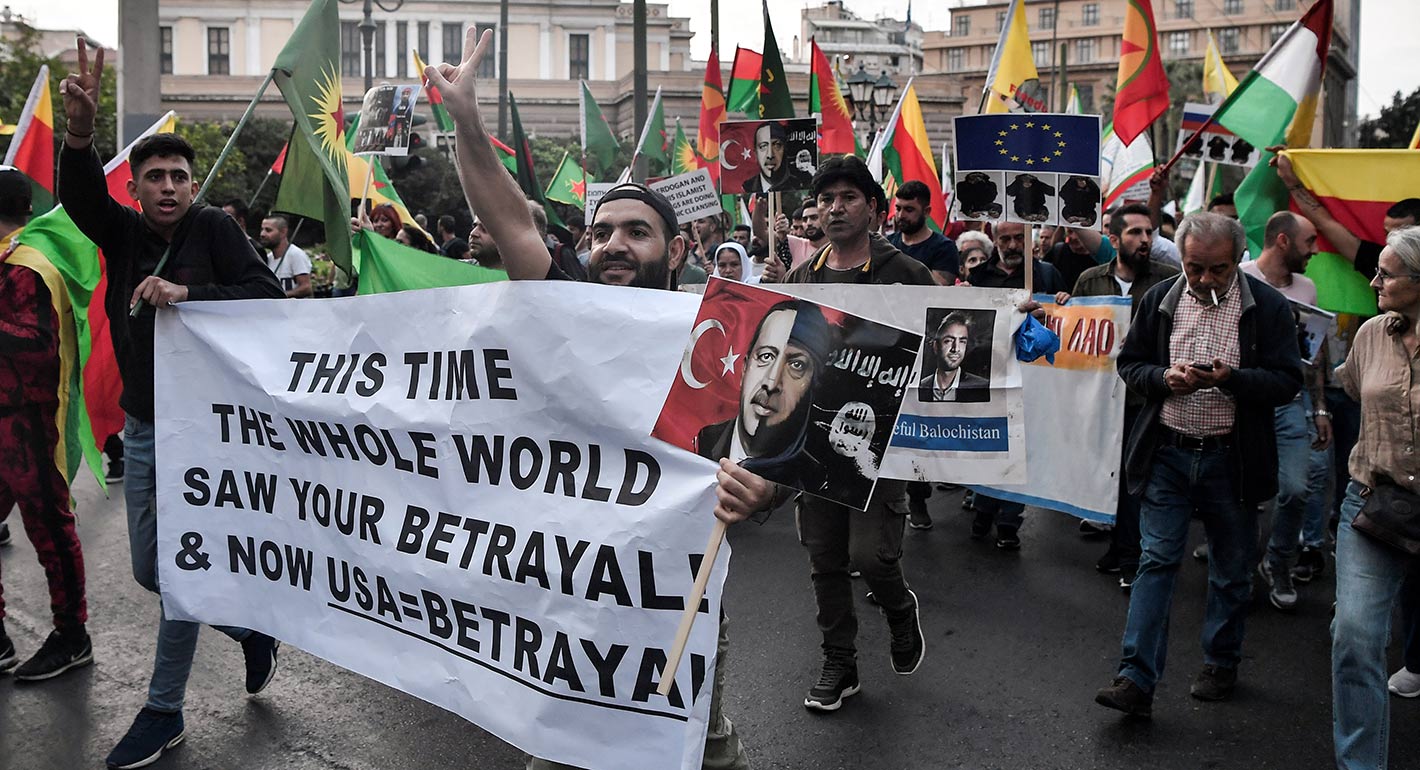
The abrupt withdrawal of American forces from northeastern Syria generated a rare moment of bipartisanship in Washington, though not the kind the Trump administration wanted. Reactions ranged from confusion to outrage. But agreeing on the disastrous consequences of the pullout is easier than figuring out how to manage them.
That’s one reason that the House of Representatives’ broad rebuke of the president’s decision, which passed 354-60, had so many “whereas” clauses (12) explaining why the decision was alarming and so few demands for action (5), all of them relatively vague. But members of Congress have an option that would at least mitigate the damage, both to Syrian Kurds and to America’s reputation as a reliable partner: compel the Trump administration to resettle a significant number of Syrian Kurdish refugees in the United States on an expedited basis.
To briefly recap why Americans should feel some responsibility: A few years ago the Islamic State was regularly using Syrian territory to direct terrorist attacks in Europe and the United States. To address that threat without deploying many thousands of American troops, and with alternatives exhausted, Washington established the Syrian Democratic Forces, a Kurdish-led coalition that includes a range of groups, to do the bulk of the fighting on our behalf.
Begun under President Barack Obama and continued under President Trump after a thorough review, that approach worked. With American support, the S.D.F. grew to 60,000 fighters. They evicted the Islamic State from its strongholds, suffering more than 10,000 killed in action. The United States deployed modest forces, with six killed in action.
And on Sunday, President Trump confirmed that information from the S.D.F. had helped lead American Special Forces to the hiding place in northwestern Syria where the leader of the Islamic State, Abu Bakr al-Baghdadi, committed suicide before he could be killed or taken captive. He and his extended family had found haven only three miles from Turkey’s border.
Turkey viewed the security situation differently. It considered the Kurdish component of the S.D.F. — the only local force able to fight the Islamic State effectively — as its primary threat, even as tens of thousands of Islamic State fighters crossed its border. Two United States administrations worked to alleviate these concerns, including offers of border surveillance, participation in reconciliation talks, and granting political power to groups inside Syria that Turkey favored. Last month, American diplomats established a fragile but functioning security arrangement with Turkey in the very areas it recently attacked in northeastern Syria— areas that were the lifeblood of the Islamic State not long ago.
President Trump could have bolstered these diplomatic initiatives. Instead, without warning to his own national security team, let alone the S.D.F., he pulled the plug on the American mission, undercut diplomacy then in progress, green lit a Turkish-led military attack on our partners, and precipitated a rapid unraveling of northeastern Syria.
We believe that the United States has a special obligation to those who supported or fought alongside American forces, particularly when their plight is so directly tied to American decisions. In the 1970s, at the end of the Vietnam War, the United States brought hundreds of thousands of Southeast Asian refugees to our shores. One of them, Huan Nguyen, who fled Vietnam in 1975, recently became the first Vietnamese-American admiral in the United States Navy. In the mid-1990s, when the Iraqi dictator Saddam Hussein attacked the Kurds of northern Iraq, the United States airlifted tens of thousands of them to Guam to be processed as refugees. More recently, large numbers of Afghan and Iraqi refugees, whose countries were destabilized by American wars, have been resettled.
Today, that generosity feels as if it came from a different country, not just from a different era. At the height of the gravest human migration crisis since World War II, the Trump administration plans to admit just 18,000 refugees worldwide for resettlement over the next year, the fewest in recent history.
Last week, President Trump described resettling refugees as “importing the terrorism,” even as he abandoned those who fought with us against the gravest terrorist threat in recent memory. And as thousands of Syrian Kurds seek refuge in northern Iraq, he is reportedly sending more troops to Syria — to guard small oil fields. Inexplicably, he later tweeted a hollow appreciation for “what the Kurds have done” before suggesting that they, too, “start heading to the oil region!”
Members of Congress can help mitigate this unfolding disaster. Proposals include further sanctions to restrain Turkey, and reinforcing Syria’s neighbors Iraq, Jordan and Israel. But those worthy initiatives should be accompanied by two others that would support the refugees at greatest risk after America’s retreat.
One would establish special access to visas for Syrians who worked most closely with our forces, such as interpreters and advisers, if they have a recommendation from a high-ranking American officer and pass a rigorous background check. Another would designate a broader class of Syrians — including those with an immediate family member in the United States — as “priority” refugees, not counted against the administration’s paltry 18,000-person cap.
In addition to passing these proposals, Congress should insist that the State Department immediately enhance refugee processing where it is likely that those displaced will flee.
It’s unclear exactly how many lives such programs could save or improve, but a good eventual target might be at least 10,000, to mirror the number of casualties suffered by the S.D.F. on our nation’s behalf. The United States should also seek resettlement commitments from other countries whose people are now safer thanks to the S.D.F. (Europe has not suffered a terrorist attack orchestrated from Syria since 2016).
Such steps may be opposed by the administration. But polls from as recently as last week show a majority of Americans support accepting more refugees from Syria, so long as rigorous background checks are conducted — and already, refugees receive more intensive screening than any other immigrant population.
The rationale for steps like this is not purely humanitarian. America’s partners around the world are watching closely to see if we still stand by those who stood with us. It is too late to reverse the decision that has imperiled American partners. But it is not too late to do right by those who helped the United States by ensuring that those seeking refuge will find it.
This article was originally published in the New York Times.
Jon Finer
Former Nonresident Senior Fellow, Middle East Program
Brett McGurk was a nonresident senior fellow in the Middle East Program at the Carnegie Endowment for International Peace.
Carnegie does not take institutional positions on public policy issues; the views represented herein are those of the author(s) and do not necessarily reflect the views of Carnegie, its staff, or its trustees.

The aftermath of the Ceuta crisis shows Europe has drawn the wrong lessons. Rather than doubling down on failed migration policies, the EU needs to address the underlying roots of such episodes.

Richard Youngs

Canadian Prime Minister Mark Carney has twice inspired praise for standing up to U.S. President Donald Trump: at the 2026 World Economic Forum in Davos and on Canada-U.S. trade negotiations. Is Carney showing a third way better than the EU has in dealing with the Trump administration?

Rym Momtaz, ed.

The EU’s responses to two recent incidents expose the gulf between European perceptions and capabilities. Unless the union can bridge that gap, it will never become a real geostrategic power.
Rym Momtaz

European states control several Overseas Countries and Territories around the world that carry strategic, economic, and environmental weight. As great powers challenge the rules-based order, defending them is a geopolitical imperative for Europe.

Marc Pierini

In supporting Europe’s far-right, MAGA and Russia both want the same thing: a weaker EU. Europe must defend itself without abandoning the openness these forces exploit.

Armida van Rij