

Commentary
The EU can impose sanctions but struggles to enforce them without the United States. With Washington increasingly disinterested in backing European interests, the bloc must now fend for itself.
Nicu Popescu, Tiago Antunes
{
  "authors": [
    "Christophe Jaffrelot",
    "Jean-Thomas Martelli"
  ],
  "type": "legacyinthemedia",
  "centerAffiliationAll": "dc",
  "centers": [
    "Carnegie Endowment for International Peace"
  ],
  "collections": [],
  "englishNewsletterAll": "ctw",
  "nonEnglishNewsletterAll": "",
  "primaryCenter": "Carnegie Endowment for International Peace",
  "programAffiliation": "SAP",
  "programs": [
    "South Asia"
  ],
  "projects": [],
  "regions": [
    "South Asia",
    "India"
  ],
  "topics": [
    "Political Reform",
    "Democracy",
    "Foreign Policy",
    "Global Governance"
  ]
}
Source: Getty
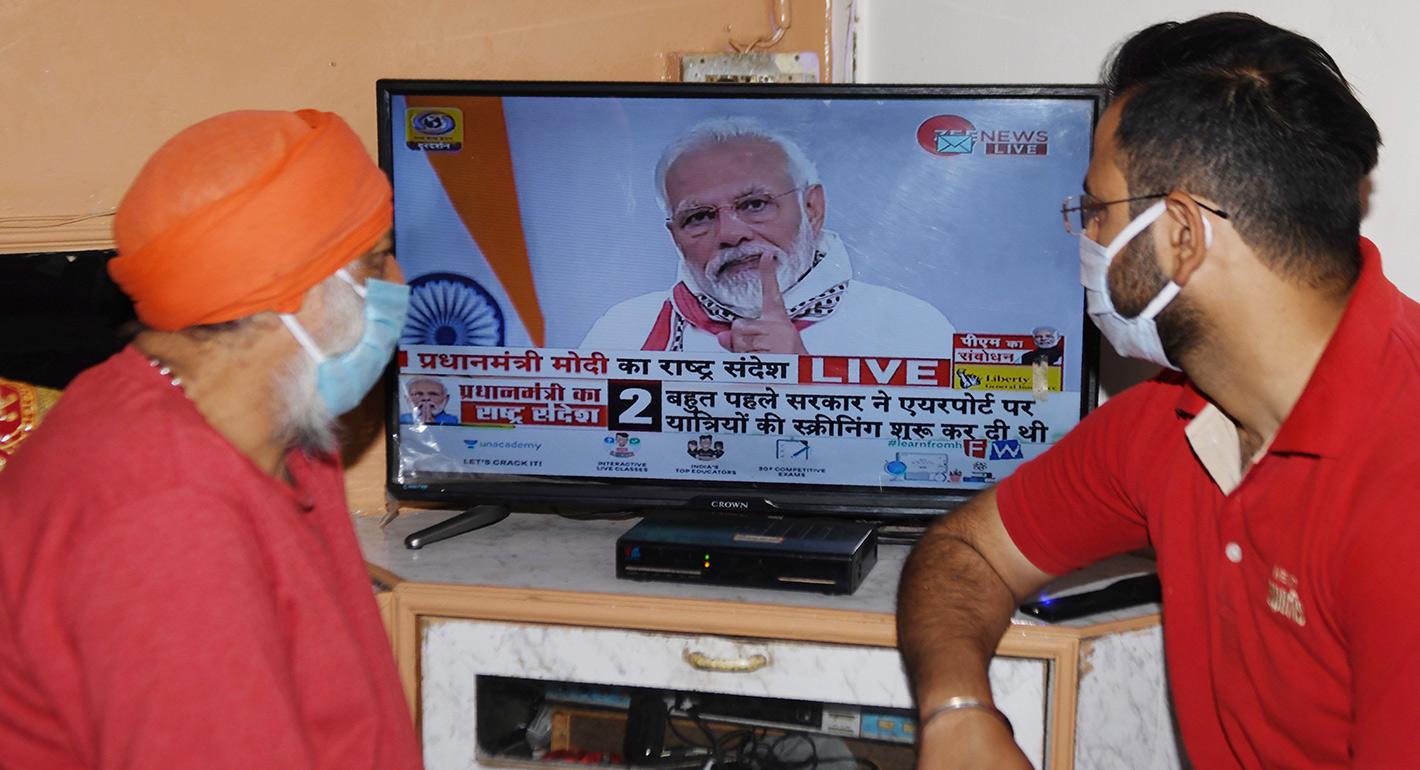
At the national level, the current crisis consolidates a populist rapport between a person, Modi, and a fictional representation of the people.
Source: Indian Express
In the context of the COVID-19 crisis, political decisions are presented as instruments of warfare. Narendra Modi recently proclaimed that the executive must “work on war footing” to fight the new, invisible enemy. Because, in a Clausewitzian sense, war is the continuation of politics by other means, we need to ask what this politics of warfare is the extension of.
At the national level, the current crisis consolidates a populist rapport between a person — Modi — and a fictional representation of the people. Here, populism does not refer to irresponsible economic redistribution. It is understood not only as the enactment of stands against corrupt elites, but as a practice of democracy in which a political leader personifies in his/her style and governance a direct, imitative relation to the imagined people. This entails institutional disintermediation and the “flaunting of the low” that Pierre Ostiguy has pointed out. Several aspects of the management of the COVID-19 outbreak by Modi confirm the populist rooting of India’s democracy.
Modi’s simpler language relies mostly on the use of short sentences and non-conceptual vocabulary. He does not engage in institutional or political dialogues but speaks with “the people”. This results in the underuse of vocabulary associated with institutional processes. Democratic accountability is minimal in Modi’s India; instead, what is enforced is permanent authorisation through constant campaigning. Hence, an accumulation of rhetorical questions, “I and you” periphrases, vocative cases as well as self-references — sometimes in the third person. The language of intimacy is a striking feature: Modi’s discourses keep on referring to conversant realms of family, kinship and home. But he shuns the use of “we” which is associated with unequal power relations.
First, all major decisions related to the crisis are announced by Modi himself using direct visual mediums. No cabinet member, no parliamentary or party official, not even the Minister of Health and Family Welfare is communicating any significant policy information — in fact, most of the briefings are made by a joint secretary. Not only does this maintain an unmediated connection between the ruler and the ruled, it also constitutes a “one-way traffic” since no press conference and no parliamentary debate has created the space for questioning the handling of the crisis.
While healthcare is a state subject and contagious diseases are on the Concurrent List, the imposition of the lockdown and the creation of the PM Cares Fund for coronavirus-related medical expenses were pushed by the Centre without consultation with elected state governments. Not only that, while CSR money can go to the PM Cares Fund, it cannot finance similar initiatives at the state level. This personalisation of power stands in stark contrast to the style of Modi’s predecessor, the primus inter pares of a team of experienced ministers.
Second, Modi continues to tap into popular emotions, in contrast, once more, to Manmohan Singh who was a policy-oriented technocrat. Today, the politics of emotions prevails, sometimes at the expense of administrative efficiency — hence delays in dealing with the COVID-19 epidemic. While the 2016 demonetisation was about requesting sacrifices from citizens to eradicate the black money of the corrupt wealthy lot, the “people’s curfew”, “imposed by the people” — in Modi’s own words — was similar in scope, as it demanded “sacrifices” “in service of the nation.” This call transformed society into what Victor Turner called a communitas, a group in fusion, as evident from the taali bajana, thaali bajana (clap your hands, clang your vessels) and diya jalao, mombatti jalao (light earthen lamps, light candles) events.
Third, Modi’s language is comparatively more accessible and culturally evocative than that of his predecessors. The majoritarian turn in Indian politics means that references to the Hindu fold have stronger electoral appeals, inducing the Opposition to talk like Modi in the hope of retaining its vote-share. COVID-19 or not, this modality of Indian politics is here to stay. The legitimate complaint by liberal circles that Modi’s speeches have led to diffusion of superstitious messages on social media is not inconsequential. The spreading references to astrology and the destructive powers of devotional noise are triggered by Modi’s fetishised references to the Hindu cultural and religious folklore.
In this scenario, another feature of Modi speeches is consolidated: The multiplicity of readings it offers. Approached literally, Modi’s discourses are about constructive and optimistic values, but when associated with the content of his governance, they consistently prompt communal interpretations. After the episode of “corona jihad”, in which many media reports painted the Muslim community as responsible for the hike in infections linked to a religious meeting of the Tablighi Jamaat, Modi’s call for switching off lights on April 5 also generated religious polarisation. His appeal for expressing solidarity in the “war” against COVID-19 sparked fear that non-compliance from Muslims would cause retaliation against them —and in some places, it did.
The management of the COVID-19 outbreak is not only the outcome of remarkable times, it is also the persistence of an unremarkable — yet efficient — politics, characterised by the populist ethos of Modi. An exploration of the Indian Prime Ministers’ Speeches (DIPMS) dataset, containing 5,254 speeches (91,54,654 words) of 11 prime ministers since Independence, confirms that the official discourse today is a prolongation of the Modi strand of politics. A text analysis of the DIPMS corpus indicates that Modi most the language associated to intimacy, disintermediation and simplicity. He enables multiple readings of his speeches, cultivating an image of unchallenged authority while simultaneously emphasising humility, victimisation and social harmony. Similarly, he activates anti-minorities readings of his decisions, accompanying an otherwise positive discourse.
In the global context of the COVID-19 crisis, heads of state capture the whole media attention, limiting — in the name of public interest — the spaces for healthy checks and balances in which an argumentative civil society would have its say. In this scenario, surveillance and the limitation of freedoms of assembly and expression have become everywhere the war-time norm. This trend may bear longstanding consequences in democratic countries where populism has already developed affinities with authoritarianism.
This article was originally published by the Indian Express.

Former Nonresident Scholar, South Asia Program
Jaffrelot’s core research focuses on theories of nationalism and democracy, mobilization of the lower castes and Dalits (ex-untouchables) in India, the Hindu nationalist movement, and ethnic conflicts in Pakistan.
Jean-Thomas Martelli
Jean-Thomas Martelli is a Doctoral Candidate at King’s India Institute, King’s College London, and a sessional lecturer in Sciences Po Paris. He tweets @jtmartelli.
Carnegie does not take institutional positions on public policy issues; the views represented herein are those of the author(s) and do not necessarily reflect the views of Carnegie, its staff, or its trustees.

The EU can impose sanctions but struggles to enforce them without the United States. With Washington increasingly disinterested in backing European interests, the bloc must now fend for itself.


Nicu Popescu, Tiago Antunes

Russia is testing the waters of NATO’s mutual defense clause. What do strikes in Romanian territorial waters mean for the alliance’s posture toward Moscow?

Dimitar Bechev

With its public finances in shambles, the far right polling at 35 percent ahead of the 2027 presidential election, and a growing protest movement, is France’s crisis a threat to the EU’s geopolitical awakening?

Rym Momtaz, ed.

Ahead of a tough winter for Ukraine, Donald Trump’s swing back toward Russia bodes ill. But instead of panicking, Kyiv’s European allies are focusing on action.
Rym Momtaz

Funding Ukraine remains a priority for European leaders. As Russia’s war of aggression heads into another winter, two feasible options to mobilize support for Kyiv should be fast-tracked.


Vladyslav Rashkovan, Gregory P. Wilson