

Article
Zaha Hassan
{
  "authors": [
    "Zaha Hassan"
  ],
  "type": "legacyinthemedia",
  "centerAffiliationAll": "dc",
  "centers": [
    "Carnegie Endowment for International Peace",
    "Malcolm H. Kerr Carnegie Middle East Center"
  ],
  "collections": [],
  "englishNewsletterAll": "menaTransitions",
  "nonEnglishNewsletterAll": "",
  "primaryCenter": "Carnegie Endowment for International Peace",
  "programAffiliation": "MEP",
  "programs": [
    "Middle East"
  ],
  "projects": [],
  "regions": [
    "Middle East",
    "Israel",
    "Palestine",
    "United Arab Emirates",
    "Gulf"
  ],
  "topics": [
    "Political Reform",
    "Foreign Policy"
  ]
}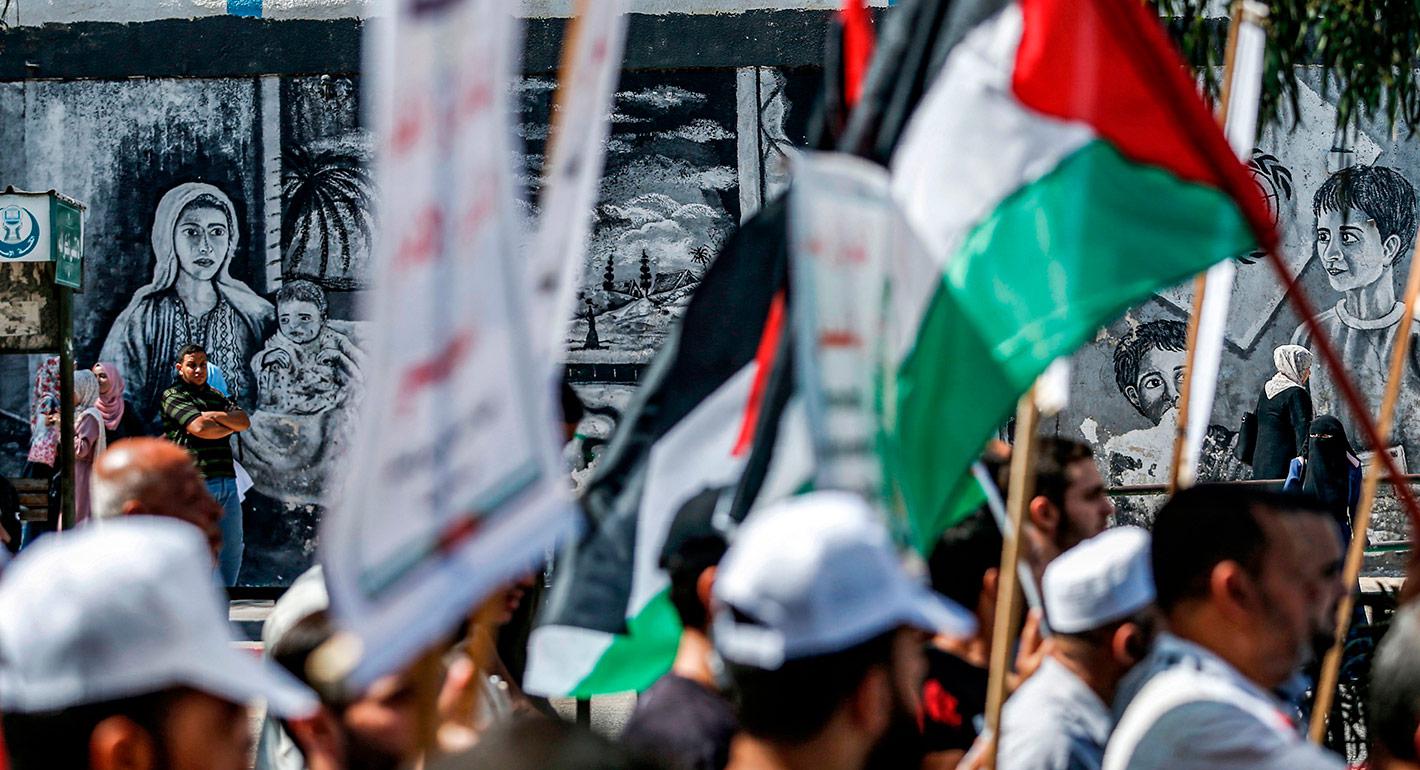
Source: Getty
The loss of the Arab world’s commitment to an end of Israel’s occupation as a precondition for Middle East peace will spell the death knell for a negotiated political solution.
Source: Newsweek
Peace is good. Friendly relations between belligerent states in a fragile region plagued by conflict? That's a hallelujah moment, or so it might seem at first glance. But despite the hype, the agreement between Israel and the United Arab Emirates announced by President Trump on Thursday (dubbed the "Abraham Accord") to normalize relations between the two countries is not a miracle of biblical proportions. It's cold, hard political opportunism taken at the expense of Palestinians. It is political theater in which Palestinians and the remains of their homeland offer a convenient backdrop. The UAE may wish to portray itself as Palestine's Arab savior, pulling Israel back from the brink of illegally annexing more Palestinian land, but the reality is that Palestinians and their rights had nothing to do with it.
For years, the UAE has been enjoying the benefits associated with military, intelligence and technological cooperation with Israel, but behind the scenes. So why be that Gulf state to step into the fray of Arab public opinion as the first—though likely not the last—to tear up the 2002 Arab Peace Initiative, which offered Israel peace and normal relations with Arab states and dozens of other Muslim countries, in exchange for an end to Israel's now 53-year-old military occupation of Palestinian land? Blame it on the U.S. presidential elections and Trump's pandering to right-wing Evangelicals and big pro-Israel donors. Blame it on a microcopic virus that is taking down the unmasked and untethered president of the United States. Blame it on the fact that Arab regimes of questionable repute and in need of refurbishing their tarnished image believe that the road to redemption in Washington runs through Israel.
And why would Israeli Prime Minister Netanyahu promise to temper his territorial ambitions for a Greater Israel in exchange for open diplomatic ties with a small Gulf state? He hasn't. He has only pledged to "suspend" his annexation plans. Postponing annexation for a little while—until after November, perhaps?—in order to have the UAE and maybe other Arab Gulf countries, or even a Muslim-majority country on the African continent announce normalized relations, is a much smarter move, politically.
Netanyahu can then bank the surge in his popularity that will follow for breaking Arab resolve around normalization with Israel and he will spend that cache to win any fourth Israeli election that might soon come. Most assuredly, he will use it to carry him over until after the U.S. election in November when he can freely annex the West Bank once and for all if he wishes, without consequence from the US.
The loss of the Arab world's commitment to an end of Israel's occupation as a precondition for Middle East peace will spell the death knell for a negotiated political solution. The leverage Palestinians had with a united Arab front cannot be replaced by Europe or any multilateral mechanism. The Palestinian movement for national liberation will be set back even beyond the first Palestinian uprising against Israeli occupation in 1987, when, at least, there was a functioning Palestine Liberation Organization that hadn't yet been hollowed out from years of neglect.
No doubt Palestinians will rebuild their national struggle. But in order to mobilize the 13 million people dispersed around in the world and in the land of historic Palestine, Palestinians will have to embrace a vision of peace that centers Palestinian citizenship in a homeland were there is equality for all regardless of religion or national origin.
Tragically, a majority of Jewish Israelis are still far away from imagining either a single democratic state with equal rights for all or a separate independent Palestinian state. If the international community wishes to avert total disaster and even more suffering in the region, it must finally take measures to compel Israel to respect Palestinian rights and international law.
It's clear Trump and the Republicans will continue to deliver Netanyahu political wins up until the last votes are counted in November, encouraging him to deepen Israel's hold over the West Bank. That means it's up to Democrats to act to salvage hopes for peace. Vice President Biden has an opportunity now to change Netanyahu's calculations around annexation before it's too late.
A strong statement expressing his intention to reverse US recognition of Israeli sovereignty over the West Bank that Trump may offer as a parting gift to Israel would go a long way. Biden should also outline the ways in which the US relationship to Israel will be impacted by annexation, including by expressing his intention to restrict US funding to Israel used to facilitate colonization and annexation of the West Bank as was proposed by Senator Van Hollen and others.
This isn't only about Palestinians and Israelis and peace in the Middle East, after all. It is about resetting the U.S. axis so that it serves to be a force that upholds a rules-based international order and human rights in the region and beyond—and begins to undo some of the damage done to the US under the Trump Administration.
Senior Fellow, Middle East Program
Zaha Hassan is a human rights lawyer and a senior fellow at the Carnegie Endowment for International Peace.
Recent Work
Zaha Hassan
Zaha Hassan, Charles H. Johnson
Carnegie does not take institutional positions on public policy issues; the views represented herein are those of the author(s) and do not necessarily reflect the views of Carnegie, its staff, or its trustees.

Ahead of a tough winter for Ukraine, Donald Trump’s swing back toward Russia bodes ill. But instead of panicking, Kyiv’s European allies are focusing on action.

Rym Momtaz

Funding Ukraine remains a priority for European leaders. As Russia’s war of aggression heads into another winter, two feasible options to mobilize support for Kyiv should be fast-tracked.


Vladyslav Rashkovan, Gregory P. Wilson

While the EU and European governments are embracing the much-lauded middle-power moment, this entails three difficult conundrums.

Richard Youngs

A notable degree of participative democracy has firmly arrived in Europe. But to have more far-reaching impact, democratic deliberation needs to move into a radically new phase.
Richard Youngs

Much has been said of the changes Brussels is trying to make to the EU enlargement process. Here’s why gradual integration might—or might not—be the answer.

Dimitar Bechev