

Commentary
Alexander Baunov
{
  "authors": [
    "Alexander Baunov"
  ],
  "type": "commentary",
  "centerAffiliationAll": "",
  "centers": [
    "Carnegie Endowment for International Peace",
    "Carnegie Russia Eurasia Center"
  ],
  "collections": [],
  "englishNewsletterAll": "",
  "nonEnglishNewsletterAll": "",
  "primaryCenter": "Carnegie Endowment for International Peace",
  "programAffiliation": "",
  "programs": [],
  "projects": [],
  "regions": [
    "Russia",
    "Eastern Europe",
    "Ukraine"
  ],
  "topics": [
    "Economy"
  ]
}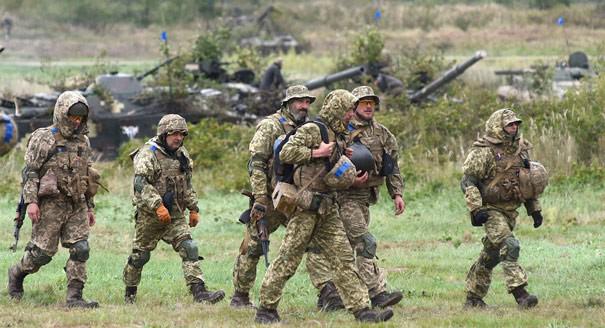
Source: Getty
Russia’s military preparations and other actions signal that Moscow has recognized the danger of coexisting with a fortified area on its border, but doesn’t yet know what to do about it.
Once again, the world is discussing the possibility of Russia waging war against Ukraine. This time, however, the circumstances are extraordinary.
Back in the spring, the buildup of Russian troops for military drills close to Ukraine’s borders ended in a series of communications between the U.S. president and the leaders of Russia and Ukraine, followed by the summit this summer between Russian President Vladimir Putin and U.S. President Joe Biden. At the time, that flare-up in tensions was explained as being down to the desire to put the Donbas conflict firmly on the agenda of the new U.S. president and to force new talks on the issue.
Although the current escalation appears similar to that of the spring, a whole host of new circumstances has been thrown into the mix. The Russian Foreign Ministry has broken a diplomatic taboo by publishing confidential correspondence with Germany and France over Ukraine: something that would have needed to be approved at the very top.
Speaking at the Foreign Ministry soon after this, Putin called for “serious, long-term guarantees that ensure Russia’s security in this area [its Western borders], because Russia cannot constantly be thinking about what could happen there tomorrow.”
It’s not clear what form such guarantees would take, but it’s likely that ahead of another possible summit between Putin and Biden, Moscow would like to receive assurances similar to those made to Beijing: not to enter into an open conflict with China, and not to try to change the Chinese political system. Instead of such assurances, however, Russia has seen Western military vessels close to Russia’s borders, and a resolution introduced to the U.S. Congress that would automatically declare Putin’s rule illegitimate beyond the next elections in 2024.
It seems that Russia does not have the same sway as China to obtain the promises that one superpower has given another. As a recent superpower, Russia considers this particularly unpleasant, and the simmering conflict in eastern Ukraine could be used to give it more clout.
The West finds itself, therefore, facing the uncomfortable dilemma of whether to boost Russia’s status, thereby rewarding the dangerous exploitation of a simmering conflict, or to refuse to give Moscow the promises it desires, thus conserving the conflict in its heated state.
Russia’s action of releasing the diplomatic correspondence and Putin’s call for guarantees can be interpreted in two ways. Either—and this is unlikely—Moscow has information that Kyiv is seriously considering a military solution to the problem of the Donbas separatists, or Russia itself is preparing for a military operation in eastern Ukraine, and these overwrought statements are an attempt to absolve itself of responsibility for its future actions: alas, Moscow had warned of the coming storm, and called for action, but to no avail.
The problem is that even if the first, less likely scenario of Ukraine taking back Donbas by force were implemented, it would instantly turn into the second: of Russia invading Ukraine. Western journalists and politicians would not have enough time to decide who started it, nor indeed the motivation, since Ukraine would be acting on territory internationally recognized as its own, unlike Russia, which would inevitably be designated the aggressor.
Even if Russia were only responding to action taken by Ukraine, it would still be seen as invading: something the West has warned against. Determining how proportionate a response was to the use of force would be a long and difficult process.
In Kyiv, the tone of Moscow’s statements is seen as a sign that Russia itself is preparing to strike first, and is simply trying to push responsibility for resumed hostilities elsewhere. Russia vividly recalls Georgia’s attempt to regain control over South Ossetia in 2008, which was thwarted by Russia’s intervention. Despite the fact that Georgia’s proactive role in the events of the six-day war is now much clearer (thanks to Wikileaks and the Tagliavini report), that war is still broadly cited as an example of Russian aggression and occupation, since it unfolded on territory internationally accepted as part of Georgia, albeit at the location of a frozen conflict. Georgia’s then president Mikheil Saakashvili’s attack on South Ossetia is still considered to have been prompted by a deliberate provocation by separatists and Moscow.
In a situation in which the two sides suspect each other of harboring the worst intentions—or, at least, pretend to do so—and with every hour counting at the start of military action, the South Ossetia scenario could unfold of its own accord. A confrontation on the Donbas demarcation line that goes beyond the regular clashes could prompt a response like that over Ossetia: why wait for the worst to happen? Nor would it be hard to manufacture such an event, should there be any desire to do so.
If the West views any events in Donbas in the broader context of a Russian attack on Ukraine’s territorial integrity, and even the restoration of the Russian empire, many in Moscow see those same events as an attack by the Kyiv authorities on the integrity of ethnic Russians. In his recent article on Ukrainian history, Putin wrote in startlingly harsh terms about the disappearance of hundreds of thousands of Russians, comparing it to the use of weapons of mass destruction. A man who holds such views is unlikely to simply step down from his post without even trying to stop such an adverse turn of events. What would his successors say? After all, Ukraine was offered the decent option of the Minsk agreements and voluntary federalization, while the West was offered Ukrainian neutrality. The options left are the bad ones.
Russia, for its part, is discovering its own worst option. For three decades, the greatest fear of the Russian leadership was that Ukraine (and Belarus) would join NATO and move Western military infrastructure right up to Russia’s borders. Now it turns out that that can happen even without NATO, and in more real and long-term and less predictable ways. An aggrieved country that is building its entire identity on the rejection of everything Russian is far easier to turn into a fortified area on Russia’s border than a country confined by NATO procedures. In the absence of any security guarantees from a bloc, that country will be ready at the drop of a hat to welcome foreign aircraft, ships, and troops, and to equip its own army, leaping into action out of fear.
Russia’s military preparations, the publication of the confidential correspondence, and Putin’s call for guarantees on its southwestern flank signal that Moscow has recognized the danger of coexisting with such a fortified area and does not want to accept it, but doesn’t yet know what to do about it.
For now, Moscow and Kyiv are opting to increase their own significance by showing how—with their restrained and responsible behavior—they are saving humanity from the danger of a global conflict into which the opposite side would readily drag the world.
This publication is part of a project carried out with the support of the Royal Danish Embassy in Moscow.

Senior Fellow, Editor-in-Chief, Carnegie Russia Eurasia Center
Baunov is a senior fellow and editor-in-chief at the Carnegie Russia Eurasia Center.
Recent Work
Alexander Baunov
Alexander Baunov
Carnegie does not take institutional positions on public policy issues; the views represented herein are those of the author(s) and do not necessarily reflect the views of Carnegie, its staff, or its trustees.

A summer of escalation in the Black Sea has hurt Ukraine economically and is exacerbating world food security. A truce is needed—as is a broader reframing of Europe’s Ukraine strategy.

Thomas de Waal

European Commission President Ursula von der Leyen is about to give her annual address on the state of the EU. Here’s what she won’t—but should—say.

Rym Momtaz

The EU’s responses to two recent incidents expose the gulf between European perceptions and capabilities. Unless the union can bridge that gap, it will never become a real geostrategic power.
Rym Momtaz

European states control several Overseas Countries and Territories around the world that carry strategic, economic, and environmental weight. As great powers challenge the rules-based order, defending them is a geopolitical imperative for Europe.

Marc Pierini

In supporting Europe’s far-right, MAGA and Russia both want the same thing: a weaker EU. Europe must defend itself without abandoning the openness these forces exploit.

Armida van Rij