

Commentary
Artyom Shraibman
{
  "authors": [
    "Artyom Shraibman"
  ],
  "type": "commentary",
  "centerAffiliationAll": "",
  "centers": [
    "Carnegie Endowment for International Peace",
    "Carnegie Russia Eurasia Center"
  ],
  "collections": [],
  "englishNewsletterAll": "",
  "nonEnglishNewsletterAll": "",
  "primaryCenter": "Carnegie Endowment for International Peace",
  "programAffiliation": "",
  "programs": [],
  "projects": [],
  "regions": [
    "Eastern Europe",
    "Belarus"
  ],
  "topics": [
    "Economy"
  ]
}
Source: Getty
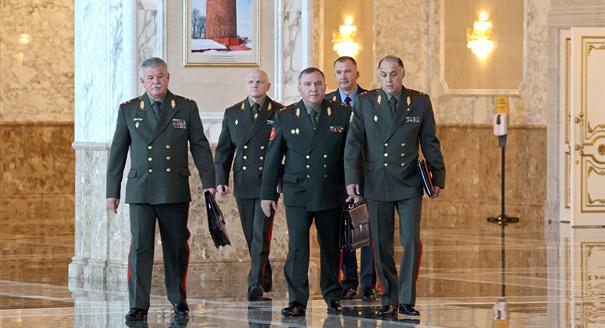
If there was once speculation about how the Belarusian leader Alexander Lukashenko would act in the event of a major regional conflict, that is no longer the case. Belarusian territory is simply a staging area for the Russian army, and the extent of the threat from Belarus is determined by one factor alone: how keen the Kremlin is to go to war.
As Russia tries to force the United States into making concessions on security guarantees by surrounding Ukraine with troops, Belarus has—by virtue of geography—become one of the fronts in this unprecedented bout of saber-rattling.
Since the middle of January, Russia has been moving troops from the Far East to the vicinity of the Belarus-Ukraine border where, for ten days from February 10, joint Russian-Belarusian military exercises called “Allied Resolve” are taking place. It’s not known how many soldiers are involved, but it appears the number of Russian troops in Belarus constitutes a post-Soviet record.
NATO Secretary General Jens Stoltenberg has spoken about 30,000 Russian troops, while Russian military experts have said 10,000 is a more realistic figure. Either way, they are accompanied by Su-35S fighter aircraft, as well as Pantsir, Iskander, and S-400 missile systems.
Lukashenko has played more than a walk-on part in all of this, and is pretending to have initiated the joint maneuvers himself. It was he who announced the exercises back at the beginning of December, and he has since taken every opportunity to stress that he invited the Russian troops because Belarus needs to protect its southern flank from the Ukrainian “threat.”
The military drills illustrate Minsk’s new role in the region—and show just how far events have moved on from the professed dreams of Belarusian officials only a couple of years ago for Belarus to become an “Eastern European Switzerland.”
Until 2020, Lukashenko exploited bad relations between Russia and the West by performing a balancing act between the two sides, selling risks to one side and opportunities to the other. But following the regime’s violent crackdown on opposition protests over the contested presidential election that year, Minsk has no room for maneuver left with the West. Any attempt to distance Belarus from Russia would barely be noticed in the West and—to put it mildly—would not be understood in Moscow.
If there was once speculation about how Lukashenko would act in the event of a major regional conflict, that is no longer the case. Belarusian territory is simply a staging area for the Russian army, and the extent of the threat from Belarus is determined by one factor alone: how keen the Kremlin is to go to war.
At the same time, Lukashenko has not changed, and he’s not comfortable with the fact that he’s no longer considered the master of his own country. He’s hurt by the thought that other countries and his own senior officials might see him as a Russian vassal. At a recent meeting, Lukashenko argued at length that he would not allow the country to be occupied.
Understanding this aspect of Lukashenko’s character, Washington has taken to taunting him: an anonymous State Department official briefed the media that the Belarusian dictator was no longer in control of the situation. This looks like an attempt to goad Lukashenko into showing some sort of independence.
At the same time, the United States is threatening Minsk with new sanctions if it participates in Russian aggression against Ukraine. That’s not an empty threat: as the Belarusian economy has little significance for the world and has already been hit by several rounds of economic sanctions, it would be politically more straightforward for the West to turn Belarus into a new Iran than it would be to do the same with Russia.
If a war did break out, it’s highly unlikely the Belarusian army would take part in the fighting. The only exception would be in the apocalyptic eventuality that, following Russian strikes against Ukraine from Belarusian territory, Ukraine launched counterstrikes against Belarus, or dispatched guerrilla units into Belarus and killed Belarusian soldiers or civilians.
There’s no way Lukashenko would involve Belarusian troops in a conflict of his own volition. Militarily speaking, Moscow doesn’t particularly need them, but there are also significant political reasons. Throughout his twenty-seven years in power, Lukashenko has stressed his success in preserving peace. It would be extremely difficult for him now to explain taking an active role in a war—especially one with neighboring Ukraine—to his supporters, let alone most ordinary Belarusians.
Judging by his recent state of the nation address, Lukashenko understands this perfectly. There was a lot of militaristic rhetoric in his speech, but when a woman in the audience asked whether Belarusian mothers would be sending their sons to fight in a foreign war, Lukashenko replied that the Belarusian army was created to protect the country on its own territory. There are no questions at such events that are not agreed in advance, which means that Lukashenko wanted an opportunity to calm some of the growing fears of war.
For the Belarusian regime, either extreme outcome to the confrontation between Russia and the West—war or reconciliation—is undesirable. In the event of war, Belarus would be forced into making risky and likely self-destructive concessions to the Kremlin, while a reconciliation would make it difficult for Belarus to interest the Kremlin in its anti-Western posturing. But a gray zone of manageable conflict would be ideal, allowing Belarus to sell its rhetorical loyalty to Moscow without sustaining any serious losses.
In a situation of protracted confrontation, Lukashenko would be seen as a true ally who, at a crucial time, fulfilled his obligation to Russia while the Kremlin sought its sacred security guarantees. Wouldn’t such loyalty be a reason for Moscow to be a little more generous when it came to the next round of debt negotiations?

Nonresident Scholar, Carnegie Russia Eurasia Center
Artyom Shraibman is a nonresident scholar at the Carnegie Russia Eurasia Center.
Recent Work
Artyom Shraibman
Artyom Shraibman
Carnegie does not take institutional positions on public policy issues; the views represented herein are those of the author(s) and do not necessarily reflect the views of Carnegie, its staff, or its trustees.

Mounting economic strain and battlefield losses will not necessarily make the Kremlin less dangerous. They could instead push Moscow toward a more aggressive hybrid campaign designed to test NATO’s Eastern flank, exploit allied hesitation, and fracture European resolve.

Maksym Beznosiuk

As the EU confronts profound challenges, several leaders have called for fundamental reform to the union’s model—but only modest, superficial changes have resulted. What if Europe really could be reimagined from zero today: What should such a redesigned European order look like?

Richard Youngs, ed.
As Russia's war on Ukraine drags on, NATO is expanding its footprint in the Black Sea. Turkey, Romania, and Bulgaria are upgrading their fleets and deepening trilateral cooperation.

Dimitar Bechev
For ninety years, Turkey has been positioned as the principal gatekeeper of Black Sea security. As a result, European and NATO efforts to support Ukraine will require closer engagement with Ankara.

Thomas de Waal
As geopolitical rivalry weaponizes global supply chains, the EU’s true vulnerability lies in emerging-risk imports. For these goods, suppliers are growing more concentrated, substitution more difficult, and political risk is looming.

Sinan Ülgen