

Paper
Ian Klaus, Stewart Patrick
{
  "authors": [
    "Ian Klaus"
  ],
  "type": "legacyinthemedia",
  "centerAffiliationAll": "dc",
  "centers": [
    "Carnegie Endowment for International Peace"
  ],
  "collections": [
    "Trans-Pacific Relationships"
  ],
  "englishNewsletterAll": "ctw",
  "nonEnglishNewsletterAll": "",
  "primaryCenter": "Carnegie Endowment for International Peace",
  "programAffiliation": "CC",
  "programs": [
    "Carnegie California"
  ],
  "projects": [],
  "regions": [
    "North America",
    "United States"
  ],
  "topics": [
    "Foreign Policy",
    "Subnational Affairs"
  ]
}
Source: Getty
The summit is a chance for Californians to consider their place in the world.
San Francisco is a boom-and-bust town. The gold rushes of the 1850s and 1870s, the defense industry boom of the 1940s and 1950s, and the internet bonanzas of the 1990s and 2010s all had their attendant busts, often wiping out jobs, savings, and real estate wealth.
This is another difficult moment in the city and region’s history. People are suffering on the streets, and they are disproportionately Black and Native American. More than a third of San Francisco’s unsheltered lived in the city for at least a decade before losing housing. Government officials, and even the judiciary, have found themselves stuck in internecine policy fights and legal disputes about how to address some of the resulting challenges, even if just in the near term. Meanwhile, local businesses have experienced a weak coronavirus pandemic recovery, particularly those that benefit from urban density and office employees.
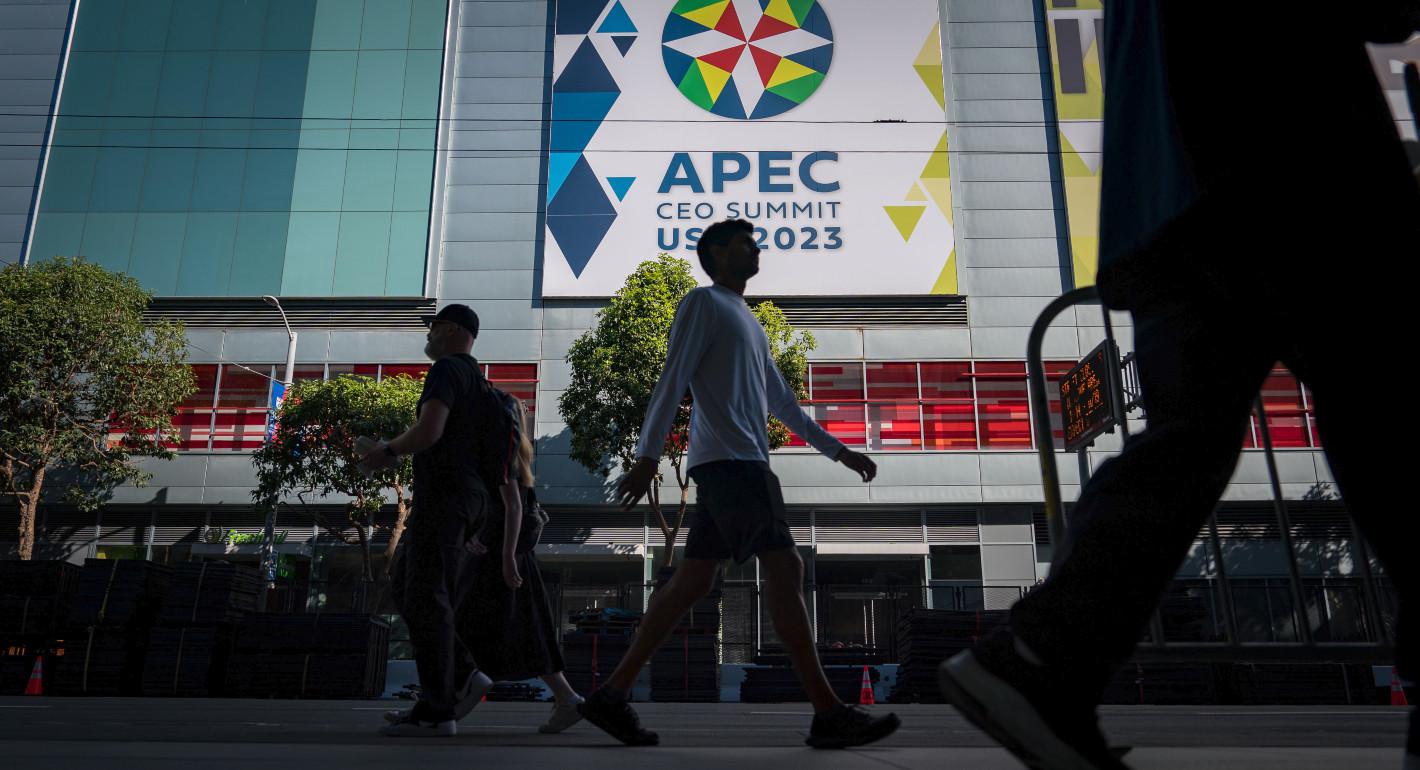
In this context, more than twenty world leaders, including U.S. President Joe Biden and Chinese President Xi Jinping, are convening in San Francisco this week for the Asia-Pacific Economic Cooperation (APEC) leaders’ summit. While U.S.-China relations are top of mind for most foreign policy observers, a large number of civic groups and private sector actors have seized on the summit as an opportunity for rebranding. The city itself has done much the same, polishing up its urban fabric and welcoming arrivals at San Francisco International Airport to an APEC that will be, to borrow surfers’ lingo, “epic.” Media from across the country and the world, a fair share of which has looked at the Bay Area’s struggles with no small amount of schadenfreude, has wondered whether the city can maintain at least an aura of diplomatic respectability.
But with their unscheduled side meetings, invite-only events, and concentric rings of security—enforced by a dizzying array of agencies from the local, state, and federal levels—such summits exist in many ways outside of geography. The headquarters of the United Nations—whose charter was signed in San Francisco—looks over the East River from Manhattan’s East Side but possesses extraterritorial status. And the UN General Assembly high-level week, in which tens of thousands of diplomats, policymakers, and experts descend on the city’s East Side, is something that happens to New York as much as in it. Geneva feels so intertwined with diplomatic functioning, in part, because it has given itself over to it.
But as the Pacific world descends upon San Francisco, and as local leaders attempt to utilize APEC as a rebranding opportunity, it’s worth considering how Bay Area residents and Californians more generally think about their state and city’s place in the world. In summer 2023, Carnegie California, with YouGov, surveyed residents on their views on global affairs and foreign policy. Some important findings stood out.
First, Californians see a strong relationship between diplomacy, development, and domestic well-being. They do not view the diplomacy currently taking place in San Francisco as irrelevant or superfluous. Indeed, almost four in five Californians believe international engagement is important to American security and prosperity. This is true across the state’s regions. When asked to what degree they consider diplomacy and international development essential to American security and prosperity, 81 percent of respondents in the Bay Area answered either “a great deal” or “a fair amount.” In the Central Valley, that number was 82 percent, and in Los Angeles, 78 percent. Somewhat similarly, a broad majority of Californians think that international affairs and domestic affairs are interconnected, with 70 percent saying they are linked either “a great deal” or “a fair amount.”
Californians, especially when compared with Americans more generally, are more likely to be westward looking, prioritizing Asia over Europe with regard to economic and security concerns. Thirty-five percent of Californians identify Asia as the most important region to the U.S. economy, over Europe at 30 percent. The partisan divide is not huge in this case—with 38 percent of Democrats and 31 percent of Republicans prioritizing Asia—but a notable regional difference emerged. Way beyond the state average, 49 percent of Bay Area residents think the country’s prosperity is linked first to Asia.
What about the most important of diplomatic relationships—between the United States and China—that will be under a microscope this week? A vast majority of Californians recognize relations with China as important to the United States, with 81 percent of state residents and 82 percent of Bay Area residents saying the relationship is either “very important” or “somewhat important.” And they’re worried about the state of this relationship. Nearly 50 percent of Californians believe relations with China are “poor,” and nearly a quarter still describe them as “fair.”
Should a city at the nadir of another—and in this case, particularly challenging—boom-and-bust cycle be host to a major diplomatic event? Protests and op-eds pointing to the severe situation on the city’s streets will offer their own respective responses, but this much is clear: Californians and San Franciscans think their well-being is tied to international affairs and is advanced by diplomacy; they think the U.S.-China relationship is essential to the future of the United States, and that it’s in a bad way; and they think regional cooperation with Asian partners such as Japan and South Korea should be a priority of U.S. engagement. If that doesn’t add up to an argument for diplomacy, I don’t know what does.

Founding Director, Carnegie California
Ian Klaus is the founding director of Carnegie California. He is a leading scholar on the nexus of urbanization, geopolitics, and global challenges, with extensive experience as a practitioner of subnational diplomacy.
Recent Work

Ian Klaus, Stewart Patrick

Ian Klaus, Mark Baldassare, Rachel George, …
Carnegie does not take institutional positions on public policy issues; the views represented herein are those of the author(s) and do not necessarily reflect the views of Carnegie, its staff, or its trustees.

Ahead of a tough winter for Ukraine, Donald Trump’s swing back toward Russia bodes ill. But instead of panicking, Kyiv’s European allies are focusing on action.

Rym Momtaz

Funding Ukraine remains a priority for European leaders. As Russia’s war of aggression heads into another winter, two feasible options to mobilize support for Kyiv should be fast-tracked.


Vladyslav Rashkovan, Gregory P. Wilson

While the EU and European governments are embracing the much-lauded middle-power moment, this entails three difficult conundrums.

Richard Youngs

Europe is facing rising populism internally as well as external pressures from Russia, China, Turkey, and the United States.

Dimitar Bechev

Much has been said of the changes Brussels is trying to make to the EU enlargement process. Here’s why gradual integration might—or might not—be the answer.
Dimitar Bechev