
• Research
  • Strategic Europe
  • About
  • Experts
Carnegie Europe logoCarnegie lettermark logo
EUUkraine
  • Donate
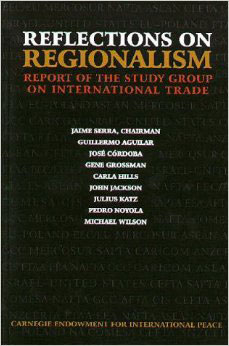
Reflections on Regionalism: Report of the Study Group on International Trade
Book

Reflections on Regionalism: Report of the Study Group on International Trade

Reflections on Regionalism: Report of the Study Group on International Trade

Link Copied
By Gene Grossman, John Jackson, Pedro Noyola, Michael Wilson, Julius Katz, José Córdoba, Carla Hills
Published on Jul 1, 1997

Source: Washington, DC: Carnegie Endowment for International Peace, 1997

Summary

Over the last three decades, regional trade agreements (RTAs) have proliferated to the point where, by 1995, virtually all members of the newly formed World Trade Organization (WTO) were members of an RTA of some kind—whether a customs union, a free-trade agreement, or an interim agreement leading to one or the other.

Analysts are divided about the effects of RTAs. Some believe that taking further steps in the direction of trade and investment liberalization—even when restricted to a particular region—contributes to creation of world trade and investment. Others believe that the implicit discrimination that these agreements embody diverts rather than creates worldwide trade and investment.

The Study Group—composed of eminent former trade negotiators and experts—gives its assessment of the thrust of existing theoretical as well as empirical analyses of the effects of RTAs. It then offers the WTO a series of recommendations aimed at strengthening its leadership role in managing RTAs. The proposals focus on improving existing rules governing RTA formation as well as operation so as to minimize the risk of trade and investment diversion resulting from RTAs and to induce trade- and investment-creating behavioral patterns for existing and future RTAs.

Advance Praise

“Reflections on Regionalism points up a neglected issue in GATT/WTO negotiations. We need to be sure the strong interest in regional arrangements doesn't undermine the multilateral system, and the illustrious and experienced authors show how it should be done.”

—Paul A. Volcker

“This report focuses beautifully on the reasons why the proliferating free trade agreements now pose a danger to the world trading system and offers creative solutions to the problems they present.”

—Jagdish Bhagwati

About the Authors

Gene Grossman

John Jackson

Pedro Noyola

Michael Wilson

Julius Katz

José Córdoba

Carla Hills

Authors

Gene Grossman
John Jackson
Pedro Noyola
Michael Wilson
Julius Katz
José Córdoba
Carla Hills
Trade

Carnegie does not take institutional positions on public policy issues; the views represented herein are those of the author(s) and do not necessarily reflect the views of Carnegie, its staff, or its trustees.

More Work from Carnegie Europe

  • Commentary
    Strategic Europe
    Global Instability Makes Europe More Attractive, Not Less

    Europe isn’t as weak in the new geopolitics of power as many would believe. But to leverage its assets and claim a sphere of influence, Brussels must stop undercutting itself.

      Dimitar Bechev

  • Turkey Erdogan Caucasus Central Asia
    Article
    How Turkey Can Help the Economies of the South Caucasus to Diversify

    Over the past two decades, regional collaboration in the South Caucasus has intensified. Turkey and the EU should establish a cooperation framework to accelerate economic development and diversification.

      • Feride Inan
      • Güven Sak
      • Berat Yücel

      Feride İnan, Güven Sak, Berat Yücel

  • Commentary
    Strategic Europe
    Can Europe Still Matter in Syria?

    Europe’s interests in Syria extend beyond migration management, yet the EU trails behind other players in the country’s post-Assad reconstruction. To boost its influence in Damascus, the union must upgrade its commitment to ensuring regional stability.

      Bianka Speidl, Hanga Horváth-Sántha

  • Commentary
    Strategic Europe
    Europolis, Where Europe Ends

    A prophetic Romanian novel about a town at the mouth of the Danube carries a warning: Europe decays when it stops looking outward. In a world of increasing insularity, the EU should heed its warning.

      Thomas de Waal

  • Commentary
    Strategic Europe
    Europe Falls Behind in the South Caucasus Connectivity Race

    The EU lacks leadership and strategic planning in the South Caucasus, while the United States is leading the charge. To secure its geopolitical interests, Brussels must invest in new connectivity for the region.

      Zaur Shiriyev

Get more news and analysis from
Carnegie Europe
Carnegie Europe logo, white
Rue du Congrès, 151000 Brussels, Belgium
  • Research
  • Strategic Europe
  • About
  • Experts
  • Projects
  • Events
  • Contact
  • Careers
  • Privacy
  • For Media
  • Gender Equality Plan
Get more news and analysis from
Carnegie Europe
© 2026 Carnegie Endowment for International Peace. All rights reserved.