

Research
- +5
Alper Coşkun, Fatih Ceylan, Tacan İldem, …
{
  "authors": [
    "Sinan Ülgen"
  ],
  "type": "commentary",
  "blog": "Strategic Europe",
  "centerAffiliationAll": "",
  "centers": [
    "Carnegie Endowment for International Peace",
    "Carnegie Europe"
  ],
  "englishNewsletterAll": "",
  "nonEnglishNewsletterAll": "",
  "primaryCenter": "Carnegie Europe",
  "programAffiliation": "",
  "regions": [
    "Europe",
    "Türkiye"
  ],
  "topics": [
    "EU",
    "Foreign Policy",
    "Security",
    "Trade",
    "NATO"
  ]
}
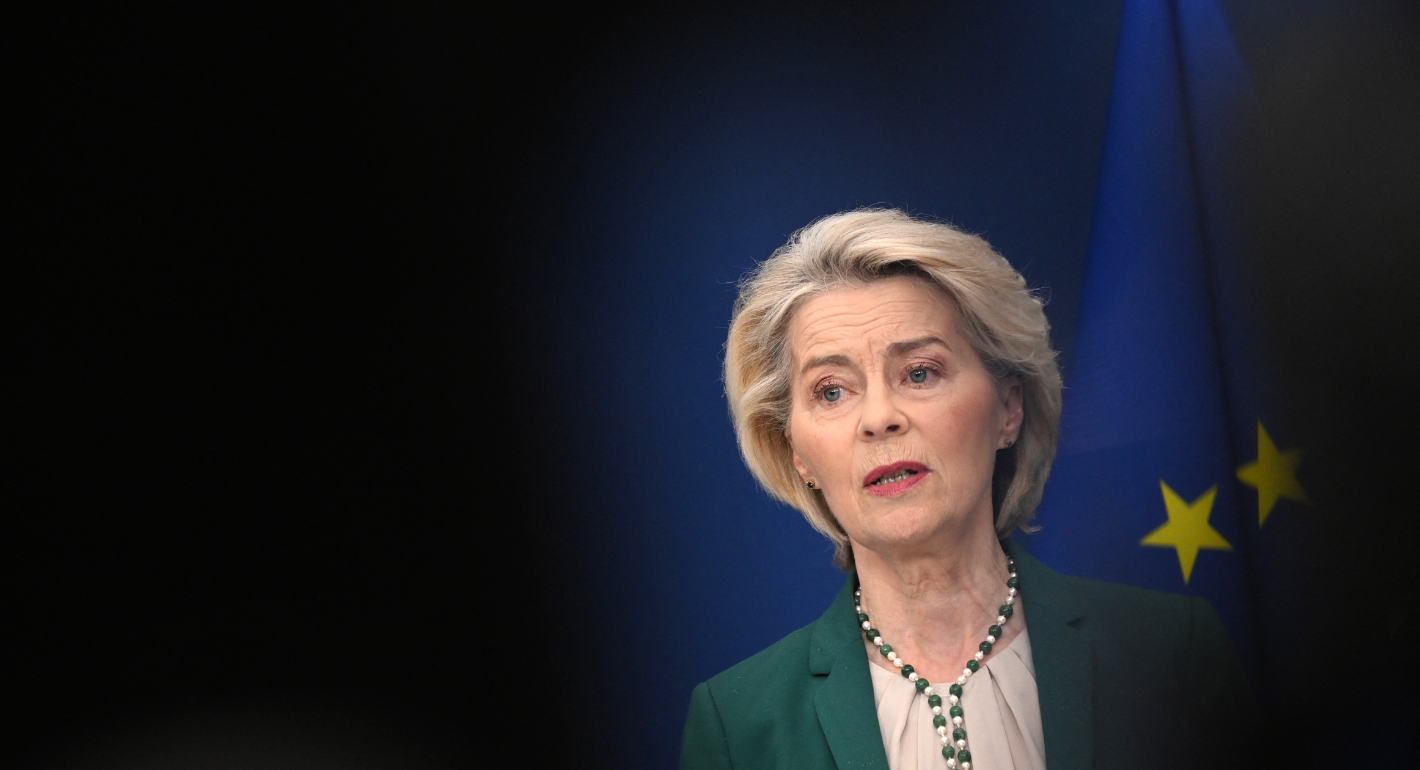
Source: Getty
Following Ursula von der Leyen’s gaffe equating Turkey to Russia and China, relations with Ankara risk deteriorating even further. Without better, more consistent diplomatic messaging, how can the EU pretend to be a geopolitical power?
The importance of consistency in foreign policy has rarely been demonstrated as vividly as when two top European Commission officials adopted radically different language on the EU’s relationship with Turkey.
One, President Ursula von der Leyen, positioned Turkey squarely as a member of a malign axis alongside China and Russia. She claimed that the construction of Europe should be completed so that “it does not fall under Russian, Turkish, or Chinese influence.” She added for good measure that “we must think bigger and more geopolitically,” insinuating that Ankara was actually a geopolitical rival.
The other, EU enlargement chief Marta Kos, adopted a radically different narrative in an address to the European Parliament, stating that “we need Turkey in light of the changing geopolitical realities in Europe and the Middle East.” She prefaced her remarks by underlining Ankara’s importance as a trade and security partner.
In foreign policy, the long-term effectiveness of a state actor in shaping the nature of its bilateral ties hinges on its credibility. And consistency is an essential component of credibility. Appearing to be consistent and credible will be a critical success factor in the EU’s transformation as a stronger and more effective foreign policy entity.
That is why this public demonstration of an internal schism between top EU officials is so detrimental to the union’s ambitions to be a dependable foreign policy actor. Constructive ambiguity has its place in international diplomacy. But publicly rehashing the geopolitical cleavages on Turkey goes further. It underlines a severe and detrimental lack of a cohesive vision. Such egregious inconsistency should trigger a reexamination of how the EU can become a genuinely geopolitical actor. It should justify the creation of a more streamlined and thorough process of internal consensus-building in foreign and security policy. In the absence of this, the EU will forever remain at a disadvantage in a power-driven geopolitical contest.
The EU’s ambivalence on Turkey is a long-standing theme. For a long time, the main intellectual cleavage was about the country’s eventual union membership. Despite being a candidate country and having started formal accession negotiations in 2005, the prospect of Turkish membership remained a controversial issue. Then, in 2007, the former French president Nicolas Sarkozy reneged on the commitment to keep the door open to Ankara. He fiercely opposed Turkey’s entry, opining that “I do not think that Turkey has a place in Europe,” and that the country’s place was in “Asia Minor.”
In recent years, the terms of this divide have shifted again. With democratic backsliding in Turkey and the rise of anti-enlargement movements in many European countries, Ankara’s eventual accession has become a dormant topic. This dynamic has since coincided with the EU’s more overt aspirations to enhance its strategic autonomy in a changing and more challenging geopolitical environment. As a result, the European debate is now much less about Turkey’s eventual accession and more about how to define its role as a possible strategic partner.
A geopolitical EU needs to determine the nature of its relationship with the global and regional actors that have a bearing on its ability to shape regional stability. That is why, for instance, there is a keen interest in reanchoring the UK as a close partner in the wake of a toxic era created by the Brexit debacle. That is also why there is a justifiable aspiration to remodel the relationship with a less predictable United States. Clearly defining a new relationship with Turkey in light of the turmoil in the transatlantic relationship and the threat from Russia is a strategic imperative for the EU.
The scope of a possible strategic partnership framework with Turkey could actually be quite ambitious. Turkey is ranked as the EU’s sixth most critical global partner in terms of its contributions to economic security, just below Japan and ahead of the United States. As a NATO ally, Turkey is also an indispensable security actor. Its growing defense industrial base can help to address European aspirations to reduce dependence on the United States. Given its geography, cooperation in broadening the interconnectedness of Europe—be it in energy or logistics—represents another possible avenue of collaboration. But even this positive agenda is seriously hindered by the union’s indecision on how it views the future of its relations with Ankara.
Short of that, the EU’s inconsistent stance could further deteriorate an already strained relationship with Turkey. Von der Leyen’s remarks have been read by many in the country as proof that the union is indeed a geopolitical rival. Those who hold this view in Ankara hence posit that Turkish foreign policy can never depend on a lasting and deep partnership with Brussels, and accordingly that it should develop its foreign and security policy not only to hedge against the EU but also to work actively to harm the EU’s interests in the neighborhood—including in the Balkans, the Middle East, and even Africa. They also advocate against any compromise on prevailing political disagreements, including in Cyprus. A concomitant conclusion is the need to establish closer relations with non-Western powers like China and Russia. Calculated or not, this is exactly the type of thinking that the commission president’s statements have bolstered.
Back in 1952, addressing the UK Conservative Party conference, then-prime minister Winston Churchill said that “it is better to be both right and consistent. But if you have to choose—you must choose to be right.” That is exactly where the EU stands in relation to Turkey after von der Leyen’s remarks. In this instance, it needs to start being right, and then consistent. And being right requires cogency: Cogency between the union’s aspirations to transform itself into an effective geopolitical actor and the terms of its engagement with a candidate country that, in many ways, already is one.
Subscribe to Strategic Europe, delivered every Tuesday and Thursday!

Senior Fellow, Carnegie Europe
Sinan Ülgen is a senior fellow at Carnegie Europe in Brussels, where his research focuses on Turkish foreign policy, transatlantic relations, international trade, economic security, and digital policy.
Recent Work

Alper Coşkun, Fatih Ceylan, Tacan İldem, …

While the EU and European governments are embracing the much-lauded middle-power moment, this entails three difficult conundrums.

Richard Youngs

Much has been said of the changes Brussels is trying to make to the EU enlargement process. Here’s why gradual integration might—or might not—be the answer.

Dimitar Bechev

The European Commissioner for Trade is headed to China. But after President Xi’s bridge-building visit to Washington, can a more isolated EU overcome Beijing’s stranglehold on critical raw materials? Who will blink first?

Rym Momtaz, ed.

The domestic impacts of how long it is taking to end the war in Ukraine have pushed the French electorate to the political extremes and compromised the country’s diplomatic capacity.
Rym Momtaz

Before the next wave of EU enlargement takes place, the union needs to grapple with thorny questions of how power is distributed among its members.


Emil Sondaj Hansen, Ditte Brasso Sørensen