

Commentary
European Commission President Ursula von der Leyen is about to give her annual address on the state of the EU. Here’s what she won’t—but should—say.
Rym Momtaz
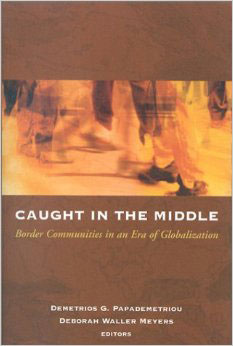
This volume looks at the inner workings and realities of border communities along five international borders: United States-Canada, United States-Mexico, Germany-Poland, Russia-China, and Russia-Kazakhstan. The case studies focus on innovative cross-border initiatives and contribute unique insights into the daily lives and local perspectives of border communities.
Source: Washington

"This astutely conceived work addresses itself to a refreshingly precise subject: What are the appropriate functions of borders between states in the age of globalization? Drawing from case studies that reveal the wide range of situations encountered in the world at large, Papademetriou and Meyers elaborate guidelines for an approach to border management that will effectively promote North American integration."
—Aristide R. Zolberg, New School University
"Papademetriou and Meyers give us an excellent analysis of the issues of governance, cross-border initiative and cooperation, international migration, and the tension that is inherent in the interplay of national and local policy perspectives . . . and an imaginative vision of a new NAFTA border regime that would enable the United States, Canada, and Mexico to realize the full potential of their regional economic integration initiative."
—Peter Karl Kresl, Bucknell University
"Caught in the Middle is of outstanding importance to anyone who is interested in feasible alternatives to defensive and at times inefficient border controls."
—Dilek Cinar, European Centre for Social Welfare Policy and Research, Austria
"These comparative border studies skillfully highlight some of the key emergent political issues of the twenty-first century."
—Steven Vertovec, Transnational Communities Programme, University of Oxford
"A superb analysis, relevant worldwide."
—Luis G. Solis, Trans-Border Cooperation in Central America, FUNPADEM, Costa Rica
Former Associate
Demetrios G. Papademetriou
G.
Carnegie does not take institutional positions on public policy issues; the views represented herein are those of the author(s) and do not necessarily reflect the views of Carnegie, its staff, or its trustees.

European Commission President Ursula von der Leyen is about to give her annual address on the state of the EU. Here’s what she won’t—but should—say.

Rym Momtaz

Radical-right parties are expected to do well in upcoming elections in four of the EU's biggest member states. If successful, they could prevent the union from addressing key challenges ahead.

Stefan Lehne

Canadian Prime Minister Mark Carney has twice inspired praise for standing up to U.S. President Donald Trump: at the 2026 World Economic Forum in Davos and on Canada-U.S. trade negotiations. Is Carney showing a third way better than the EU has in dealing with the Trump administration?
Rym Momtaz, ed.

European states control several Overseas Countries and Territories around the world that carry strategic, economic, and environmental weight. As great powers challenge the rules-based order, defending them is a geopolitical imperative for Europe.

Marc Pierini

In supporting Europe’s far-right, MAGA and Russia both want the same thing: a weaker EU. Europe must defend itself without abandoning the openness these forces exploit.

Armida van Rij