

French President Emmanuel Macron has unveiled his country’s new nuclear doctrine. Are the changes he has made enough to reassure France’s European partners in the current geopolitical context?
Rym Momtaz, ed.
Taiwan’s military is clearly modernizing and will improve in the near- to mid-term. A reorientation away from an army-centric focus has led to such improvements as joint warfighting capabilities among branches of the military and improvements in missile defense systems, front-line military units, and naval defense capabilities.
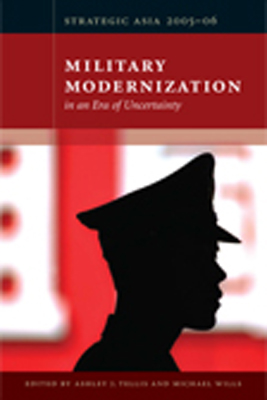
Source: Strategic Asia 2005-06: Military Modernization in an Era of Uncertainty
In their chapter in Strategic Asia 2005–06: Military Modernization in an Era of Uncertainty, Michael Swaine and Roy Kamphausen argue that Taiwan’s military is clearly modernizing and will improve in the near- to mid-term. A reorientation away from an army-centric focus has led to such improvements as joint warfighting capabilities among branches of the military and improvements in missile defense systems, front-line military units, and naval defense capabilities. Progress has been slow, however, and characterized by a number of deficiencies, including inadequate funding levels, an absence of strategic clarity, often misplaced priorities, and unaddressed vulnerabilities. Deficiencies in Taiwan’s military modernization in large part reflect the influence of Taiwan’s highly dynamic and divisive domestic political, bureaucratic, and social environment; a historical legacy of military-oriented rule; and the vagaries of U.S. political and military assistance.
Through a combination of country, regional, and topical studies, Strategic Asia 2005–06 assesses how Asian states are modernizing their military programs in response to China's rise as a regional power, the war on terrorism, changes in U.S. force posture, the revolution in military affairs, and local security dilemmas. The book is edited by Ashley J. Tellis, senior associate at the Carnegie Endowment for International Peace, and Michael Wills, Strategic Asia program director at the National Bureau of Asian Research.
Strategic Asia 2005–06: Military Modernization in an Era of Uncertainty is available to order from NBR.
Former Senior Fellow, Asia Program
Swaine was a senior fellow at the Carnegie Endowment for International Peace and one of the most prominent American analysts in Chinese security studies.
Roy Kamphausen
Carnegie does not take institutional positions on public policy issues; the views represented herein are those of the author(s) and do not necessarily reflect the views of Carnegie, its staff, or its trustees.
French President Emmanuel Macron has unveiled his country’s new nuclear doctrine. Are the changes he has made enough to reassure France’s European partners in the current geopolitical context?
Rym Momtaz, ed.
The drone strike on the British air base in Akrotiri brings Europe’s proximity to the conflict in Iran into sharp relief. In the fog of war, old tensions in the Eastern Mediterranean risk being reignited, and regional stakeholders must avoid escalation.
Marc Pierini
For years, the United States anchored global cyber diplomacy. As Washington rethinks its leadership role, the launch of the UN’s Cyber Global Mechanism may test how allies adjust their engagement.
Patryk Pawlak, Chris Painter
Europe isn’t as weak in the new geopolitics of power as many would believe. But to leverage its assets and claim a sphere of influence, Brussels must stop undercutting itself.
Dimitar Bechev
Europe’s reaction to the war in Iran has been disunited and meek, a far cry from its previously leading role in diplomacy with Tehran. To avoid being condemned to the sidelines while escalation continues, Brussels needs to stand up for international law.
Pierre Vimont