• Research
  • Strategic Europe
  • About
  • Experts
Carnegie Europe logoCarnegie lettermark logo
EUUkraine
  • Donate
Issues in U.S.-India Nuclear Cooperation

Source: Getty

Article

Issues in U.S.-India Nuclear Cooperation

Link Copied
By Sharon Squassoni
Published on Nov 7, 2007

Additional Links

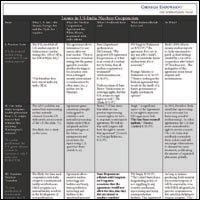
123 Agreement Table (PDF)
Chart
In October, the U.S.-India nuclear cooperation agreement -- a foreign policy priority for the Bush Administration -- hit a snag in Indian domestic politics. In response to heavy criticism by Indian leftist parties, which threatened to call for early elections, Prime Minister Singh put negotiations on safeguards with the International Atomic Energy Agency (IAEA) on hold. Since the safeguards agreement is a likely prerequisite for a Nuclear Suppliers Group (NSG) decision to make an exception for India -- both of which must be completed before the deal comes back to the U.S. Congress -- this delay provides some much-needed room for reflection. In particular, Congress and the NSG should use the time to resolve significant ambiguities.
 
One ambiguity is whether the nuclear cooperation agreement is consistent with the Hyde Act, passed last December to provide certain waiver authorities to the President. On October 4, 2007, Representatives Berman and Ros-Lehtinen introduced a resolution (H. Res. 711) in the House, which noted that it remained to be seen whether the nuclear cooperation agreement was fully consistent with the Hyde Act, and urged the Administration to resolve all outstanding questions raised by Congress. H. Res. 711 also urged the Administration to propose a NSG exemption that clearly calls for the termination of all exports should India test a nuclear explosive device.
 
Although it might seem like common sense to halt nuclear exports to a state that violates the international norm of not testing, the U.S.-Indian agreement is rather ambiguous on the matter, as the table above illustrates. It's not clear what would happen if India tests another nuclear device -- do U.S. exports terminate? Will the U.S. encourage or discourage other states from supplying India in that event? Would U.S. consideration of mitigating factors surrounding an Indian test lead to continuation of exports? 
 
At this stage, it is remarkable that there continue to be so many uncertainties. It will be important to take every opportunity -- for example, when the NSG consultative group meets in November and in congressional hearings -- to clarify and resolve issues before the NSG opens up nuclear commerce to India.

Sharon Squassoni is senior associate in the Nonproliferation Program at the Carnegie Endowment for International Peace.

About the Author

Sharon Squassoni

Former Senior Associate, Nuclear Policy Program

Squassoni came to Carnegie from the Congressional Research Service. She also served for nine years in the executive branch. Her last position at the State Department was director of Policy Coordination in the Nonproliferation Bureau.

    Recent Work

  • Other
    Grading Progress on 13 Steps Toward Nuclear Disarmament

      Sharon Squassoni

  • Report
    Nuclear Energy: Rebirth or Resuscitation?

      Sharon Squassoni

Sharon Squassoni
Former Senior Associate, Nuclear Policy Program
Sharon Squassoni
North AmericaUnited StatesSouth AsiaIndiaNuclear Policy

Carnegie does not take institutional positions on public policy issues; the views represented herein are those of the author(s) and do not necessarily reflect the views of Carnegie, its staff, or its trustees.

More Work from Carnegie Europe

  • Commentary
    Strategic Europe
    Macron Makes France a Great Middle Power

    France has stopped clinging to notions of being a great power and is embracing the middle power moment. But Emmanuel Macron has his work cut out if he is to secure his country’s global standing before his term in office ends.

      • Rym Momtaz

      Rym Momtaz

  • Commentary
    Strategic Europe
    Taking the Pulse: Can the EU Attract Foreign Investment and Reduce Dependencies?

    EU member states clash over how to boost the union’s competitiveness: Some want to favor European industries in public procurement, while others worry this could deter foreign investment. So, can the EU simultaneously attract global capital and reduce dependencies?

      • Rym Momtaz

      Rym Momtaz, ed.

  • Article
    What Can the EU Do About Trump 2.0?

    Europe’s policy of subservience to the Trump administration has failed. For Washington to take the EU seriously, its leaders now need to combine engagement with robust pushback.

      Stefan Lehne

  • Commentary
    Strategic Europe
    Europe Falls Behind in the South Caucasus Connectivity Race

    The EU lacks leadership and strategic planning in the South Caucasus, while the United States is leading the charge. To secure its geopolitical interests, Brussels must invest in new connectivity for the region.

      Zaur Shiriyev

  • Commentary
    Strategic Europe
    Taking the Pulse: Is It Time for Europe to Reengage With Belarus?

    In return for a trade deal and the release of political prisoners, the United States has lifted sanctions on Belarus, breaking the previous Western policy consensus. Should Europeans follow suit, using their leverage to extract concessions from Lukashenko, or continue to isolate a key Kremlin ally?

      Thomas de Waal, ed.

Get more news and analysis from
Carnegie Europe
Carnegie Europe logo, white
Rue du Congrès, 151000 Brussels, Belgium
  • Research
  • Strategic Europe
  • About
  • Experts
  • Projects
  • Events
  • Contact
  • Careers
  • Privacy
  • For Media
  • Gender Equality Plan
Get more news and analysis from
Carnegie Europe
© 2026 Carnegie Endowment for International Peace. All rights reserved.