• Research
  • Strategic Europe
  • About
  • Experts
Carnegie Europe logoCarnegie lettermark logo
EUUkraine
  • Donate
{
  "authors": [
    "Sharon Squassoni"
  ],
  "type": "other",
  "centerAffiliationAll": "dc",
  "centers": [
    "Carnegie Endowment for International Peace"
  ],
  "collections": [
    "U.S. Nuclear Policy"
  ],
  "englishNewsletterAll": "",
  "nonEnglishNewsletterAll": "",
  "primaryCenter": "Carnegie Endowment for International Peace",
  "programAffiliation": "NPP",
  "programs": [
    "Nuclear Policy"
  ],
  "projects": [],
  "regions": [
    "North America",
    "United States",
    "East Asia",
    "China",
    "Caucasus",
    "Russia",
    "Western Europe",
    "United Kingdom",
    "France"
  ],
  "topics": [
    "Nuclear Policy",
    "Nuclear Energy"
  ]
}
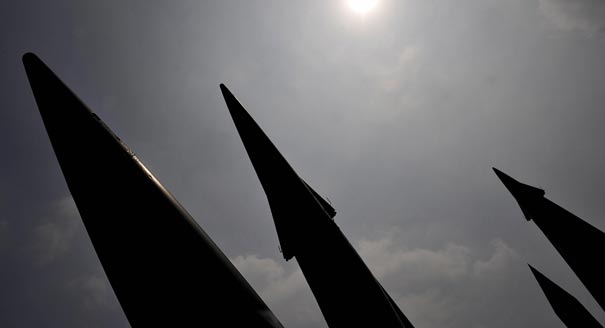
Source: Getty

Other

Grading Progress on 13 Steps Toward Nuclear Disarmament

All NPT states agreed in 2000 to lay out a practical path toward nuclear disarmament – the 13 Steps. While some steps toward disarmament have been taken, much more needs to be done.

Link Copied
By Sharon Squassoni
Published on May 8, 2009

Source: Carnegie Endowment

Grading Progress on 13 Steps Toward Nuclear Disarms North Korea prepares for another nuclear test and Iran continues to install centrifuges to enrich uranium, the Nuclear Non-Proliferation Treaty (NPT) needs shoring up more than ever. Delegates are meeting in New York now to prepare for the next review of the landmark treaty in 2010. A topic that will certainly be on the agenda is the "13 Practical Steps" toward nuclear disarmament.

All NPT states agreed in 2000 to lay out a practical path toward nuclear disarmament—the 13 Steps. Are these still the right steps? How far have we come? Sharon Squassoni assesses the progress of the declared nuclear-weapon states (United States, Russia, China, France, and the United Kingdom) on the steps, and recommends measures to breathe new life into the 13 Steps or a similar package.

Recommendations:
  • The 13 Steps are still the currency of the nuclear bargain, but need updating. New approaches, like Japan's "11 Benchmarks for Global Nuclear Disarmament" deserve attention.
     
  • U.S. leadership is critical, but not enough. Other states, nuclear-weapon states and non-nuclear weapon states, must do their part.
     
  • Recent Russian initiatives are helpful, but nuclear weapons deserve less, rather than more emphasis in their security policies.
     
  • India, Israel, and Pakistan – all weapon states outside the NPT – must be included in the disarmament dialogue.

About the Author

Sharon Squassoni

Former Senior Associate, Nuclear Policy Program

Squassoni came to Carnegie from the Congressional Research Service. She also served for nine years in the executive branch. Her last position at the State Department was director of Policy Coordination in the Nonproliferation Bureau.

    Recent Work

  • Report
    Nuclear Energy: Rebirth or Resuscitation?

      Sharon Squassoni

  • Article
    Venezuela: A Nuclear Profile

      Nima Gerami, Sharon Squassoni

Sharon Squassoni
Former Senior Associate, Nuclear Policy Program
Sharon Squassoni
Nuclear PolicyNuclear EnergyNorth AmericaUnited StatesEast AsiaChinaCaucasusRussiaWestern EuropeUnited KingdomFrance

Carnegie does not take institutional positions on public policy issues; the views represented herein are those of the author(s) and do not necessarily reflect the views of Carnegie, its staff, or its trustees.

More Work from Carnegie Europe

  • Commentary
    Strategic Europe
    Taking the Pulse: Can European Defense Survive the Death of FCAS?

    France and Germany’s failure to agree on the Future Combat Air System (FCAS) raises questions about European defense. Amid industrial rivalries and competing strategic cultures, what does the future of European military industrial projects look like?

      • Rym Momtaz

      Rym Momtaz, ed.

  • Commentary
    Strategic Europe
    Macron Makes France a Great Middle Power

    France has stopped clinging to notions of being a great power and is embracing the middle power moment. But Emmanuel Macron has his work cut out if he is to secure his country’s global standing before his term in office ends.

      • Rym Momtaz

      Rym Momtaz

  • Commentary
    How Can Europe Renew a Stalled Enlargement Process?

    Despite offering security benefits to candidates and the EU alike, the enlargement agenda appears stalled. Why is progress not being made, and is it time for Europe to rethink its approach?

      Sylvie Goulard, Gerald Knaus

  • EU democracy support policies
    Paper
    European Democracy Support Annual Review 2025

    European democracy support strategy in 2025 prioritized protecting democratic norms within Europe. This signals the start of a structural recalibration of the EU’s approach to democracy support.

      • Elena-Viudes-Egea
      • +6

      Richard Youngs, ed., Elena Viudes Egea, Zselyke Csaky, …

  • Commentary
    Strategic Europe
    Taking the Pulse: Can the EU Attract Foreign Investment and Reduce Dependencies?

    EU member states clash over how to boost the union’s competitiveness: Some want to favor European industries in public procurement, while others worry this could deter foreign investment. So, can the EU simultaneously attract global capital and reduce dependencies?

      • Rym Momtaz

      Rym Momtaz, ed.

Get more news and analysis from
Carnegie Europe
Carnegie Europe logo, white
Rue du Congrès, 151000 Brussels, Belgium
  • Research
  • Strategic Europe
  • About
  • Experts
  • Projects
  • Events
  • Contact
  • Careers
  • Privacy
  • For Media
  • Gender Equality Plan
Get more news and analysis from
Carnegie Europe
© 2026 Carnegie Endowment for International Peace. All rights reserved.








