

Other
Sharon Squassoni
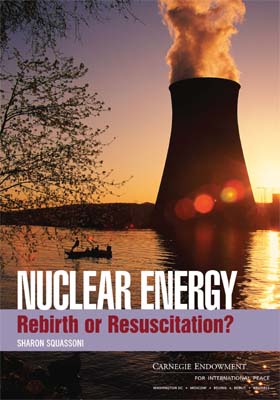
Increased interest in nuclear power has fueled talk of a "nuclear renaissance." But the reality of nuclear energy’s future is more complicated. Without major changes in government policies and aggressive financial support, nuclear power is actually likely to account for a declining percentage of global electricity generation.
After several decades of disappointing growth, nuclear energy seems poised for a comeback. Talk of a “nuclear renaissance” includes perhaps a doubling or tripling of nuclear capacity by 2050, spreading nuclear power to new markets in the Middle East and Southeast Asia, and developing new kinds of reactors and fuel-reprocessing techniques. But the reality of nuclear energy’s future is more complicated. Without major changes in government policies and aggressive financial support, nuclear power is actually likely to account for a declining percentage of global electricity generation.
Projections for growth assume that government support will compensate for nuclear power’s market liabilities and that perennial issues such as waste, safety, and proliferation will not be serious hurdles. Before embarking on such a path, policy makers need to achieve greater certainty across a wide range of issues. In the meantime, all possible efforts should be made to minimize the risks of any nuclear expansion that might occur. These include strengthening the rules of nuclear commerce and transparency, deemphasizing the element of national prestige with respect to nuclear energy, undertaking clear-eyed assessments of all available options for generating electricity, and limiting the acquisition of sensitive nuclear technologies like uranium enrichment and spent-fuel reprocessing.
Former Senior Associate, Nuclear Policy Program
Squassoni came to Carnegie from the Congressional Research Service. She also served for nine years in the executive branch. Her last position at the State Department was director of Policy Coordination in the Nonproliferation Bureau.
Recent Work
Sharon Squassoni
Nima Gerami, Sharon Squassoni
Carnegie does not take institutional positions on public policy issues; the views represented herein are those of the author(s) and do not necessarily reflect the views of Carnegie, its staff, or its trustees.

The EU can impose sanctions but struggles to enforce them without the United States. With Washington increasingly disinterested in backing European interests, the bloc must now fend for itself.


Nicu Popescu, Tiago Antunes

With its public finances in shambles, the far right polling at 35 percent ahead of the 2027 presidential election, and a growing protest movement, is France’s crisis a threat to the EU’s geopolitical awakening?

Rym Momtaz, ed.

Ahead of a tough winter for Ukraine, Donald Trump’s swing back toward Russia bodes ill. But instead of panicking, Kyiv’s European allies are focusing on action.
Rym Momtaz

While the EU and European governments are embracing the much-lauded middle-power moment, this entails three difficult conundrums.

Richard Youngs

Europe is facing rising populism internally as well as external pressures from Russia, China, Turkey, and the United States.

Dimitar Bechev