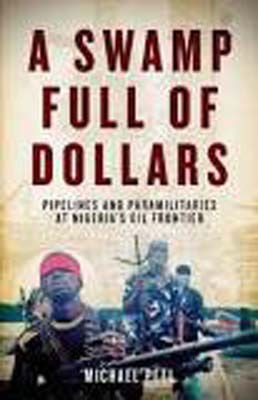
Author Michael Peel offers a 360-degree look at Nigeria, a country he describes as a "brittle motor of 21st-century capitalism." As Peel documents, the root of Nigeria's troubles springs from the ground: oil.
Link Copied
Published on Sep 5, 2009
Source: Financial Times
It is fair to say that Nigeria was born out of convenience. An enormous patchwork of peoples, languages and traditions, it was centralised into a single state in 1914 because doing so made it simpler for Britain to administer its colony. From the beginning, Nigeria was created for the benefit of others. It shouldn’t, therefore, come as a surprise that its success as an independent nation-state since 1960 has been compromised from the start.
Whether referring to the country’s crippling corruption, lawless militants, or the swelling megacity of Lagos, modern Nigeria is synonymous with dysfunction. It is one of the world’s most oil-rich countries but it suffers from occasional petrol shortages. It enjoys billions in oil revenues, but roughly 70 per cent of its people live below the poverty line. For most westerners, a mention of Nigeria prompts a discussion of absurd internet scams. It is as if the avaricious corruption that has seeped into all corners of Nigerian society could not be contained, so it has spilled over into millions of e-mail inboxes.
In A Swamp Full of Dollars, Michael Peel, legal correspondent and former west Africa correspondent for the FT, reveals how our connection to Nigeria’s despair goes far deeper than our e-mail accounts. Although he doesn’t announce it as such, Peel’s book is the story of modern-day globalisation, and he ably explains Nigeria’s predicament in such a way that makes Lagos and London appear much closer than any map will ever indicate. After spending time in west Africa, he writes: “I could see the obscene asymmetry between the smoothness of my oil-fuelled life in Britain and the toxic impact of crude on one of its main source regions.” The uncomfortable and awkward symbiosis between the properly developed and the improperly destitute quickly becomes clear to the reader too.
As Peel documents, through vivid reporting, the root of Nigeria’s troubles springs from the ground: oil. The country’s crude may have offered it vast windfalls but it is simultaneously a curse: when the majority of wealth comes in the form of oil – or just about any other natural resource – the only thing that matters is who controls the tap and how the spoils are divided.
People have little incentive to create, innovate or compete. Local economies and industries fail to develop. Combined with decades of mismanagement and corruption, citizens are reduced to becoming scavengers of an oil-dependent society gone awry. And when the riches are as plentiful as Nigeria’s natural storehouse, locals are hardly the only ones on the take. Indeed, some of the greatest sums have been siphoned off by those who have never set foot there.
Peel’s reporting introduces readers to a rich cast of characters who each play a different part in the country’s oil saga. He travels into the Niger Delta to meet the militants who have diverted millions from foreign-owned pipelines to fuel their own insurgency. He spends time with neighbourhood bullies and bus drivers to show how even the most basic social interactions are contorted by the country’s oil dependency. He sits down with an oil company executive whose rationales and explanations are almost as slick as the commodity he deals in. With colourful reportage and intelligent analysis, he offers a 360-degree look at a country he describes as a “brittle motor of 21st-century capitalism”.
Peel does an admirable job of exploring the oil economy’s global ties that place affluent westerners on the same web as Nigeria’s most downtrodden. Still, learning or being reminded of our interdependence doesn’t curb most people’s ability to imagine Nigeria and its problems as distant, remote and removed. But this, too, may be a luxury set to expire. The west, and increasingly fast-moving economies such as China and India, view Nigeria’s energy resources as an important strategic hedge against the unpredictable political vagaries of the Middle East.
It was no mistake that US secretary of state Hillary Clinton visited both Nigeria and Angola on her trip to Africa last month. These two countries are the largest sources of oil on the African continent, and supply a growing share of American oil imports. But, to paraphrase the author, if Nigeria is part of our insurance against the instability in the Middle East, God help us all. And, as Peel’s book makes clear, if there is any justice, God should start by helping Nigeria.
Carnegie does not take institutional positions on public policy issues; the views represented herein are those of the author(s) and do not necessarily reflect the views of Carnegie, its staff, or its trustees.
As the EU confronts profound challenges, several leaders have called for fundamental reform to the union’s model—but only modest, superficial changes have resulted. What if Europe really could be reimagined from zero today: What should such a redesigned European order look like?
Preparing candidate countries for EU membership is no longer enough. As the enlargement process becomes a reality, the union must also prepare its own societies.
Countries face several hurdles in joining the EU, including the final stage of ratifying their accession treaties. Procedural reforms and substantive adjustments could help move the process forward.
Europe has an interest in supporting Armenian leader Nikol Pashinyan as he tries to make peace with neighbors and loosen ties with Russia. But it is depersonalized support in the long term, not quickfire flash, that will win the day.
Montenegro and Albania are frontrunners for EU enlargement in the Western Balkans, but they can’t just sit back and wait. To meet their 2030 accession ambitions, they must make a strong positive case.