

Article
Marina Ottaway, Omar Hossino
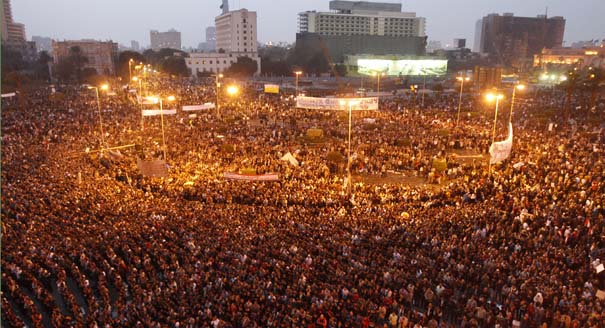
Source: Getty
While the removal from power of Tunisian President Zine El Abidine Ben Ali and Egyptian President Hosni Mubarak were historic moments for the entire Arab world, the old regimes in Tunisia and Egypt are still fighting to retain as much power and control as they can.
The removal from power of Tunisian President Zine El Abidine Ben Ali and Egyptian President Hosni Mubarak were historic moments for the entire Arab world. But the old regimes—the submerged icebergs of personal connections, institutions, and common interests of which the presidents and their immediate entourage were the visible tips—are still there and they are fighting back to retain as much power and control as they can. These are still only the early days of a long process of transition, but it is clear that the battle to disband the regimes will be difficult. In this battle, street protest remains essential.
Early moves by the members of Egypt’s Supreme Council of the Armed Forces suggest that it intends to preserve as much of the regime as it possibly can. It has announced that the present government, composed entirely of Mubarak appointees, will remain in power until the end of a transition period lasting a maximum of six months. It has dissolved the parliament and abrogated the constitution, measures demanded by the opposition because last year’s parliamentary elections were rigged to the point of absurdity and the constitution was designed to protect the regime from real competition and perpetuate its power.
But the military has given no indication that anybody but government-aligned experts will participate in the drafting of the new constitution and has announced that the constitution will be ready in ten days, with a popular referendum to approve it held within two months. This time table does not allow adequate time for a broad process of consultation with the opposition and a period of public discussion over the document. Without consultation and discussion, the popular referendum will be as meaningless as referenda have always been in Egypt. And if elections are held within six months, as the military council has announced, the long-repressed—hence weak—opposition parties will be poorly prepared when voters go to the polls. The plan, in other words, appears carefully designed to limit change, not promote it.
The military will probably be forced to modify its plan. It seems unlikely that opposition parties and protesters will be content to let the military, which is still led by Mubarak loyalists, and the members of a government appointed by Mubarak to govern single-handedly for the next six months and draw up the new rules of the game. But the reforms proposed so far make it clear that the regime wants to hold on.
Tunisia, which is now a month into its transition, offers some inkling of how difficult it is to dismantle a well-implanted regime. As in Egypt, the regime forced the president’s resignation in order to protect itself. The continuity was striking, with Parliament Speaker Fouad Mebaaza, replacing Ben Ali as president and Prime Minister Mohammed Ghannouchi remaining in his position. Most ministers also remained in their previous spots. Attempts to add a few new members—drawn from small opposition parties and trade unions—to the government, did little initially to change the face of the government; in fact, most of the new appointees—including those from the official labor union—resigned.
Ever since that first attempt, members of the old regime have been waging a quiet battle to stay in control while introducing sufficient change to pacify protesters. The president and the prime minister resigned from the ruling Constitutional Democratic Rally (RCD) party almost immediately and eventually all other cabinet ministers carried over from the old government did the same. The RCD’s central committee was disbanded and the party itself was later “suspended.” The government-controlled labor unions federation tried to recast itself as the defender of the rights of workers and protesters, but without renewing its leadership.
A new government was eventually formed, but Ghannouchi remains prime minister and Mebaaza is still president. The process is still ongoing, and it is impossible to know how many additional concessions the regime will have to make before the government takes on a sufficiently new look to become acceptable, but it is clear that the old guard will make as few as it possibly can.
So far, the outcome of the two transitions is disquieting: two presidents were ousted but the old regimes remain. In Tunisia, the former power brokers are still trying to stay in control, making grudging concessions only when they have no choice. In Egypt, all power is now in the hands of an unreformed military establishment.
The removal of Ben Ali and Mubarak has not “bent the arc of history,” as President Obama poetically but prematurely declared—at least not yet. The fight for meaningful change is far from over. And the United States will again face the difficult choice between the false security that comes from supporting old allies made more palatable by a veneer of reformism, and the uncertainty of a real change in regimes that could lead to democracy.

Former Senior Associate, Middle East Program
Before joining the Endowment, Ottaway carried out research in Africa and in the Middle East for many years and taught at the University of Addis Ababa, the University of Zambia, the American University in Cairo, and the University of the Witwatersrand in South Africa.
Recent Work
Marina Ottaway, Omar Hossino
Marina Ottaway
Carnegie does not take institutional positions on public policy issues; the views represented herein are those of the author(s) and do not necessarily reflect the views of Carnegie, its staff, or its trustees.

A notable degree of participative democracy has firmly arrived in Europe. But to have more far-reaching impact, democratic deliberation needs to move into a radically new phase.

Richard Youngs

Before the next wave of EU enlargement takes place, the union needs to grapple with thorny questions of how power is distributed among its members.


Emil Sondaj Hansen, Ditte Brasso Sørensen

As the EU confronts profound challenges, several leaders have called for fundamental reform to the union’s model—but only modest, superficial changes have resulted. What if Europe really could be reimagined from zero today: What should such a redesigned European order look like?
Richard Youngs, ed.

The EU’s new migration policy is not suited to today’s realities. With climate change increasingly becoming a driver of displacement, Europe needs to rethink its deterrence-focused approach.

Shana Tabak
Europe seems to have accepted its sidelining in the Middle East. The EU must reassert its support for the international rules-based order and step up engagement.

Rym Momtaz