

Commentary
The EU can impose sanctions but struggles to enforce them without the United States. With Washington increasingly disinterested in backing European interests, the bloc must now fend for itself.
Nicu Popescu, Tiago Antunes
Source: Getty
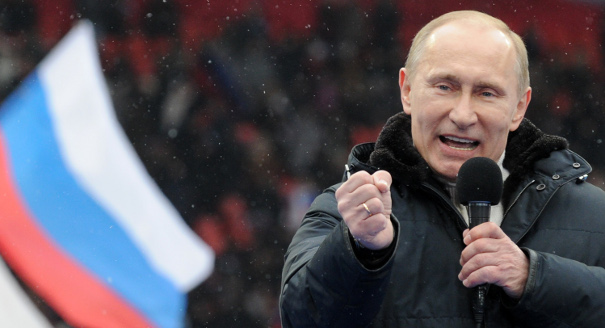
In a series of long articles in Russian-language newspapers, Putin has acknowledged the many political, economic, and social problems facing Russia and outlined his vision for a stronger country.
On March 4, Vladimir Putin will face what is shaping up to be the most significant electoral contest in his twelve years at the top of Russia’s “power vertical.” Although the current prime minister will likely win reelection to the presidency, opponents will almost certainly claim fraud and thousands will take to the streets across Russia as they have done repeatedly in recent months—many even calling for Putin to resign. Putin and his ruling circle have responded to the public protest movement in several different ways—by belittling and insulting protesters, by sponsoring counterdemonstrations, and, perhaps most importantly, by writing.
Putin may be averse to participating in public debates with his opponents, but he has wasted little time putting pen to paper to state his case. In a series of long articles in various Russian-language newspapers, he has openly acknowledged the many economic, social, and political problems facing Russia and has proposed some fairly reasonable ways to address them. Although he is still quite popular across Russia, Putin seems to recognize that he must make at least some concessions and promise some reforms in order to retain the confidence of a majority of voters. His articles are thus a response not just to the recent protest movement but also to the uncertainties and insecurities now felt by ordinary Russians about their country’s future.To help assuage these concerns, Putin is once again running on a familiar platform of restoring and sustaining Russian power. A common theme in his articles is the need for modernization in economic, political, and social spheres. Sounding much like his “tandem” partner, President Dmitri Medvedev, Putin has acknowledged many of the problems that his detractors typically criticize him for ignoring, such as lack of government accountability and transparency, demographic decline, economic stagnation, and technological backwardness. His thinking seems to be that unless Russia removes these obstacles to development, it risks falling behind other great powers and becoming irrelevant in twenty-first-century world politics. As his writings make clear, Putin has an abiding faith in Russia’s unique destiny as a global great power, but he sees himself as the only leader with the comprehensive vision, experience, and willpower necessary to achieve that destiny.
“Russia and the changing world,” Moskovskiye Novosti, February 27, 2012.
In his latest article in Moskovskiye Novosti, Putin reiterates his support for the inviolability of state sovereignty and declares that foreign intervention represents a serious breach of international law. He argues that any attempt to interfere in states’ internal affairs through military intervention or “political engineering” without the support of the United Nations is unacceptable.
Putin is especially critical of Western policy on the “Arab Spring.” In a thinly veiled reference to the recent overthrow of Muammar Qaddafi’s regime, he describes NATO military support for Libyan rebels not as humanitarian intervention but as “outright demagogy.” As evidenced by Russia’s recent veto of a United Nations resolution on Syria, Putin is adamant that a Libya-style scenario should not be repeated.
Furthermore, the West (and the United States in particular) continues to disregard Russia’s concerns about NATO expansion and the threat Russia believes missile defense poses to strategic stability. He concludes that the United States’ desire to achieve “absolute invulnerability” threatens to make other states, like Russia, more vulnerable.
Throughout the article, Putin also lists a number of specific foreign policy priorities for Russia:
“Being strong: National security guarantees for Russia,” Rossiiskaya Gazeta, February 20, 2012.
In a recent article in Rossiiskaya Gazeta, Putin stresses the importance of modernizing Russia’s armed forces and defense industry in order to ensure national sovereignty. Citing the devastating Nazi surprise attack on the Soviet Union in 1941, Putin argues that weakness of any kind can and will be exploited by outside powers to Russia’s detriment. In the face of possible foreign aggression, Russia cannot afford to be unprepared or caught off guard and must therefore revitalize its military-industrial complex to match the capabilities of potential adversaries. Provocations in Russia’s near abroad (for example, the 2004 Orange Revolution) and violations of international law (such as the NATO intervention in Libya) mean that Russia must remain vigilant and seek to prevent further outside intervention.
Putin notes that the once-feeble Russian military that nearly collapsed in the 1990s has since grown into a formidable fighting force, but he also acknowledges the need to strengthen Russia’s strategic deterrence, engage in strategic forecasting, pursue military education reform, and create a “professional contract army.” In short, Russia’s ability to achieve military superiority and maintain a strategic advantage over its opponents is vital to maintaining Russia’s great power status.
Among Putin’s specific recommendations outlined in the article are the following:
“Building justice: A social policy for Russia,” Komsomolskaya Pravda, February 13, 2012.
Putin provides a frank assessment of Russia’s socioeconomic problems in a recent article in Komsomolskaya Pravda. Rather than downplay issues such as poverty and inequality, a poor business environment, and a lack of social mobility, Putin openly admits that “the glaring income disparity is unacceptably high,” “businessmen still lack confidence in our society,” and “our system of social mobility functions badly and inconsistently.” Many Russian citizens, he argues, find it difficult to build successful careers and climb Russia’s social ladder.
Perhaps the greatest threat to Russia’s long-term development, he worries, is its shrinking population. Putin warns that without a large population, Russia cannot maintain control over its own territory and resources and ensure its own sovereignty.
The following are among his suggestions for overcoming Russia’s socioeconomic woes:
“Democracy and the quality of government,” Kommersant, February 6, 2012.
In Kommersant, Putin outlines his plans to “modernize the mechanisms of our democracy” in order to develop more effective, accountable, and transparent governance. He notes, however, that democracy takes time to develop and can backfire if implemented too hastily, as occurred during the chaotic 1990s. On the one hand, Putin appears to support decentralization with his decision to reinstate the direct election of governors, but on the other, he argues that Russia “needs a strong, competent and respectable federal centre acting as the key political stabilising force.”
Putin claims that the demonstrations are tangible evidence of a new and increasingly outspoken middle class that has achieved prosperity under his leadership. Political competition in the public sphere is fine, he argues, as long as it does not turn into a meaningless “political entertainment show.”
Putin includes several other democratization proposals:
“Economic tasks,” Vedomosti, January 30, 2012.
In an article in Vedomosti, Putin envisions the development of a modern and competitive economy that can ensure “stability, sovereignty, and prosperity” and wield influence on the world stage. With a nod to economic modernization, Putin calls for Russia to move beyond a commodity- and energy-based economy and become a leader in scientific research and high-tech innovation.
Putin realizes that resource wealth is a double-edged sword. On the one hand, he argues that natural resources have buoyed Russia’s economy; on the other, he understands that Russia’s continued reliance on oil and natural gas is not sustainable in the long-term. Putin also recommends an overhaul of Russia’s underdeveloped transportation and communication infrastructure in order to better integrate industries located in remote areas of Siberia and the Far East.
He mentions several specific ways to restore Russia’s economic prestige:
“Russia: The Ethnicity Issue,” Nezavisimaya Gazeta, January, 2012.
Putin believes strongly in Russia’s uniqueness as a Eurasian power and a “multiethnic civilization.” Although he often appeals to Russian patriotic nationalism, Putin sees the ethnic chauvinism and xenophobic slogans of extreme nationalists as a threat to the territorial integrity of the Russian state.
At the same time, he proposes that all Russian citizens and temporary residents, regardless of their ethnicity or creed, should express an interest in Russian culture and history, which serve as the “linchpin” holding the state together. As a result, he recommends “subtle cultural therapy” in order to build a unifying national identity and proposes tougher regulations to integrate Russia’s large migrant population into the fabric of society.
Among his specific recommendations outlined in the article are the following:
“Russia muscles up—the challenges we must rise to face,” Izvestia, January 16, 2012.
In an article in Izvestia, Putin makes it clear that Russia has come a long way since the turbulent 1990s and has even prospered during his tenure. People’s standard of living, Putin argues, is now better than it ever was during the Soviet era. He highlights his past achievements—among them the suppression of violent separatism, the establishment of economic stability, and the emergence of a middle class—and criticizes opposition leaders for their failure to propose a concrete agenda for Russia’s future.
He openly acknowledges that Russia faces serious problems, such as poverty and a lack of economic diversification, and declares that these issues must be addressed. Above all, Putin stresses that Russia is no longer a state in transition but a great power once again.
In the article, he also lists several specific recommendations for improving Russians’ lives:
Former Deputy Director, Russia and Eurasia Program
Rojansky, formerly executive director of the Partnership for a Secure America, is an expert on U.S. and Russian national security and nuclear-weapon policies.
Harrison King
Former Junior Fellow, Russia and Eurasia Program
Carnegie does not take institutional positions on public policy issues; the views represented herein are those of the author(s) and do not necessarily reflect the views of Carnegie, its staff, or its trustees.

The EU can impose sanctions but struggles to enforce them without the United States. With Washington increasingly disinterested in backing European interests, the bloc must now fend for itself.


Nicu Popescu, Tiago Antunes

Russia is testing the waters of NATO’s mutual defense clause. What do strikes in Romanian territorial waters mean for the alliance’s posture toward Moscow?

Dimitar Bechev

With its public finances in shambles, the far right polling at 35 percent ahead of the 2027 presidential election, and a growing protest movement, is France’s crisis a threat to the EU’s geopolitical awakening?

Rym Momtaz, ed.

Ahead of a tough winter for Ukraine, Donald Trump’s swing back toward Russia bodes ill. But instead of panicking, Kyiv’s European allies are focusing on action.
Rym Momtaz

Funding Ukraine remains a priority for European leaders. As Russia’s war of aggression heads into another winter, two feasible options to mobilize support for Kyiv should be fast-tracked.


Vladyslav Rashkovan, Gregory P. Wilson