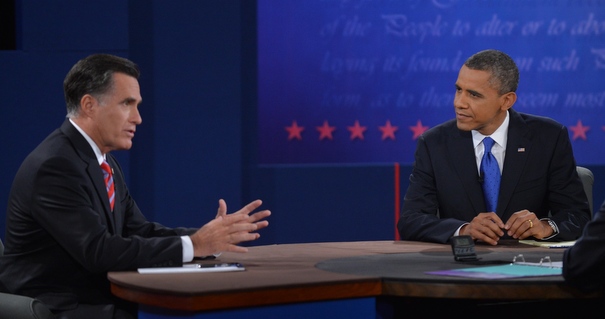
The U.S. presidential election campaign is in full swing, and debate between the two candidates, the incumbent Barack Obama and the Republican challenger Mitt Romney, is certainly heating up. On China policy in particular, the negative rhetoric is not necessarily in line with general sentiments in the country, and it could have long-term consequences.
Many Chinese identify more often with a moderate policy position than with hardline stances. Surveys show similarly reassuring results for Americans. When it comes to China, the majority of Democrats and Republicans agree on the seriousness and substantive nature of bilateral relations with Beijing, but maintain primarily moderate views even if they have different political leanings.
When forming U.S. policy toward China, leaders of both parties could tap into this moderate majority and work across party lines to mobilize support for a more consistent bipartisan consensus to steer the course of future U.S.-China relations. So even with the U.S. presidential election season’s typical “rhetorical excess,” the debate on China policy does not have to lead to “China bashing.” Moreover, once a president is elected and the campaign ends, it is generally argued that the president-elect becomes more pragmatic anyway, shifting China policy away from campaign rhetoric and toward “engaging China” while strategically hedging U.S. bets.
However, the 2012 U.S. presidential campaign has gone beyond “China bashing.” The major presidential candidates are vying to see who can be tougher on China. Romney has vowed that upon taking office, he would immediately label China a “currency manipulator” and would stop “borrowing money” from China. He also condemned Obama for being "a near supplicant to Beijing” and essentially aiding attempts by China to “steal” American jobs. He swore to take China “to the carpet.”
It is not presidential election rhetoric alone that contributes to the antagonistic mood. The Obama administration has taken a number of steps that suggest substantive changes in policy and tone. It has filed two complaints with the World Trade Organization over China’s allegedly illegal subsidies to its automobile industries. After friction between Japan and China flared up over the disputed Senkaku/Diaoyu Islands recently, two U.S. aircraft carriers were dispatched to the western Pacific Rim.
Beyond the administration’s actions, a House of Representatives Intelligence Committee report released in October 2012 said Huawei and ZTE Inc., Chinese global telecommunications companies, are threats to U.S. national security because of their attempts to obtain protected intellectual property and their links to the Chinese government. This elicited a strong response from the Chinese government, calling for redress and even threatening some sort of retaliatory action. If Beijing fights back, it would likely further stir up the China debate in the U.S. presidential election campaign, and fuel more hostility toward China.
This is occurring against the backdrop of the U.S. “pivot” toward Asia, which is poised to become increasingly substantive with regard to the American strategic presence in the region. The United States’ attempt to balance China’s rise has never been stronger. Washington is aware of Chinese efforts to increase its presence in disputed territories. For example, China has established the Sansha military garrison in the South China Sea. This kind of presence is a signal of Beijing’s intent to strengthen its sovereign claims against its Asian neighbors and it might clamp down on the United States’ freedom to navigate in Asia-Pacific waters as broadly construed in Washington.
In the end, there has been no serious China policy debate between the two leading presidential candidates yet. Understandably, foreign policy is not a primary focus in the U.S. presidential election. But without substantive discussion on this issue, the election season’s hostility might well harm U.S. relations with China.
President Obama once clearly stated that the U.S.-China relationship was one of the most important bilateral relationships in the world. It is undeniable that the U.S.-China bilateral relationship is too important to fail. But both sides must come to a mutual understanding, and they must take steps to nurture the ties for the long run. The 2012 presidential candidates need to realize this and cultivate that process rather than letting hostility toward China play out. They must take proactive steps to enhance mutual understanding. In addition, both candidates need to make clear to the Chinese and American general public that no matter how bumpy the path ahead could get for the United States and China, it is possible to build a workable and productive long-term relationship.
The 2012 U.S. presidential campaign has produced neither a serious nor a particularly enlightening discussion of what the United States’ policy toward China should be. A serious policy debate may never emerge from the campaign trail. But most Americans and Chinese do not have set stereotypes of China or the United States, respectively. Chinese and U.S. political leaders have the flexibility to guide public opinion on the other nation in numerous directions. If the rhetoric remains negative, this will likely erode the public support needed to maintain long-term cooperation between Washington and Beijing.
Zhu Feng is the deputy director of the Center for International & Strategic Studies and a professor at the School of International Studies at Peking University.
This article was published as part of the Window into China series.