

Article
Abigail Bellows
Source: Getty
The professionalization of the anticorruption field has produced a cadre of capital-based NGOs with the technical expertise to be formidable government watchdogs. But at what cost?
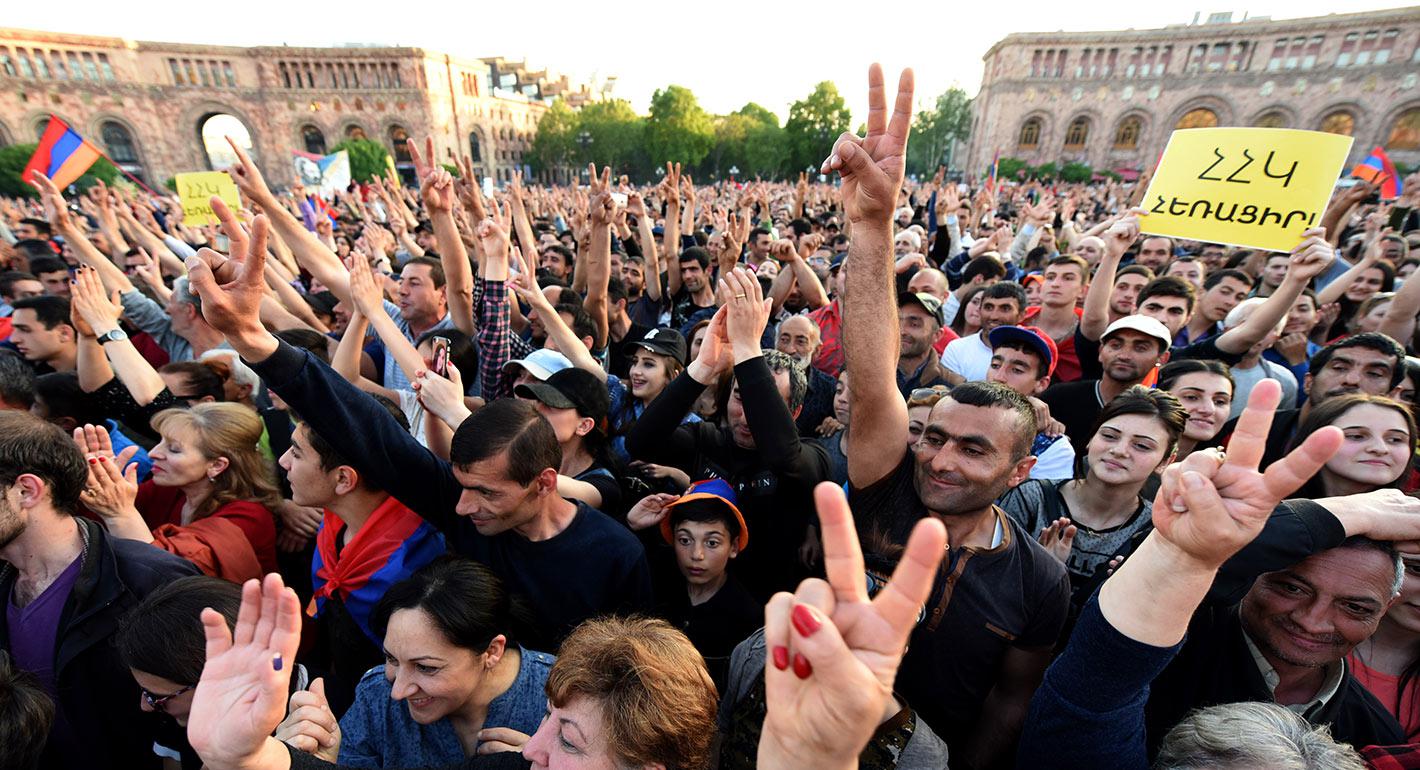
Corruption-fueled political change is occurring at a historic rate—but is not necessarily producing the desired systemic reforms. There are many reasons for this, but one is the dramatic dissipation of public momentum after a transition. In countries like Armenia, the surge in civic participation that generated 2018’s Velvet Revolution largely evaporated after the new government assumed power. That sort of civic demobilization makes it difficult for government reformers, facing stubbornly entrenched interests, to enact a transformative agenda.
The dynamics in Armenia reflect a trend across the anticorruption landscape, which is also echoed in other sectors. As the field has become more professionalized, anticorruption nongovernment organizations (NGOs) have developed the legal and technical expertise to serve as excellent counterparts/watchdogs for government. Yet this strength can also be a hurdle when it comes to building credibility with the everyday people they seek to represent. The result is a disconnect between elite and grassroots actors, which is problematic at multiple levels:
Two strategies can help civil society address this challenge. First, organizations can seek to hybridize, with in-house capacities for both policy analysis and mass mobilization. Alternatively, organizations can build formal or informal coalitions between groups operating at the elite and grassroots levels, respectively. Both strategies pose challenges: learning new skills, weaving together distinct organizational cultures and methodologies, and defining demands that are both technically sound and publicly appealing. In many instances, coalition-building will be an easier road given it does not require altering internal organizational and personnel structures. Political windows-of-opportunity on anticorruption may lend urgency to this difficult task and help crystallize what both sides have to gain from increased partnership.
International supporters can play an important role in advancing civil society alignment on anticorruption. New resources are needed to build domestic constituencies and coalitions—ideally provided in a flexible manner, to a range of groups, over a sustained period of time—and measured by jointly developed metrics. In addition, international actors can provide in-kind training and coaching to NGOs eager to build new partnerships and capabilities, ideally tailored to the governance sector.
Technological change will only intensify the need for greater cohesion in the field. Empowered with new data sources and social media outlets, individual citizens are increasingly assuming the role of corruption watchdog once reserved for professionalized NGOs. This type of expanded public participation can be good but can also amplify calls for quick—and at times superficial—responses to corruption. In this newly cacophonous environment, grassroots NGOs can play a vital role in channeling public engagement toward constructive ends, in partnership with policy organizations that have the technical know-how, historical perspective, and comparative expertise to make the most of growing civic participation.
Public anger at corruption has triggered a remarkable wave of large-scale citizen protests around the world in recent years, from Brazil to South Africa to Puerto Rico to Iraq. In many of these cases, protests have resulted in leadership changes—either ahead of scheduled elections or through elections in which incumbents are punished for their perceived corruption. Between 2013 and 2018, 10 percent of countries in the world experienced corruption-fueled leadership change.1 Yet often, political change and new governing actors fail to produce the systemic reforms and tangible results that protesters seek.
Why do corruption-fueled political transitions often fail to deliver? In some cases, the new government is not genuinely committed to reform but instead flies the anticorruption banner out of political expediency. New leaders come to office by wrapping themselves in the garb of anticorruption reform while actively seeking to profit from public office. This pattern is illustrated by the scandals that have come to plague the presidency of Brazilian President Jair Bolsonaro, who originally ran on an anticorruption platform.2
In many other cases, however, new leaders are genuinely committed to anticorruption reforms—at least initially—but once elected, they prove unable to follow through. They may be daunted by the enormity of the task—disentangling corruption’s stranglehold on state institutions—and opt for superficial reforms or punishing individuals rather than changing systems. They may struggle to build capacity in oversight institutions crippled by years of deliberate neglect, with little help from a fractured and slow-moving donor landscape. Perhaps most commonly, they may be deterred by the powerful domestic actors who benefit from the status quo. As former chair of the Nigerian Economic and Financial Crimes Commission Nuhu Ribadu explained, suspects targeted by law enforcement often “own radio and television stations and newspapers, and can hire the best lawyers,” such that when anticorruption reforms start to work, “corruption fights back.”3
In the face of these challenges, well-intentioned officials need to be able to draw on continued public anticorruption momentum to stand up against entrenched interests. Yet in most cases, citizen movements are not able to adequately provide that independent power base. Too often the protesters who successfully drove leadership changes demobilize as soon as new leadership is in place. Elite, technocratic nongovernment organization (NGOs) focused on the specifics of anticorruption reform are left responsible for holding the government accountable politically. But they typically lack the organizing capacity to do so. How can an alliance between “the wonks” and “the street” be sustained long enough to make lasting change?
This paper examines why the disconnect between “the wonks” and “the street” exists in many countries embroiled in corruption issues and the negative consequences of that division. The paper identifies two strategies for overcoming the divide and offers recommendations for international actors to support anticorruption NGOs in building deeper linkages with the citizens they seek to represent. The paper concludes by noting that technological change will only intensify the need for greater cohesion in the anticorruption field. Throughout, the focus is on cases where there is at least some political will for reform at the leadership level. These are contexts where better alignment within civil society could be the game-changing factor that pushes a teetering governance equilibrium toward a new norm of accountability.
As one critical part of the maturation of the anticorruption field in the last two decades, an increasingly professionalized array of elite anticorruption NGOs has emerged within many countries.4 These organizations, typically based in capitals, boast the requisite legal and technical expertise to support and assess government functions, as well as an international network to draw upon as needed. They play a vital watchdog function and sometimes help build the capacity of local governments.
However, these civil society organizations (CSOs) tend to operate at the elite level and are often disconnected from grassroots stakeholders who have the capacity for mass mobilization (for example, student groups or trade unions). Meanwhile, grassroots communities are well-versed in the patterns of bribery at the local level but do not necessarily see the systemic linkages between different types of corruption. They frequently struggle to identify nuanced and pragmatic policy solutions and lack strong national and international networks.
The gap between elite and grassroots anticorruption groups was reflected in the theme of the Open Government Partnership’s (OGP) 2019 Civil Society Day: “broadening the base.” According to a 2017–18 OGP survey of 900 stakeholders, approximately two-thirds of civil society organizations active in OGP conduct work at the national level, while only one-third work at the local level.5 Across different contexts, civil society leaders expressed concern that the field had become a victim of its own success. In focusing so much on becoming legitimate counterparts to government, elite civil society groups had lost some of their connection to and credibility with the people. Tonu Basu, who leads OGP’s civic space strategy, noted that “many governments have exploited the perceived gap between professionalized NGOs and grassroots communities to delegitimize civil society, portraying it as elitist in contrast to politicians who claim to establish dialogue directly with the people.”6
Recent research in Kenya by the U.S. Institute of Peace highlights a number of these dynamics: “Most professional anti-corruption organizations have a national focus in their change efforts and relatively little two-way engagement with the grass roots. When this engagement does occur, it is often one-way or top-down in the form of information-sharing and civic education initiatives.” Many citizens are aware of these patterns. A nationally representative survey of Kenyans found that “nearly half of the respondents expressed dissatisfaction with the level of effort by CSOs to include grassroots participation.” These cleavages “can make it easier for corrupt officials to pick off individual anti-corruption groups and brand them as agents of the opposition and make galvanizing an already jaded populace more challenging.”7
The gulf between elite and grassroots civil society is not a challenge unique to the anticorruption field. It appears in several areas of civil society activity. A number of civil society projects, like Accountable Now, focus on “constituency-building” with stakeholder communities to strengthen civil society legitimacy.8 CIVICUS’s Resilient Roots initiative invests in making organizations more accountable to their beneficiaries as a way to build their resiliency in a context of increasing government restrictions on civic space.9
However, the anticorruption sector involves several distinctive dynamics that give particular importance and complexity to the elite-grassroots divide. Two of these dynamics make anticorruption a more difficult topic to build grassroots constituencies around, while two other factors tilt toward anticorruption being an easier topic in this regard.
The elite-grassroots gap in anticorruption activism stymies the efficacy of both types of actors. As Mungiu-Pippidi and Johnston note, organizations with clear civic agendas are most effective in achieving anticorruption impact when they work alongside “social clubs, ethnic and neighborhood associations, recreational and hobby groups, and many groups whose reasons for being have little immediate connection to the political world.” These organizations are essential to “produce legitimate grassroots leadership cadres.”15 In turn, grassroots movements gain their strength from representing affected communities. As Shaazka Beyerle finds in her analysis of over twenty-five bottom-up campaigns against corruption, “in virtually every case, the catalysts for the civic initiatives were either already connected to the grass roots or deliberately cultivated relationships with regular people . . . [making] painstaking efforts to establish credibility and trust, thereby building a foundation upon which to engage and mobilize people.”16
A disconnect between elite and grassroots actors can reinforce unhelpful siloes between grand and petty corruption, the capital and rural areas, and advocacy and monitoring efforts—all of which makes it difficult to build critical mass for changing governance norms. Sectoral disunity also has specific negative impacts on professionalized NGOs, grassroots actors, and political reformers.
The elite-grassroots divide often causes elite NGOs to:
Recent dynamics in Slovakia illustrate several of these challenges. Zuzana Wienk, a steering committee member of OGP and founder of the leading Slovak political watchdog NGO Fair-Play Alliance, explained that over the course of her many years in civil society, “we believed that our work was delivering for citizens at large due to the fact that our causes are universal. We did not realize that the tools necessary to advance these causes—access to information, work with open data, legal actions against corruption, and so on—are much more accessible to elites (educated, skilled).” Her team’s intensive focus on applying these technical tools meant that they did not have the energy to, in her words, “broaden our base and find a way how to a) meaningfully involve less educated, marginalized [people] into our causes, b) to provide hope and a positive way out of state capture and corruption.”18
Their lack of grassroots connectivity, plus the frustration that the public felt when faced with the startling corruption that Slovakian watchdog groups had exposed, proved a dangerous combination. Wienk acknowledged that corruption revelations ended up, inadvertently, feeding political extremists in Slovakia, who exploited public outrage to gain power. When civil society pushed back in defense of democracy, Wienk reported, “they started to portray us as foreign traitors who are not genuine and are in the NGO ‘business’ just for good money.”
Wienk acknowledged that these lessons have only emerged with the benefit of time, but he noted, “if I had known the consequences earlier, I would have probably tried much more to balance our efforts by focusing on inclusion and a broader base (both making less educated, marginalized [people a] direct part of the cause [and] finding narratives and using language closer to these constituencies) and also balancing out the watchdogging [role] much more strongly by trying to find ways out to hope and positive solutions.”19
For grassroots organizations and movements, the elite-grassroots divide means that they often:
For government reformers, the divide often leads to:
When political upheavals fail to deliver on their soaring promises, citizens who took to the streets—who dared to hope—may grow cynical about democracy itself. Over time, it becomes harder to entice people into civic participation. Disillusioned and lacking civil society pathways to express their grievances, they become more receptive to the appeal of authoritarian populists. Unified action on corruption during windows of opportunity can be a prevention strategy against civic hopelessness and its dangerous side effects.
Armenia’s recent trajectory encapsulates several of these dynamics. The anticorruption window of opportunity opened by the historic Velvet Revolution in 2018 was driven less by established NGOs and more by informal networks, connected via social media, animated by a charismatic reformist leader, Nikol Pashinyan. But after new leadership took power, public engagement quickly dissipated. Citizens reported, “We did our part. Now the government will do its part.”21 The notion that more work would be required—that even a well-intentioned administration still requires public pressure to uproot corruption, especially in the face of resistance from Russian oligarchs—has proved painful for many to acknowledge. Policy experts and investigative journalists that do acknowledge it can face a backlash from citizens who accuse them of being “anti-revolutionary.” Furthermore, the post-revolution government did not create clear pathways for sustained civic participation, especially by youth—believing in some cases that the activists-turned-bureaucrats now in government could adequately represent the views of civil society. Meanwhile, the pace of reform has slowed.
There are ways to ameliorate this dynamic—methods Armenia’s reformers have belatedly found. Policy groups like Transparency International’s Armenia chapter are investing in youth outreach while youth-led organizations like Article 3 conduct popular education events in rural areas to inform citizens about their rights.22 These sort of bridging functions will be essential to strengthen civil society’s hand in advocating for long-lasting reform. Starting such interventions early could avoid squandering time during a brief political window of opportunity.
Some anticorruption activists are trying to overcome the elite-grassroots divide via two strategies: (a) building hybrid anticorruption organizations, with both policy and organizing capacity, or (b) building coalitions between groups focused on anticorruption policy and groups with existing organizing capacity.
The focus here is on arrangements through which national and local organizations can cooperate in an egalitarian manner rather than a hub-and-spoke model through which a headquarters interacts with its chapters, or a lead organization with its field implementers. Such models do little to level the power imbalance between center and periphery. With an agenda and tone set at the national level, rather than negotiated jointly between national and local levels, these models fail to fully tap into the insights, priorities, and strengths of subnational leaders. The grassroots credibility of such campaigns also falls short, as power clearly rests at the elite level. Given these limitations, this paper focuses on models that build co-equal relationships between grassroots and technical experts, in the service of shared goals.
Hybrid organizations can originate either as organizing groups or policy-focused groups. The former scenario, in which an established people’s organization grows its policy engagement and international networks, is exemplified by Mazdoor Kisan Shakti Sangathan (MKSS), based in the Indian state of Rajasthan.23 Its work on land and wage issues led MKSS to campaign for a Right to Information law, which it successfully won at the national level. MKSS leaders are now internationally renowned in the open government community while remaining rooted in their work on the ground.24
Amarribo, founded in the Brazilian city of Ribeirão Bonito, started in 1999 with a focus on local development issues.25 Soon it became apparent that corruption was a first-order priority. Amarribo shifted its focus to fighting corruption and succeeded in achieving municipal-level reforms. Their success captured the interest of anticorruption campaigners in other cities, and Amarribo now hosts a network of 200 organizations across Brazil in addition to continuing its work in Ribeirão Bonito—thus bridging historic divides between national and local groups.26
A variant on the bottom-up route is organizations that emerge from protest movements, and then professionalize over time—while seeking to retain their activist spirit and public appeal. In Guatemala, the organization #JusticiaYa emerged from unprecedented street protests in 2015, which ultimately toppled then president Otto Pérez Molina’s government.27 It has now transformed into an established organizing collective with campaigns to influence public policy decisions related to corruption alongside sustained political education activities.
The alternative route to hybridization involves a policy group that builds a base of constituents. This top-down route could characterize several Transparency International chapters around the world. In addition, Ukraine’s Anti-Corruption Action Center—which enjoys international renown and has strong policy analysis capability—is now seeking to connect with everyday Ukrainians by building a movement of taxpayers to power their edgy campaigns.28 In Kenya, former UN special rapporteur on the rights to freedom of peaceful assembly and of association Maini Kiai co-directs a community organizing group, InformAction, which uses film to engage communities about rights issues and spark grassroots action.29 And in several OGP member countries, especially at the subnational level, NGOs have started supporting platforms that provide citizens a direct channel to influence and monitor public decision-making, for example where it relates to the delivery of public services intended for them.30
In some instances, authoritarian environments prompt professionalized NGOs to strategically build constituencies to bolster their work. When restrictions on foreign funding were imposed in Russia, the independent media platform 7x7 found itself adversely affected and somewhat isolated from the domestic communities it sought to serve. This prompted 7x7 to deepen its efforts to connect with audiences, which has led to a boost in growth. Now the platform is expanding to new regions. Also in Russia, Agora International Human Rights Group pursues both strategic litigation as well as legal aid to individuals, paired with intensive public outreach efforts, which builds a stable network of citizen supporters to buffer their more politically controversial work.
Organizations seeking to hybridize face a series of questions. Those moving from the bottom up may wrestle with how to gain policy sophistication and a new set of elite relationships while retaining credibility and resonance with everyday people. They may ask questions like: “How can we stay accountable locally? How can we avoid ‘mission drift’ as we seek out new funding and partnerships?” They also may struggle to identify pathways for members to stay meaningfully engaged as parts of the work become more technical. Doing so may require development of clear units within the organization, each with distinct specialties—which can open a new suite of organizational change questions. Some movements seek to hybridize via partisan engagement. That can be a rocky path, as evidenced in the trajectory of Spain’s Podemos movement. It started with an anticorruption street mandate as part of the indignado movement against austerity policies in 2011,31 but in recent years it has struggled to balance institutionalist and activist wings of the party.32
Meanwhile, when policy groups seek to build constituencies around their work, they too face several quandaries:
The second broad strategy for linking technical anticorruption experts with grassroots communities is to form coalitions between existing groups. In her study of anti-corruption “people power,” Beyerle discusses coalitions as follows: “In addition to affording higher levels of participation, protection through numbers (of people), credibility, and legitimacy, such alliances are a font of creativity, ideas, and talent, as well as increased resources, relationships, and contacts—all of which the civic campaign or movement can use.”40
Coalitions can be enduring alliances among organizations or ad hoc structures built around specific campaigns. An example of the latter is detailed by Beyerle.41 In the face of a politicized attempt to undermine Indonesia’s formidable anticorruption commission (known as the KPK) in 2009, anticorruption watchdogs and lawyers based in the capital decided they needed a wide-ranging coalition. Initial members were expert groups such as the Centre for Policy and Law Studies and Indonesia Corruption Watch, but they quickly enlisted the support of women’s groups, student groups, religious communities, organized labor, and more. Ultimately over 100 groups at the national and local levels joined the coalition, and under the banner “Love Indonesia, Love Anti-Corruption Commission” they were able to defend the KPK, at least for a time.
A more recent example comes from the U.S. city of Seattle. A broad coalition frustrated by the corrupting influence of big money in politics succeeded in establishing a public financing program for municipal elections, known as the Democracy Voucher Program.42 Their victory was particularly notable because historically the campaign finance field has been predominately white, technical, and elite—and has often failed to galvanize public attention. Yet in Seattle, democracy advocates were able to form an alliance with grassroots activists from other sectors—education, gun control, workers’ rights—who realized that the outsized influence of corporate spending in elections was standing in their way. By tapping into the self-interest of a broad swath of progressive organizations, the coalition was able to win a historic money-in-politics campaign.
When professionalized anticorruption NGOs seek alliances with grassroots groups, they must first decide which type of partner to pursue. Culturally, it may be easiest to build cross-sectoral NGO coalitions where elite anticorruption organizations partner with NGOs in sectors with more mobilized constituencies—such as healthcare or wildlife trafficking. Alternatively, NGOs may seek to partner with nonpolitical civic institutions whose members are affected by corruption (for example, student associations, religious congregations, trade unions, and regional organizations).
A third option—which poses both the highest risk and highest potential reward—is to cultivate partnerships with a social movement. Movements typically are fluid groupings that emerge in response to politically salient grievances. Depending on the local conditions, they may have a loosely established member base or be a network connected via social media that emerges around a particular event.43
If NGOs can work with movement organizers to harness the power of the crowd to advance strategic demands, the outcomes can be historic. The U.S. civil rights movement, for example, combined established policy/legal organizations such as the National Association for the Advancement of Colored People (NAACP) with a deep bench of grassroots leaders trained in nonviolent action. Yet tensions within the civil rights movement also point to the difficulty of coordination across the NGO-movement divide. Foundations can play an important role in easing these tensions by using their convening power and resources to support coalition-building (while mitigating the risk that fundraising competition among organizations will deepen divisions in the field). In the civil rights case, the Taconic Foundation and Ford Foundation played an important role in convening the Council for United Civil Rights Leadership, which bridged established and grassroots wings of the movement, while Taconic and others supported collaborative initiatives like the Voter Education Project, a joint project of the NAACP, the Student Nonviolent Coordinating Committee, and others.44
One challenge is that a quickly growing movement can become unglued as quickly as it formed, as the salience of the issue fades or resignation sets in. Not all participants will be interested or able to sustain their involvement over the long term, leading some of the protest energy to naturally dissipate.45 Even if the movement endures, its operations may be decentralized, based in rural areas rather than the capital, and driven by volunteers rather than professionals—all of which can produce a culture clash with NGOs. An NGO may need to cultivate individual relationships with movement organizers rather than pursuing a formal coalition structure, or it may work through intermediary organizations that can serve a bridging function. The NGO also may need to navigate generational divides or ethnic and class divisions to build a productive alliance. If these obstacles can be surmounted, technical experts have much to gain from the input of movement organizers and vice versa.
In any form, partnerships between technical anticorruption experts and affected communities face the question of how to scope demands. Too narrow and the demands will not be inspirational; too broad and they will not be achievable.46 Left to their own devices, policy experts might frame demands in strictly technical terms—which may fail to resonate with the public and can also be appeased with superficial fixes that leave the structures of corruption untouched.47 At the same time, movement leaders may face pressure to adopt grandiose demands (“end corruption!”) that are difficult to measure or meet. Even slightly less grandiose demands (“the president must go!”) will likely fail to untangle deep networks of corruption. Working together, technical experts and grassroots communities can carefully calibrate demands that are both concrete and resonant. One possibility is to craft demands that link anticorruption directly to a measurable service-delivery problem, as the International Budget Partnership has done in South Africa by advocating for budget transparency in the context of improved sanitation.48
In all scenarios, participants will have to harmonize organizational cultures as part of building a shared culture for the coalition while guarding the integrity of their individual missions. Parties face the risk of capture or mission drift if they are not clear about the areas of overlap—and divergence—from other coalition partners. Throughout, they must weigh the benefits of coalition work against the costs of coordination.
Naturally, the choice between hybridizing and building coalitions will depend on context. As a general principle, though, existing entities may have an easier time building coalitions than trying to transform their internal structure and personnel to become a hybrid organization, as it can be challenging for a single organization to straddle the different demands (and cultures) of both analyzing policy and organizing people. Even if a policy group succeeds in developing the skills to build grassroots constituencies, the organization may face internal cleavages as different units take on different tones, jargon, dress, and so on. A policy expert from the capital may feel it is beneath him/her to risk rejection by grassroots activists in a rural area, while a rural activist may struggle to “code switch” to relate to policy professionals in the capital. The large gulfs of mistrust between the two communities make this an adaptive challenge—and not just a technical one.49 As such, coalitions are often a more viable strategy.
Whichever method is adopted, aligning policy and organizing efforts requires both sides to adapt their communications. Grassroots organizations may have to increase the nuance with which they talk about corruption and invest in political education on relevant solution sets. Policy organizations may have to shift, as Beyerle puts it, “from abstract exhortations against corruption or legalistic and administrative jargon (too technical and removed from citizens’ lives) to discourse, tactics, and objectives derived from the social and cultural realities of the grass roots in the particular struggle context.”50 This could include identifying clear pathways for citizen engagement, which would ideally be highlighted via “narrative change” campaigns cocreated with affected communities.51
This work is hard in any circumstance. Window-of-opportunity moments may be valuable catalysts for these sorts of partnerships. Granted, the initial burst of protest energy may work against prospects for collaboration, given that newly high-profile movement leaders may be disdainful of elites while technocrats who have worked for years with little public profile may be suddenly disconcerted by their lack of relevance. Yet as protests continue, enlightened movement leaders may see the upside of elevating rigorously considered policy solutions while technocrats recognize the value of tapping into this unprecedented swell of civic energy. Thus, such moments of heightened public attention can be a wake-up call for both parties and lend urgency to the project of civil society alignment.
Of course, in the best case scenario, those partnerships would already be in place long before the political spark is lit—allowing time for the slow process of trust building to unfold. That way, no time would be wasted during the window of opportunity on inward looking civil society dynamics. This points to the need for visionary civil society leaders and donors with the foresight to support alignment efforts before a window opens. In the absence of such planning, high stakes political openings can provide powerful fuel for bridging civil society cleavages.
International actors can take various measures to facilitate greater cohesion among domestic actors confronting corruption:
Technology is accelerating the need to build linkages between elite and grassroots actors.
Expanded internet access and social media connectivity fueled many of the anticorruption success stories that Mungiu-Pippidi and Johnston document.66 One of the earliest examples of crowdsourced anticorruption action yields some lessons about the constructive role technology can play. The website IPaidABribe.com started in the city of Bangalore as a tool to track the market price of bribery in different government services.67 By leveraging technology, it created a pathway for mass public participation, thereby accomplishing something that could not have been achieved by a professionalized NGO alone—identifying hotspots of corruption in local service delivery. The tool was embedded in the ongoing work of the NGO Janaagraha,68 which was able to aggregate public input, combine it with policy expertise, and formulate winning campaigns that reduced corruption and improved public services. The group’s success shows how public participation—enabled by technology—can be paired with policy analysis for unstoppable impact.
While IPaidABribe.com channeled grassroots engagement in a highly targeted manner, technology also enables the sparks of public participation to fly in a much less controlled manner. Institutions that once held a monopoly over watchdog functions or large-scale coordination now risk obsolescence as once-passive citizens are increasingly taking on the role of corruption investigator—and sometimes litigator in the court of public opinion—that was previously reserved for elites. New e-government data sets and leaks from private industry, combined with individual experiences of corruption, offer a panoply of sources for corruption allegations that can be posted on social media with little vetting. In Clay Shirky’s book Here Comes Everybody, he describes this change as “mass amateurization” and notes that “the transfer of these capabilities from various professional classes to the general public is epochal.”69
While Shirky holds an upbeat view of these changes, they could equally present serious challenges. Mass movements may be successful in achieving mass power but fail their cause through a lack of technical know-how while souring activists on the possibility of change. “Amateurs” tend to focus on highly visible manifestations of corruption (either in local service delivery or in the excesses of senior officials), while technical experts may focus on less visible but potentially more costly corruption in procurement or audit functions. In addition, the demands of nonprofessionals tilt toward the dramatic rather than the pragmatic. In the wake of a political transition, for instance, public audiences may focus exclusively on punishing corrupt actors from the past regime while those informed by external lessons might point instead to the harder—but arguably more important—work of preventing future corruption via legal and bureaucratic changes.
In addition, “amateurs” may underestimate the difficulty and duration of transformative anticorruption reforms. This can lead them to conclude the problem is solved by installing a new regime and to be baffled—or even offended—by the attempts of policy NGOs and independent media to hold the new regime to account, as in the Armenia case above. Partnerships between elite and grassroots actors can help manage public expectations about the timeline for reform while mobilizing constituent pressure to keep the pace moving as quickly as possible.
Given the practical and substantive challenges of integrating citizen viewpoints, it is no surprise that many experts are threatened by the public’s encroachment on their domain of expertise and fail to seize the opportunity to channel public interest and capability.70 Yet doing so ignores opportunities for collective action—especially if mass civic participation can be harnessed in an organized way. Moreover, elite NGOs ignore public engagement at their own peril, as remaining isolated can perpetuate accusations that they are irrelevant and illegitimate. Domestically these accusations may be fueled by illiberal populists, while internationally, technocrats seem to be losing favor with donors who are newly excited by social movements. Technology exacerbates these dynamics, as social media amplifies majoritarian instincts in a way that drowns out technical experts.
Taken together, these trends point to the inevitability of a more assertive populace. The question is not if but how anticorruption experts can build bridges with citizen-activists. If they do so deliberately, in partnership with grassroots organizations, and enabled by supportive donors, anticorruption reformers can achieve greater impact.
This paper is made possible by support from the UK Department for International Development. The views expressed herein are those of the author alone.
Abigail Bellows advises philanthropies, governments, and non-profits on accountable governance and civil society issues. An experienced facilitator, she leads trainings and strategy processes in a range of settings as an independent consultant. Previously, Bellows has spearheaded global anticorruption initiatives for the Open Society Foundations and the U.S. Department of State. While in government, she served in the Office of the Under Secretary of State for Civilian Security, Democracy, and Human Rights and as a Special Assistant to the Chairman of the Joint Chiefs of Staff. Bellows began her career as a community organizer and leadership consultant in India and the United States. She is a recipient of the public service fellowship from the Harvard Kennedy School, where she wrote her Masters thesis on foreign bribery. Bellows is a term member of the Council on Foreign Relations.
1 Thomas Carothers and Christopher Carothers, “The One Thing Modern Voters Hate Most,” Foreign Policy, July 24, 2018, https://foreignpolicy.com/2018/07/24/the-one-thing-modern-voters-hate-most-corruption/.
2 David Miranda, “Bolsonaro Says He’s Fighting Corruption. So Why Is He Surrounded By Scandal?,” Guardian, October 28, 2019, https://www.theguardian.com/commentisfree/2019/oct/28/jair-bolsonaro-brazil-paramilitaries-corruption-david-miranda.
3 Nuhu Ribadu, “Nigeria: Corruption Fights Back,” allAfrica, April 18, 2007, https://allafrica.com/stories/200704180743.html.
4 The growth of the anticorruption civil society movement is discussed in José Ugaz, “People’s Power: Taking Action to Demand Accountability,” in “Against Corruption: A Book of Essays,” UK Prime Minister’s Office, https://www.gov.uk/government/publications/against-corruption-a-collection-of-essays/against-corruption-a-collection-of-essays#jos-ugaz-peoples-power-taking-action-to-demand-accountability.
5 “OGP Now: How Is OGP Delivering for Civil Society?,” Open Government Partnership, 2018, https://www.opengovpartnership.org/wp-content/uploads/2001/01/OGP_CS-infographic_2018_ENG.pdf.
6 Tonu Basu, written correspondence with author, October 29, 2019.
7 Hussein Khalid and Tabatha Pilgrim Thompson, “Conflict Prevention in Kenya: Combating Corruption through Nonviolent Action,” United States Institute of Peace, September 2019, https://www.usip.org/sites/default/files/2019-09/sr_456-conflict_prevention_in_kenya_combating_corruption_through_nonviolent_action-sr.pdf.
8 “CSO Accountability: Why and How Should CSOs Effectively Engage Stakeholders to Increase Their Impact?,” Accountable Now, February 7, 2019, https://accountablenow.org/webinars/cso-accountability-gpsa/.
9 “Resilient Roots,” Civicus, accessed November 6, 2019, https://www.civicus.org/index.php/what-we-do/innovate/resilient-roots.
10 Shaazka Beyerle and Davin O’Regan, “Fiscal Futures: Overcoming Hurdles to Citizen Activism for Fiscal Governance,” International Budget Partnership, April 17, 2019, https://www.internationalbudget.org/2019/04/fiscal-futures-citizen-activism-for-fiscal-governance/.
11 See Duncan Green, “How to Talk About Corruption When It’s Everywhere, but Invisible?” From Poverty to Power (blog), October 28, 2019, https://oxfamblogs.org/fp2p/how-to-talk-about-corruption-when-its-everywhere-but-invisible/.
12 See “Global Corruption Barometer,” Transparency International, accessed December 10, 2019, https://www.transparency.org/research/gcb.
13 Alina Mungiu-Pippidi and Michael Johnston, Transitions to Good Governance (Cheltenham, UK: Edward Elgar Publishing, 2017), 261.
14 Nancy Birdsall, “Middle Class Heroes,” Center for Global Development, 2016, https://www.cgdev.org/publication/ft/middle-class-heroes-best-guarantee-good-governance.
15 Mungiu-Pippidi and Johnston, Transitions to Good Governance, 261.
16 Shaazka Beyerle, Curtailing Corruption (Boulder, CO: Lynne Rienner Publishers, 2014), 248.
17 Jonathan Watts, “Anti-World Cup Protests in Brazilian Cities Mark Countdown to Kick-Off,” Guardian, June 12, 2014, https://www.theguardian.com/football/2014/jun/12/anti-world-cup-protests-brazilian-cities-sao-paulo-rio-de-janeiro.
18 Zuzana Wienk, written correspondence with author, November 6, 2019. See her biography at https://www.opengovpartnership.org/people/zuzana-wienk/.
19 Ibid.
20 “Why Being a Mayor in Mexico Is So Dangerous,” Economist, May 5, 2018, https://www.economist.com/the-americas/2018/05/05/why-being-a-mayor-in-mexico-is-so-dangerous.
21 Based on the author’s discussions with a range of civil society and media representatives during trips to Armenia in March 2019 and November 2019.
22 Based on the author’s conversations with these organizations in March 2019 and November 2019.
23 “About Us,” Mazdoor Kisan Shakti Sangathan, accessed November 6, 2019, http://mkssindia.org/about/.
24 “OGP Envoys,” Open Government Partnership, accessed November 6, 2019, https://www.opengovpartnership.org/ogp-envoys.
25 “Historia,” AMARRIBO Brasil, accessed November 6, 2019, https://amarribo.org.br/a-amarribo.
26 Mariella Di Ciommo, “Transparency in Brazil,” Development Initiatives, March 2015, http://devinit.org/wp-content/uploads/2015/03/Transparency-in-Brazil_briefing_March-2015.pdf.
27 “¿Quiénes somos?,” JusticiaYa, accessed November 6, 2019, https://justiciaya.gt.
28 “About Us,” Anticorruption Action Centre, accessed November 6, 2019, https://antac.org.ua/en/pro-nas.
29 “About Us,” InformAction, accessed November 6, 2019, https://informaction.tv/index.php/about-us.
30 Tonu Basu, written communication with author, October 29, 2019.
31 Giles Tremlett, “Podemos Was the Dazzling New Force in Spanish Politics. What Went Wrong?,” Guardian, February 19, 2019, https://www.theguardian.com/commentisfree/2019/feb/19/podemos-spanish-politics.
32 Richard Youngs, Civic Activism Unleashed (New York, NY: Oxford University Press, 2019), 78.
33 Erica Chenoweth and Maria J. Stephan, Why Civil Resistance Works: The Strategic Logic of Nonviolent Conflict (New York: Columbia University Press, 2011).
34 Sarah Chayes, “Fighting the Hydra: Lessons from Worldwide Protests Against Corruption,” Carnegie Endowment for International Peace, April 2018, 14, https://carnegieendowment.org/2018/04/12/fighting-hydra-lessons-from-worldwide-protests-against-corruption-pub-76036.
35 Mark Engler and Paul Engler, “Would You Like Some Structure With Your Momentum?” Beautiful Rising, accessed September 3, 2019, https://beautifulrising.org/tool/would-you-like-some-structure-with-your-momentum.
36 “About Momentum,” Momentum, accessed November 6, 2019, https://www.momentumcommunity.org/about-momentum.
37 “What We Do,” Leading Change Network, accessed November 6, 2019, https://leadingchangenetwork.org/what-we-do/.
38 Ana Babovic , Skype interview with author, June 12, 2019.
39 Karina Grinstein, interview with author, July 12, 2019.
40 Beyerle, Curtailing Corruption, 250.
41 Beyerle, Curtailing Corruption, 92.
42 Gregory Scruggs, “Can Small-Money Democracy Vouchers Balance Out Big-Money PACs in Seattle’s Municipal Elections?,” Next City, accessed November 6, 2019, https://nextcity.org/daily/entry/can-small-money-democracy-vouchers-balance-out-big-money-pacs-in-seattle.
43 Clay Shirky refers to this as a “latent group” in his book Here Comes Everybody (New York, NY: Penguin Group, 2008), 38.
44 Sean Dobson, “Freedom Funders: Philanthropy & the Civil Rights Movement 1955-1965,” National Committee for Responsive Philanthropy, June 2014, https://www.ncrp.org/wp-content/uploads/2016/11/Freedom_Funders_and_the_Civil_Rights_Movement-FINAL.pdf.
45 Further discussion of these dynamics can be found in Tom Carothers and Richard Youngs, “The Complexities of Global Protests,” Carnegie Endowment for International Peace, October 2015, https://carnegieendowment.org/2015/10/08/complexities-of-global-protests-pub-61537.
46 Shirky, Here Comes Everybody, 18.
47 Further discussion of these dynamics can be found in Chayes, “Fighting the Hydra,” including an example from Lebanon’s 2015–2016 anticorruption demonstrations, in which the government was able to meet protesters’ narrow demands—on trash collection—without having to make fundamental reforms.
48 Dustin Kramer, “Budgeting for Decent Sanitation in South African Townships,” International Budget Partnership, July 20, 2017,
49 Ronald A. Heifetz, Alexander Grashow, and Martin Linsky, The Practice of Adaptive Leadership: Tools and Tactics for Changing Your Organization and the World (Boston, MA: Harvard Business Press, 2009).
50 Beyerle, Curtailing Corruption, 251.
51 “What Is Narrative?,” Narrative Initiative, accessed November 6, 2019, https://narrativeinitiative.org/what-is-narrative/.
52 Maria Di Mento, “Five CEOs of Wealthy Foundations Pledge to Do More to Help Charities Pay Overhead,” Chronicle of Philanthropy, September 4, 2019, https://www.philanthropy.com/article/5-CEOs-of-Big-Foundations/247063?utm_source=pt&utm_medium=en&cid=pt&source=ams&sourceId=4831954.
53 Jean Scrimgeour, “Accountability Is Expensive—The Cost(s) of Being Small & Accountable,” Accountability Lab, October 7, 2019, http://www.accountabilitylab.org/accountability-is-expensive-the-costs-of-being-small-accountable/.
54 Nicola Banks and David Hulme, “The Role of NGOs and Civil Society in Development and Poverty Reduction,” Brooks World Poverty Institute, University of Manchester, BWPI Working Paper 171, June 2012.
55 Solome Lemma, “Moving With Movements,” Thousand Currents, March 2019, https://thousandcurrents.org/wp-content/uploads/2019/03/Moving_with_Movements_Alliance.pdf.
56 Davin O’Regan, “Donor Assistance in the Transparency and Accountability Movement,” United States Institute of Peace, September 24, 2019, https://www.usip.org/index.php/publications/2019/09/donor-assistance-transparency-and-accountability-movement.
57 Khalid and Thompson, “Conflict Prevention in Kenya.”
58 Duncan Green, How Change Happens (Oxford, UK: Oxford University Press, 2016), 249.
59 O’Regan, “Donor Assistance in the Transparency and Accountability Movement.”
60 Dave Beckwith, et al., “Making a Way Forward: Community Organising and the Future of Democracy in Europe,” Ariadne and European Community Organizing Network, March 2015, https://www.ariadne-network.eu/wp-content/uploads/2015/03/Making-a-way-forward-Community-Organising-and-the-Future-of-Democracy-in-Europe.pdf.
61 Phil Mason, “How 4 Shifts in Thinking Could Transform the Battle Against Corruption,” Transparency International, July 17, 2019, https://voices.transparency.org/how-4-shifts-in-thinking-could-transform-the-battle-against-corruption-c5cdc35542da.
62 Nikhil Dey, “Fiscal Futures: When the People Demand Transparency for Accountability,” Transparency and Accountability Initiative, April 15, 2019,
63 Beyerle, Curtailing Corruption, 248.
64 “Five Things You Need to Know About Foreign Funding for Social Movements,” United States Institute of Peace, June 24, 2019, https://www.usip.org/publications/2019/06/five-things-you-need-know-about-foreign-funding-social-movements.
65 “Reimagining Civil Society,” Rights CoLab, Accessed November 6, 2019, https://rightscolab.org/civil-society/.
66 Mungiu-Pippidi and Johnston, Transitions to Good Governance, 250.
67 “About I Paid a Bribe,” IPaidABribe, accessed November 6, 2019, http://ipaidabribe.com/about-us#gsc.tab=0.
68 “Janaagraha – I Paid a Bribe,” Janaagraha Centre for Citizenship and Democracy, accessed November 6, 2019, http://www.janaagraha.org/i-paid-a-bribe/.
69 Shirky, Here Comes Everybody, 55, 17.
70 Shirky, Here Comes Everybody, 69.
Former Nonresident Scholar , Democracy, Conflict, and Governance Program
Abigail Bellows was a nonresident scholar in the Democracy, Conflict, and Governance Program at the Carnegie Endowment for International Peace
Recent Work
Abigail Bellows
Abigail Bellows
Carnegie does not take institutional positions on public policy issues; the views represented herein are those of the author(s) and do not necessarily reflect the views of Carnegie, its staff, or its trustees.
The battle over free speech has taken center stage since U.S. Vice President JD Vance accused Europe of censorship. From travel bans to social media regulation, especially around the Israel-Palestine conflict, are liberal democratic governments weaponizing free speech?

Rym Momtaz, ed.

Preparing candidate countries for EU membership is no longer enough. As the enlargement process becomes a reality, the union must also prepare its own societies.

Iliriana Gjoni

Five countries staged the biggest political boycott in Eurovision history over Israel’s participation. With the FIFA World Cup and other sporting or cultural touchstones on the horizon, are boycotts effective?
Rym Momtaz, ed.
Countries face several hurdles in joining the EU, including the final stage of ratifying their accession treaties. Procedural reforms and substantive adjustments could help move the process forward.

Stefan Lehne
Europe has an interest in supporting Armenian leader Nikol Pashinyan as he tries to make peace with neighbors and loosen ties with Russia. But it is depersonalized support in the long term, not quickfire flash, that will win the day.

Thomas de Waal