

Paper
Federica D’Alessandra
Source: Getty
Assessing U.S. compliance with the international laws of war is essential at a time when these frameworks are already fraying.
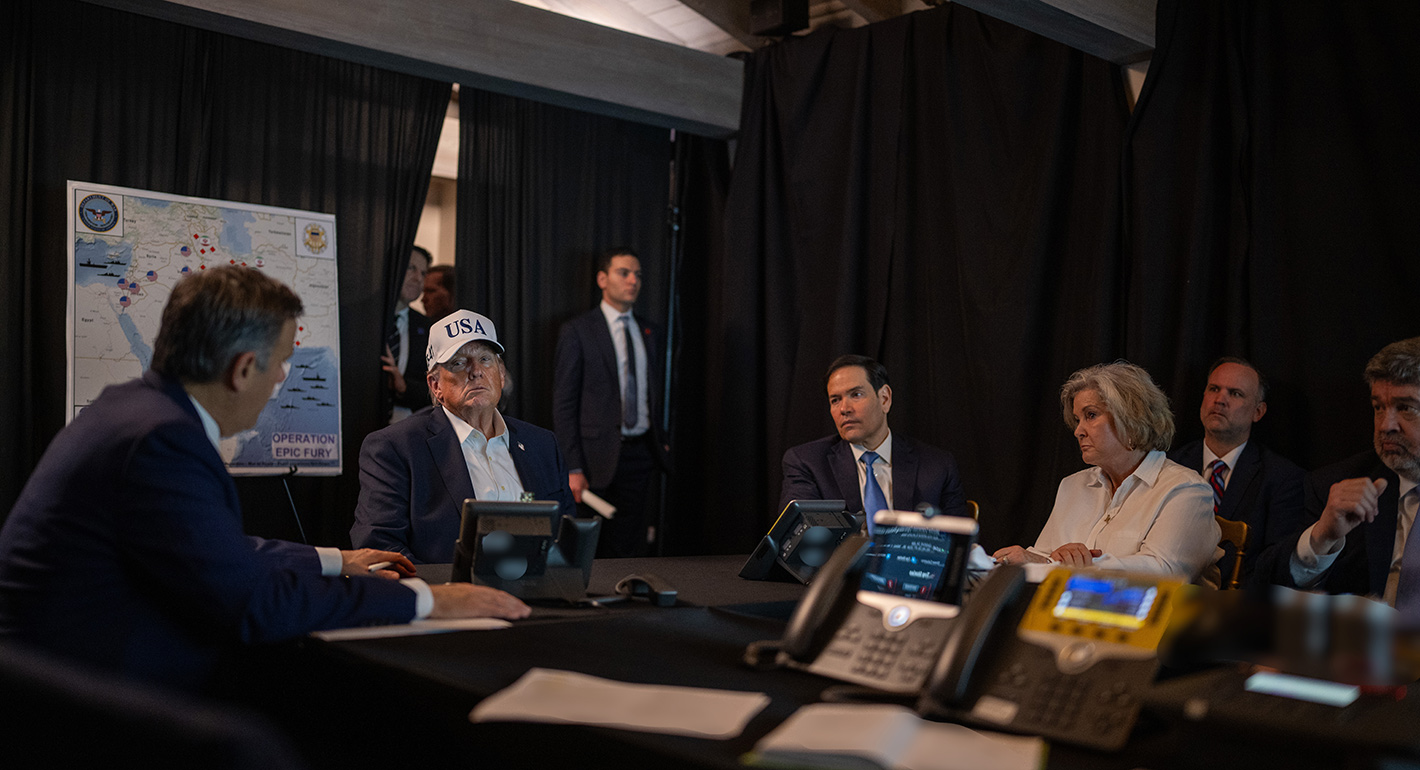
The latest U.S.-Israeli joint military campaign against Iran—codenamed Operation Epic Fury in the United States and Roaring Lion in Israel—was launched on February 28, 2026, with no end in sight. The opening salvo killed Iran’s Supreme Leader Ayatollah Ali Khamenei, prompting Iran’s indiscriminate retaliation against U.S. assets and allies in the region, including states not participating in the conflict such as Kuwait, Qatar, Saudi Arabia, and the United Arab Emirates, among others—stretching as far as Azerbaijan, Cyprus, and Türkiye.
The campaign has upended the global economy by closing crucial commercial air and sea corridors, causing oil and energy prices to skyrocket. It is reportedly costing U.S. taxpayers billions of dollars per day, and that cost is likely to increase further. At least thirteen U.S. servicemembers have been killed, with many more injured, and nearly 2,000 people have lost their lives throughout the region, which has been thrown into renewed turmoil.
On Capitol Hill, questions have swirled around the objectives and indeed legality of the campaign, which some officials insist does not qualify as “war” for the purposes of U.S. law. The U.S. Senate and House of Representatives have each held votes on war powers resolutions that would curb the war, which President Donald Trump initiated without congressional authorization. All have been narrowly defeated thus far.
With some notable exceptions, less attention has been paid to the international law dimension, at least in domestic U.S. debates. This is perhaps unsurprising, inasmuch as both Trump, as well as many administration officials and lawmakers, seem to believe that international law is immaterial or irrelevant to U.S. conduct on the global stage, particularly when it comes to the use of military force. Nevertheless, it remains critical from both a domestic and global perspective to reflect on the international legal foundations—or lack thereof—for Operation Epic Fury.
Despite the administration’s sanctioning of some international organizations crucial for the development and implementation of international law, and its imprudent withdrawal from others, including the UN International Law Commission, international law remains a core aspect of the legal framework binding on the United States.
This is particularly true for international laws regulating armed conflict, including jus ad bellum, governing states’ rights to resort to war, and jus in bello, regulating the conduct of hostilities. Indeed, both the U.S. government and U.S. military have a long and sustained track record of engagement with both bodies of law, which are unequivocally relevant to ongoing U.S. military operations, regardless of what Secretary of Defense Pete Hegseth might say on the matter.
Maintaining a focus on U.S. compliance with the international laws of war is essential as an operational matter in any U.S. military campaign, and as a matter of domestic oversight and accountability. It is even more important from a normative standpoint, in view of the legal precedent that U.S. conduct might set and its broader implications at a time when these crucial frameworks are already fraying.
Finally, paying attention to U.S. compliance with international law is important from a geopolitical perspective. At a time when international legal restraints appear to be eroding at unprecedented pace, revisiting international standards on the use of armed force is both urgent and imperative. If these restraints continue to erode, it will only further inflame geopolitical hotspots, with catastrophic implications for global stability.
This paper focuses on jus ad bellum—or that is, international law governing the recourse to force—which is being extensively (though not exclusively) ignored or contested in the Trump administration’s recent military campaigns, including in Iran, Venezuela, and potentially elsewhere. Jus ad bellum is primarily codified in the Charter of the United Nations, which is unequivocally binding on the United States, although its core principles, including the prohibition on the use of force among states and states’ right to self-defense, are also firmly established as customary international law binding on all states. The UN Charter prohibits the threat or use of force against another state (art. 2(4)) unless that use of force is authorized by the UN Security Council (art. 42) or is a necessary and proportionate act of individual or collective self-defense in response to an armed attack (art. 51).
Importantly, when states do resort to force in self-defense, they are required (art. 51) to provide a compelling legal justification for their use of force to the UN Security Council (UNSC), explaining how this action falls within one of the permissible grounds for exception. The burden of doing so unequivocally falls on the state using force.
The issue of whether the joint U.S.-Israeli campaign against Iran qualifies as “war” has been a heated topic of discussion among U.S. lawyers and policymakers, chiefly due to the implications this would have for the campaign’s legality under U.S. law. Although the U.S. Constitution confers Article II powers on the president as the commander-in-chief of the U.S. armed forces, Article I, Section 8, Clause 11 of the Constitution grants the U.S. Congress the sole power to formally declare (that is, authorize) war. The intent is to avoid placing in the hands of a single executive the authority to commit the whole nation to war. Nevertheless, there remains considerable debate on the scope of the president’s authority to use military force in the absence of congressional authorization. As reflected in a series of opinions by the Justice Department’s Office of Legal Counsel, the executive branch under both Republican and Democratic administrations has taken a broad—and ever expanding—view of the president’s Article II authority to unilaterally initiate the use of force if this is “in the national interest,” and if the use of force does not constitute “war in the constitutional sense.”
In 1973, in the context of the Vietnam War, the 93rd U.S. Congress also passed a War Powers Resolution setting important limitations on the president’s ability to conduct military operations in the absence of explicit congressional authorization. The law mandates that the president’s constitutional authority to introduce U.S. armed forces into hostilities, or situations where involvement in hostilities is imminent, may only be exercised pursuant to a congressional declaration of war, specific statutory authorization—such as an Authorization on the Use of Military Force, or AUMF (which does not exist in the situation at hand)—or a national emergency created by an attack on U.S. territories or the U.S. military. Moreover, were the executive to initiate hostilities on any such grounds, the law requires that military operations be terminated after a sixty-day period unless Congress authorizes their continuation.
As experts have long pointed out, however, the current state of U.S. law on the use of force abroad is extremely permissive of unilateral action by the executive, and has often resulted in U.S. lawmakers skirting their congressional responsibilities on the issue. This has lowered the threshold for the use of force by the executive and created the conditions for the “endless wars” that have ensnared the nation, particularly since the September 11 attack. In this light, it is no surprise that domestic debates on the legality of the campaign against Iran have focused as much on the rationales the president and his administration have provided for initiating hostilities as they have on the question of whether the campaign constitutes a “war in the constitutional sense.”
Nonetheless, the issue of whether the Iran campaign is a war is crystal clear from an international law perspective. Under Common Article 2 of the 1949 Geneva Conventions, the existence of an international armed conflict is a question of fact. Common Article 2 states that “the present Convention shall apply to all cases of declared war or of any other armed conflict which may arise between two or more of the High Contracting Parties, even if the state of war is not recognized by one of them.” In its guidance on how a situation of armed conflict is defined in international law, the International Committee of the Red Cross clarifies that situations of armed conflict are “a de facto state of hostilities dependent on neither a declaration nor recognition of the existence of “war” by its parties.” In other words, if there are hostilities between states, there is an international armed conflict, even if one of them does not formally recognize its existence.
The United States, Iran, and Israel have all ratified the four Geneva Conventions, so are bound by Common Article 2 as a matter of treaty law. Even if that were not the case, Common Article 2 is universally accepted as reflective of customary international law. Thus, for the purposes of international law, the United States, Israel, and Iran are currently at war and, as of the launch of Operation Epic Fury, all three are parties to an international armed conflict, regardless of how this might be classified under the U.S. domestic legal framework.
The administration’s rationale for the war has shifted over time. For this reason, it has come under growing pressure to articulate not only a coherent rationale but also a clear strategy and military objectives, including how the war is expected to end. That is unsurprising, since decades of U.S. military involvement in the Middle East have cost trillions of U.S. dollars, thousands of American lives, hundreds of thousands of civilian casualties in the region, and negative implications for regional and global stability. Indeed, Trump campaigned both in 2016 and in 2024 promising to “end endless wars” started by his predecessors and that “no new wars” would be started on his watch.
Of course, Trump is not the first, nor likely to be the last, U.S. president to vow to be a peacemaker, only to find himself enmeshed in war. Still, Trump has shown greater propensity than his post-Cold War predecessors for the unilateral use of military force abroad in a way that has often skirted, and even flat-out ignored, the constraints of both domestic and international law.
When asked about the war’s rationale and objectives, the administration has put forward various, often conflicting, explanations. These arguments can be grouped into three categories:
According to the administration, threats have ranged from Iran’s nuclear program, its force projection and strike capabilities, its proxy terrorist network, and other Iranian policies and practices hostile to both the United States and Israel.
As I will discuss further, however, while these are real and persistent threats, the mere existence of a threat is not sufficient to satisfy the international legal standards of self-defense, particularly when force is used anticipatorily, as these require the threat to be imminent. It should also be noted that assessments of legality do not solely rest on the legal justifications that are put forward in a given context, but equally on how that justification adds up to the facts on the ground.
Since February 28, the administration has provided little factual (and often contradictory) information to support its claims. Furthermore, it appears that the justifications provided by the administration have at times been at odds both with U.S. intelligence and how the U.S. military is carrying out operations, raising additional questions about what might actually constitute U.S. policy and strategy, as opposed to rhetoric.
For this and other reasons, most of the purported motivations for the war are not considered valid legal justifications by the majority of international law experts. Moreover, some have clearly stated that U.S. strikes against Iran constitute international aggression. Still, it is worth scrutinizing these various legal justifications, and considering potentially applicable legal standards, to seek more clarity on the U.S. government position, and to raise other important considerations.
When states use force unlawfully against the sovereignty, territorial integrity, or political independence of another state, they commit an act of international aggression, giving rise to the legal responsibility of the aggressor state. This triggers the state’s obligation to cease its conduct, ensure non-repetition, and provide restitution, compensation, or satisfaction to injured parties.
The prohibition against aggression is a peremptory norm of international law (jus cogens) applying equally to all states and is considered an erga omnes obligation that states owe to the international community as a whole. For this reason, a breach of the prohibition against aggression also gives rise to legal obligations on the part of all other states, including not to assist the aggression, not to recognize as lawful any situation arising from the aggression, and to cooperate to bring the aggression to an end through lawful means available to them.
In addition, certain forms of international aggression give rise to individual criminal liability. Although the notion of interstate aggression as an international crime has long been controversial, the “planning, preparation, initiation or waging of a war of aggression” has been recognized as an international crime ever since Axis leaders were tried and convicted for “crimes against peace” (as aggression was then known) at the Nuremberg and Tokyo tribunals set up by the United States and its allies after the end of World War II. Although there have been no prosecutions for the crime of aggression at the international level since those tribunals, international law is clear that, consistent with U.S. policy on the issue, individual criminal liability arises only when international aggression is committed in the context of large-scale military operations comparable to a war (as opposed to border skirmishes, or more targeted operations). Furthermore, it can only be incurred by high-ranking officials (leaders or policymakers, whether military or civilian) with the power to direct their state’s military forces.
Notably, the U.S. government has long opposed definitions of the crime of aggression that might either restrict certain forms of military action (for example, self-defense against terrorist groups operating in the territory of another state, or targeted military action for humanitarian or other purposes), or that might interfere with the discretion of the UNSC’s primary responsibility for international peace and security under the UN Charter. Fear of exposing U.S. officials to criminal liability for aggression has, nevertheless, been a longstanding concern in Washington. It is one of the reasons why the jurisdictional regime of the International Criminal Court is extremely narrow, explicitly excluding nationals of non-state parties (art.15 bis (5)), such as the United States.
Initially, U.S. threats to use military force against Iran appeared to be tied to the Iranian government’s violent crackdown on anti-government protests in January 2026. As repression of Iranian protesters intensified, for instance, Trump promised them that “help was on its way.” To the disappointment of many protesters and members of the Iranian diaspora, however, that help was not forthcoming. Human rights monitors have reported more than 7,000 people (and perhaps as many as 30,000) were killed since the protests began. This however does beg the question of whether the United States would, in fact, have been entitled to use force against Iran to stop its crackdown on protesters as a matter of jus ad bellum.
Forcible interventions by a state or group of states into another state to stop it from killing people en masse—or otherwise committing atrocities—on its territory are commonly, if contentiously, known as humanitarian interventions. Albeit to protect the neutrality principle that is a pre-condition to their work, humanitarian actors suggest that a better phrase to describe such efforts would be armed interventions for human protection purposes.
Even though UN member states in 2005 made a global political commitment to prevent atrocities, including by intervening when necessary in the territory of another state—known as the Responsibility to Protect norm—the prevailing view among both states and international law experts is that any such intervention in the territory of a nonconsenting state can only lawfully occur under UN Security Council (UNSC) authorization (as was the case in Somalia in 1992 and 1993, in Sudan in 2005 and 2006, and in Libya in 2011).
Support for an exception to the prohibition on the use of force based on humanitarian intervention has somewhat grown over time, particularly as the UNSC became gridlocked on all matters relating to human protection and prevention objectives, as well as accountability matters. For instance, in the context of the Syrian civil war, the United Kingdom took the position that such measures are “permitted under international law, on an exceptional basis” when “there is convincing evidence, generally accepted by the international community as a whole, of extreme humanitarian distress on a large scale, requiring immediate and urgent relief.” (See 2018 Policy paper on Syria action – UK government legal position, para. 3(i).)
In such cases, however, there must be “no practicable alternative” to using force to save lives (ibid., at 3(ii)), and “the proposed use of force must be necessary and proportionate to the aim of relief of humanitarian suffering and must be strictly limited in time and in scope to this aim (i.e. the minimum necessary to achieve that end and for no other purpose)” (ibid., at 3(iii)).
Still, the position that there is a customary international law norm permitting unilateral humanitarian intervention remains an outlier. Accordingly, unilateral humanitarian interventions, such as the one Trump appeared to suggest in January, are still considered to violate the UN Charter’s article 2(4) prohibition on the use of force. That might be tragic, but it remains true even in the face of Iran’s condemnable, deadly suppression of protests, as well as any other act of domestic repression of which it has been responsible under the current theocratic leadership.
It is also worth mentioning, as many states, scholars, and analysts have noted, that the notion of humanitarian intervention is controversial because it is widely recognized as a slippery slope highly susceptible to manipulation, as well as selectivity in application. The recent history of such interventions is, in fact, not particularly reassuring. The justification has often been invoked as a cover for international aggression as well as regime change, even when the latter was not the stated objective. An example of such abuse is (part of) Russia’s stated casus belli against Ukraine in 2022. As in its illegal annexation of Crimea and occupation of the Donbass in 2014, the Kremlin offered a baseless assertion that Ukraine was committing genocide against ethnic Russians in its eastern oblasts, thus forcing its hand into a humanitarian intervention to protect them.
When it comes to issues relating to human protection, the UNSC’s current paralysis has resulted in repeated failures to prevent the mass slaughter of civilians.
Of course, when it comes to issues relating to human protection and prevention objectives, the UNSC’s current paralysis has resulted in repeated failures to prevent the mass slaughter of civilians in countless situations. Those failures might drive renewed discussions around unsanctioned, genuine humanitarian interventions, and under what parameters these might be considered lawful under the jus ad bellum.1 Nevertheless, in light of the above, it is no wonder that many have expressed concern about the consequences that the norm would engender if implemented more widely. As renowned international law experts noted recently, “the very risk that humanitarian intervention may be a subterfuge for interference in another state’s affairs is what renders the doctrine unacceptable to many states.”
Leaving legality aside for a moment, additional considerations are in order. This purported rationale for U.S. intervention does not stand up to scrutiny, at least as a primary U.S. objective. Had it been so, the nature and time frame of U.S. military operations would arguably have been different.
Iran’s atrocities against protesters reached their peak a month before U.S. strikes began. While it obviously takes time to move military assets to the region from other theatres (which raises concerns for U.S. lawmakers when it comes to overall U.S. posture and military readiness), and while true that the regime’s vicious repression persists to this day, the desire to protect protesters from imminent danger could not be the motivation for the war. In fact, as other experts have pointed out, the administration’s “claimed concern for the protesters faded so quickly, only to be replaced by pressure to accept U.S. demands in nuclear-related negotiations”—and later demands of regime change—that it is hard to take seriously the purported humanitarian motivations for the intervention.
If one wants to take at face value the notion that Iran’s killing of protesters played any role in the president’s decision to use force, it seems more likely that the purpose was to punish Iran for its earlier conduct—which would itself be unlawful under international law in this situation2—rather than protecting civilians or preventing their slaughter altogether, as the objective to protect civilians from imminent danger in January could not evidently be fulfilled retroactively a month later.
Although Defense Secretary Pete Hegseth and other U.S. officials have rejected the notion that the administration seeks regime change, the president himself has, at various points, articulated this objective. On this matter, international law is straight-forward: wars explicitly aimed at regime change violate the UN Charter as well as states’ sovereignty and political independence, thus amounting to interstate aggression.
From an operational perspective, the objective of regime change would also seem more rhetorical than realistic.
From an operational perspective, however, the objective of regime change would also seem more rhetorical than realistic. As U.S. military experts concede, air power alone is generally not sufficient to topple a regime; it would require combining sustained pressure on a regime’s military and security apparatuses, their financial and internal political drivers, and some form of ground operations inside its territory.
In addition, such an approach would require post-intervention plans for some form of stability operation aimed to avoid internal chaos in Iran and regional spillover effects (alongside some form of nation-building or at least support for Iran’s pro-democratic elements). Trump, who has long derided U.S. efforts in Iraq and Afghanistan—and in 2016 said explicitly “we must abandon the failed policy of nation building and regime change,” appears to want to avoid that commitment if he can, given it is also unpopular with U.S. lawmakers and key members of the administration.
Leaving policy aside, the conduct of U.S. forces during Operation Epic Fury seems, at least so far, to also run counter to any such objectives. While the United States was reported to be considering arming Kurdish militias to stage ground operations to this effect, the president has since walked back the notion that their involvement would benefit U.S. objectives. As of mid-March, Trump had ordered a surge in troops including amphibious and airborne assault capabilities ahead of potential ground operations, although military experts speculate these would likely be aimed at either retrieving enriched uranium that Iran has buried deep underground, keeping open the Strait of Hormuz, or exerting financial pressure on Iran’s oil revenue by seizing Iran’s biggest strategic port and oil export hub on Kharg Island. In this latter case, however, the U.S. objective would be to capture the island rather than destroy its oil infrastructure.
In fact, although the president recently threatened to “obliterate” Iran’s energy infrastructure if it did not re-open the Strait of Hormuz, at least at this stage, the threat might have constituted a pressure tactic to force Iran back to the negotiating table. Indeed, two days later, Trump temporarily retracted the threat, citing “productive talks” with Iran.3 It is also noteworthy that after a March 18 strike on the South Pars gas field—the world’s largest and a lifeline for Iran—unsettled global energy markets, the president quickly distanced the United States from the operation, saying that Israeli forces had acted alone.4
Indeed, whether on Kharg Island or elsewhere in Iran, it appears that U.S. military strikes have, thus far, hit primarily Iranian military targets.5 By contrast, by its own admission, Israel has targeted both military and political targets within Iran, often with at least American intelligence support, including the strike that killed then supreme leader Ali Khamenei, vowed to also target his successor, and targeted a building where Iran’s Council of Experts was gathering to pick his replacement on March 3. Indeed, Israeli leaders have openly vowed not to cease operations until the Iranian regime collapses, even though they appeared to more recently soften their stance on the matter.
To be clear, regardless of its policy rationale, Israel might be entitled to a different legal justification for targeting Iran’s political leadership. As further discussed below, Israel maintains that the latest round of hostilities with Iran is not a “new” armed conflict, but part of a preexisting international armed conflict between their two countries.6 Given Israel considers itself to already be in a state of war with Iran, the legal analysis of Israel’s targeting enemy leadership turns not on whether the target is politically prominent, but on whether the killing is lawful under jus in bello, either on account of their status within the military chain of command, or their conduct, if they actively participate in hostilities.
Regardless of the above, however, further evidence that regime change is not a primary U.S. objective also lies in the fact that the president has, at various points, suggested that he might be open to working with “someone from within the regime” once the war ends, were any remnants of the old guard able to steer Iran on a different, less hostile path toward both the United States and Israel.
This would be a similar arrangement to the one Trump pursued earlier this year in Venezuela when, after removing Nicholas Maduro, he struck a deal with Vice President Delcy Rodriguez. Although still considered to be a Maduro-loyalist, U.S. intelligence reportedly assessed Rodriguez to be pragmatic enough to acquiesce to working with the United States. She was also determined to be more capable of maintaining internal stability than figures in the democratic opposition, including 2025 Nobel laureate Maria Corina Machado, whom U.S. intelligence assessed did not have the support of Venezuela’s internal security services.
To be sure, there might have been (or still be) an element of opportunism at play. The president’s call to Iranian citizens to “take over your government” and “finish the job” suggests a clear desire for a new regime in Tehran. It is also possible, and in fact likely, that the U.S. decision to provide intelligence support for the Israeli strike that killed Khamenei could have weighed heavily on the determination that a rare window of opportunity existed to move ahead with the operation at that particular time. However, the overall U.S. conduct of military operations to date, and the president’s public oscillation on the question, seem to run counter to assertions that regime change was, in fact, the primary U.S. motivation for entering into war. (Even though, of course, this might still become a U.S. objective as conditions on the ground continue to evolve.)
Leaving, once again, questions of legality aside, this ambiguity might suggest a divergence of war objectives between the United States and Israel, at least in this phase of the war, which even the president has seemed to recently indicate. This could have serious implications for when and how the war, as a whole, will ultimately end. The difference in approach could indeed come to a head were the United States to identify a viable internal candidate to attempt a Venezuela-style arrangement with Iran only for Israeli authorities to reject it. Yet it remains unclear what an alternative Israeli strategy could look like given that, as mentioned, continuing its air campaign and tightening the noose around Iran’s military and political apparatuses, alongside its oil revenue, is, on its own, unlikely to topple the regime without a local uprising (which Iran’s Revolutionary Guard and Basij militias are working hard to fend off), or some other ground operation.
Finally, the Trump administration at various points has used a third rationale to justify its intervention: self-defense. This justification, too, has been muddled by varied, confusing, and often contradictory U.S. statements. Still, we can group these into two formulations. The first justifies using force in individual self-defense from threats Iran poses directly to the United States. The second invokes the collective self-defense of Israel and (at times) other U.S. allies in the region. At present, however, it would seem that neither of these meets the required legal standards.
When announcing the operation’s launch on March 1, Trump stated the motivation for the U.S. attack on Iran to be the “degradation of its proxy terror networks” and the “end” of its nuclear threat. On this latter point, he seemed to contradict his own assertions that the threat had successfully been “obliterated” when the United States bombed Iran’s nuclear sites during Operation Midnight Hammer in June 2025, as well as the assessments of both the International Atomic Energy Agency and U.S. intelligence on the matter.
The president has, at times, also invoked the direct threat posed by Iran from its ongoing attempts to assassinate current and former U.S. officials, including Trump himself, which are undisputed as a matter of fact. Adding to the confusion, however, the president seemed to shift to an additional threat in his State of the Union address, delivered just before the launch of Epic Fury—the danger posed by Iran’s development of long-range strike capabilities, such as intercontinental ballistic missiles (ICBMs) that could “soon” reach the United States. Although it remains unclear when Trump believed such threat could materialize, given that U.S. intelligence assessed Iran’s progress toward this objective as being “unchanged” before the war began. (With Director of National Intelligence Tulsi Gabbard testifying before Congress in mid-March that Iran “could begin to develop” ICBMs “before 2035, should Tehran attempt to pursue that capability,” which would indicate that Iran has not done so yet.)7
In his statement to the UNSC on February 28, and again in the March 10 letter submitted to the UN as required under Article 51 of the UN Charter, U.S. Ambassador Mike Waltz asserted the United States’ individual right to self-defense in the face of Iran’s long-standing hostility to the United States, its heavy involvement in international terrorism, and its nuclear ambitions as constituting “ongoing attacks [that are] part of a very long pattern of aggression and provocation.” He added that U.S. combat operations against Iran were undertaken in the context of an “ongoing international armed conflict” between the United States and Iran (which the administration had previously referenced in its June 2025 letter regarding Operation Midnight Hammer). However, this justification, too, is both muddled and problematic.
As others have pointed out, the letter seems to conflate necessity and proportionality requirements under jus in bello with necessity and proportionality requirements under jus ad bellum. Even more importantly, however, for the purposes of international law, the existence of an international armed conflict is, as mentioned above, a question of fact, resting on whether there are ongoing hostilities between states. Given that there were no active hostilities between the United States and Iran prior to the launch of Operation Epic Fury, the assertion that the United States’ use of force against Iran on February 28 was justifiable as part of an ongoing armed conflict between them is patently wrong also as a matter of fact.
Finally, an official statement by Secretary of State Marco Rubio on March 2 justified the operation in two ways. The goal was to eliminate Iran’s short and mid-range strike capabilities which could have threatened U.S. forces in the region, and the timing was due to the fact that Israel was planning to attack Iran regardless of U.S. involvement. Since the administration believed Iran would retaliate against the United States no matter its involvement, it decided to enter the conflict preemptively as a protective measure.8 Unsurprisingly, the suggestion that U.S. involvement in the war came down to the Israeli rather than U.S. government created intense blowback among U.S. lawmakers. Rubio later retracted the assertion.
An operational perspective would also seem to undermine Rubio’s latter argument. If protection of U.S. forces and interests in the region would have been the primary objective, U.S. military operations would have likely been oriented toward defensive posture and capabilities, in the same manner as U.S. allies, such as the UK for example, are now doing to protect their own bases, interests, and nationals from Iran’s retaliatory strikes. They might have also entailed different rules of engagement, given that different standards prevail under the laws of armed conflict (jus in bello) for “unit self-defense” (that is, defense of a contingent of armed forces in a foreign country), which is not to be conflated with the concept of self-defense of the United States as a nation under jus ad bellum.
Finally, Rubio’s argument would seem problematic also from a diplomatic strategy and operational perspective, beyond a military one, in light of the fact that the State Department failed to issue warnings to U.S. citizens in the region (which, for all intents and purposes, would qualify as “interests” requiring U.S. government protection) on increased threat levels ahead of hostilities it knew it would be undertaking. An advisory for U.S. citizens to “leave immediately” the fourteen countries affected by Iran’s retaliatory strikes only came four days after U.S. strikes began. Importantly, U.S. authorities advised Americans abroad that the government could not immediately assist them, and that they should make plans to evacuate on their own using commercial flights (which were not available given the closure of regional airspace) following the strikes. Although evacuation flights have since been authorized, the U.S. government was reportedly scrambling for weeks, and many Americans remain stranded.
The lack of preexisting evacuation plans runs counter to the idea that the U.S. government had comprehensively thought through what “protection” of U.S. interests entailed.
At a minimum, the lack of preexisting plans, which should have been in place before the war began, runs counter to the idea that the U.S. government had comprehensively thought through what “protection” of U.S. interests in the region entailed (beyond U.S. military assets and personnel). It also speaks to the ongoing effects that the administration’s cuts to the State Department and the reductions in workforce it mandated continue to have on U.S. diplomatic readiness.
Whether it is the threat posed by its nuclear program, its missiles and drone capabilities, or its proxy terrorist network across the region, there is no question that Iran has long been a major destabilizing actor, and that its force-projection abroad has been a real and persistent security threat across (and beyond) the Middle East. Thus, in principle, its threats could be grounds for invoking the collective self-defense of U.S. regional allies, including but not limited to Israel. However, as mentioned, the mere existence of a threat is not, in itself, sufficient to satisfy a lawful self-defense argument, particularly when force is used anticipatorily. As elaborated below, this would in fact require the threat to be an imminent armed attack.
In its March 10 art. 51 letter to the UNSC, the United States explicitly invoked the collective self-defense of Israel as an additional rationale (to its individual self-defense) for its operations. The invocation of Israel’s collective self-defense, however, adds an additional layer of complexity from the perspective of jus ad bellum, warranting separate consideration. Israel has long considered itself to be in an international armed conflict with Iran. The Islamic Republic of Iran denies Israel’s right to exist and has long-espoused overt objectives to annihilate it. Equally, there is no question that Iran’s policies and practices—from its nuclear ambitions to its support of proxy militias across the region, particularly Hamas and Hezbollah—are real and persistent threats against the very survival of Israel as a state and Jewish populations inside and outside of its territory.
Israeli authorities have indeed often cited the preexisting international armed conflict between Israel and Iran as obviating additional jus ad bellum justification. (See, for example, Israel’s August 17, 2025, letter to the UNSC on its extraterritorial use of force targeting Iran’s nuclear sites during Operation Rising Lion, in which the United States also intervened.) Based on Israel’s official legal position with respect to the targeting of Ayatollah Ali Khamenei, its view on the situation remained the same when the latest round of hostilities broke out.
If Israel were in an ongoing state of armed conflict with Iran, the United States would on this basis have legal grounds to also engage Iran militarily in the collective self-defense of Israel, were Israeli authorities to so request. However, as prominent Israeli scholars Yuval Shany and Amichai Cohen recently pointed out, this argument appears to rest on shaky grounds, at least insofar as the 2026 campaign is concerned. This is for two reasons, and it is worth quoting the relevant passages at length:
This presumed Israeli position though does not seem to take into account the ceasefire understandings reached between Israel and Iran on June 23, 2025 and the more formal agreement reached between Israel and Hamas on Oct. 9, 2025 (Israel and Lebanon reached a ceasefire deal on Nov. 27, 2024 relating to Hezbollah operations). While these ceasefires are certainly brittle and all parties seem to ignore them from time to time, they did result in an end or sharp decline in major hostilities across all fronts, rendering it more difficult to refer to Iran and its proxies as still engaged in acts that meet the international definition of aggression or armed attack.
Thus, although Israel’s official position maintains that the continued existence of an international armed conflict with Iran justified its extraterritorial use of force during Operation Roaring Lion, the absence of active hostilities with Iran since the end of Rising Lion and the sharp decline in active hostilities with Iran’s proxies since at least October of last year undermined Israel’s legal argument as a factual matter. In addition, facts on the ground, at least as they are currently publicly known, would seem to also undermine Israel’s potential legal justification for the preemptive use of force to avert the imminent threat posed by Iran’s nuclear program. This is because, in the words of the same Israeli scholars:
<EXT>The Israeli position also seems to downplay the significance of what we consider to be another notable change in circumstances – the fact that, according to all accounts, Iran’s nuclear program was “rolled back” in time in June, and that therefore the imminence of the nuclear threat, which in our previous analysis we considered to be an important factor in evaluating the necessity and proportionality of Operation Rising Lion, has diminished (although, obviously, both nuclear and ballistic threats did not disappear altogether and remain a serious problem). It seems to us that these factual changes render it harder than before for Israel to justify its new military operation under prevailing interpretations of jus ad bellum (including conditions of necessity and proportionality).</EXT>
At this juncture, it is worth taking a closer look at the conditions of jus ad bellum applicable to the notion of anticipatory self-defense, which both the United States and Israel have asserted (if in different ways). Under international law, states are allowed to use force preemptively to thwart “imminent” threats. The notion of anticipatory self-defense remains controversial and is also open to manipulation, but it nevertheless remains a principle of customary international law.
The applicable customary law standards are often articulated as the Caroline test (or Caroline Doctrine). That establishes that anticipatory self-defense is lawful only when the necessity to use force is “instant, overwhelming, and leaving no choice of means, and no moment for deliberation.” In other words, it requires high standards of imminence and necessity, alongside proportionality (that is, the force being used must be limited to what is strictly necessary to counter the imminent threat.)
Of course, there is no scientific formula to assess “imminence,” and the notion itself has evolved significantly in customary international law based on the practice and opinio juris expressed by states on the matter. Nonetheless, today, the test is generally understood in either “temporal” terms, meaning the threat (that being, armed attack) is incoming, hence the use of force is necessary to thwart it, or in “contextual” terms, meaning that there is a “last window of opportunity” to avert the threat. The latter was what both the United States and Israel seemed to argue in 2025 ahead of Rising Lion/Midnight Hammer as justification for bombing Iran’s nuclear sites. Although, already at that time, international law experts were divided on whether factual circumstances indeed met the criteria for contextual imminence. (See, for example, here and here.)
To reiterate, there is no question that there are real and persistent dangers posed by Iran’s official policy toward both Israel and the United States, and its activities, force-projection capabilities, and proxies in the region. To meet the legal standard of anticipatory self-defense, however, there must be evidence that an attack is imminent—either in the temporal or contextual sense. Short of these legal requirements, the preemptive use of force by states is illegal under international law. Although additional information could still emerge, at this point there appears to be no evidence—nor has any been put forward—of an imminent Iranian attack prior to the most recent U.S.-Israeli joint operations. As the Israeli scholars cited above concede, “if any legal claim were to suffice, these claims, involving elements of an ongoing attack, necessity and anticipatory self-defense, would appear to be the strongest.” However, until any actual evidence of an imminent attack from Iran emerges, even this single legal standard that could have justified the preemptive use of force has not been met.
This reality also has relevance to Rubio’s assertion that the United States was anticipating attacks on American assets and personnel, once Israel had itself struck Iran first. Others have extensively addressed the epistemic and legal flaws of this argument. It is worth, however, citing the relevant analysis directly from Eliav Lieblich (with a few clarifying edits):
It seems that a precondition for any claim of double-preemption is that [the party invoking preemptive self-defense] is not somehow involved in [the] initial attack. This is because if [they are] implicated in a meaningful way in [the initial] attack, [they] cannot invoke preemptive self-defense against a response to an anticipated act that [they, themselves], contribute to. . . . In such a case, rather than acting preemptively, [they] would be required first to stop [their] active involvement with [the initial attack] plans. Likewise, if [they] have influence over [the first-striker], [they] would have to use said influence to dissuade [them] from attacking [first]. Otherwise, [they] fail the necessity test of self-defense.
In other words, the assertion that the United States was entitled to preemptively use force against Iran to protect assets and personnel in the region from Iran’s retaliation after Israel struck it first does not stand up to legal scrutiny because, under the jus ad bellum, “you cannot double-preempt against an action to which you are yourself a party.” (Of course, the United States would still retain both the right, and in fact the imperative, to defend its forces from any imminent attack in compliance with jus in bello.)
We know that, at a minimum, the United States provided critical intelligence that enabled Khamenei’s assassination, which occurred at the very outset of the war. Thus, for the purposes of this standard, the United States is not entitled to a lawful preemptive self-defense justification for initiating hostilities against Iran, if this rests on the argument of double-preemption.
As the Israeli scholars cited earlier also suggest, “whatever the legal position is regarding the justification for the Israeli attack, it seems that the justification for the U.S. attack – independently from a collective self-defense claim built on the Israeli self-defense claim – is even more tenuous.” Thus, if the Trump administration wants to make any argument hinging on a preemptive self-defense justification, it ought to be able to articulate what else might have qualified as an imminent threat in order to satisfy its preemptive use of force in self-defense.
Unless the administration is prepared to clean up its legal argumentation of why its use of force is justified under applicable standards of the jus ad bellum, and put forward enough evidence to support its claims of the existence of an (independent) imminent threat of an Iranian attack prior to its or Israel’s intervention, there is no other reasonable conclusion to be drawn at this stage other than its initiation of hostilities against Iran with Operation Epic Fury was unlawful under international law.
There is no other reasonable conclusion to be drawn at this stage other than its initiation of hostilities against Iran with Operation Epic Fury was unlawful under international law.
That is true regardless of any legal grounds under the U.S. domestic legal framework that the administration might claim to justify the operation, and no matter how desirable any outcomes of the operation might ultimately prove to be for U.S. policy or strategic objectives—or the well-being of global stability, for that matter.
At this point in the analysis, two questions tend to arise: Why does any of this even matter? And why should the United States not be entitled to override international law constraints when facing an enemy that is not only so clearly committed to threatening core Israeli and American interests, but which is itself a serial international law violator? (See, for example, this recent debate.)
In answering the first question, it is worth going back to the discussion on the potential consequences of breaching international laws prohibiting the use of force and international aggression. Unless the United States is able to demonstrate that it had a lawful right to use force in self-defense (either of itself or others in the region), it will be considered in breach of its international law obligations. If so, both the U.S. government and U.S. officials could face legal jeopardy under the law on state responsibility as well as, potentially, under international criminal law.9 As to any potential criminal jeopardy U.S. officials might face, although this does seem an extremely remote possibility in the case at hand, it is worth reiterating that this is a real and ongoing concern across the U.S. government, which has both shaped and constrained U.S. policy in other regions.
Most importantly, however, if the U.S.-Israeli attack against Iran were indeed to be considered by other states as international aggression, this would also trigger legal obligations on other states not to assist the war effort. From this perspective, it is worthy of note that, unconvinced by U.S. arguments on the legality of its campaign, many U.S. allies already refused to allow the U.S. military to launch attacks from U.S. bases on their territories. This includes, at least initially, the naval base on Diego Garcia that the United States jointly operates with the United Kingdom, as well as the refusal by many countries, including major NATO allies, to join U.S. naval operations to re-open the Strait of Hormuz.
It appears that some countries could be changing course. However, it is important to note that, thus far, twenty-two countries have only agreed to peacetime naval escorts of commercial oil tankers once hostilities have ended, or to the use of their bases and other military assets only with respect to defensive operations, citing the collective self-defense of Arab Gulf states from Iran’s unlawful retaliation. This speaks to their ongoing legal concerns about exposing themselves to potential liability under the law of state responsibility were they to support the U.S.-Israeli offensive.
Going to the second question, some U.S. allies have indeed expressed some sympathy for the notion that international law might have fallen short of providing adequate avenues to mitigate or confront the persistent threat Iran has posed for decades (even as they later criticized the joint U.S.-Israeli campaign as “inconsistent” with international law).
Some scholars, too, have argued that the war in Iran might speak to the inadequacy of international law, and particularly the law on the use of force in its current state, in the face of certain “existential” threats. They posit that the somewhat muted criticism of the operation might either indicate acceptance of the notion that some military campaigns might be considered “illegal but legitimate,” or that states’ right to “self-preservation” might be gaining traction as a lawful exception to the prohibition on the use of force in the face of certain threats. In either case, some level of introspection could follow from the significant strain that the war in Iran is exerting on states’ understanding of how international laws on the use of force might evolve in order to remain relevant.
This is a hugely important question for the future of the world order at a time when the prohibition on the use of force seems to be collapsing as the international peace and security architecture repeatedly fails to prevent and mitigate serious global threats amid the apparent return of revanchist ideologies and expansionist designs, particularly among some of the very states invested with responsibility as the main guarantors of international peace and security under the UN Charter.
The danger of a world with no legal restraint on states’ use of force should be self-evident. Accordingly, as other scholars have noted, any introspection that might follow in the wake of this war should focus on strengthening international law and its associated standards.
It is equally imperative to reflect on the consequences that any large-scale military operations will inevitably have, and the potential costs and always uncertain outcomes that the pursuit of policy and strategic objectives through military means generally present. Any such considerations are, of course, aggravated if military force is used without a clear strategy, without proper authority, and without legal justification. The Trump administration has evidently given little thought to this, thus far.
This is even more so in the case of hostilities unilaterally initiated by the U.S. executive without congressional authorization, not simply out of concerns of compliance with the U.S. legal framework (which is, of course, a central concern), but also from the perspective of transparency and accountability to the American public. That is a sacred duty the U.S. government owes to the nation as a whole, to U.S. servicemembers, and especially to the families of the brave American soldiers who have already fallen, and those who might still make the ultimate sacrifice fighting on the frontlines of this, or any future, U.S. war effort.

Nonresident Scholar, Global Order and Institutions Program
Federica D’Alessandra is a nonresident scholar with the Global Order and Institutions Program at the Carnegie Endowment for International Peace.
Recent Work
Federica D’Alessandra
Carnegie does not take institutional positions on public policy issues; the views represented herein are those of the author(s) and do not necessarily reflect the views of Carnegie, its staff, or its trustees.

As we close out another season of Strategic Europe, it is worth taking stock of the deep shifts underway.

Rym Momtaz

The hybrid warfare landscape is evolving rapidly, leaving policymakers without clear strategies. To better inform their work in addressing emerging challenges, governments must dig deeper into the underlying dynamics at play.


Raluca Csernatoni, Alicia Wanless

Trump is distracted and Ukraine wants Europe to step up. The continent’s leaders must find their voice and assert it in talks with Russia.

Alissa de Carbonnel

Mounting economic strain and battlefield losses will not necessarily make the Kremlin less dangerous. They could instead push Moscow toward a more aggressive hybrid campaign designed to test NATO’s Eastern flank, exploit allied hesitation, and fracture European resolve.

Maksym Beznosiuk

Over the past ten years, NATO has held almost as many summits as it did during the entirety of the Cold War. Are they still useful, or is it time to stop holding annual meetings?
Rym Momtaz, ed.