
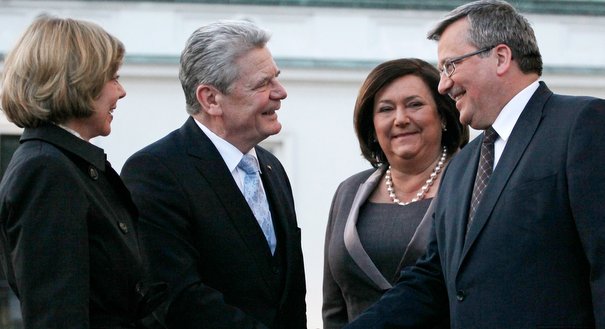
Just four days after his inauguration as the president of Germany, Joachim Gauck paid his first official trip to Poland on March 27.
From all accounts, it was a huge success.
Gauck, 72, who was born and raised in communist East Germany, told his host and counterpart, Bronislaw Komorowski, how the underground Solidarity trade union movement had inspired him.
And by sheer coincidence, after his speech Mr. Komorowski gave Mr. Gauck an original Solidarity poster.
When he saw the poster, Mr. Gauck stared, just a moment. He then said he had the same one on his wall at home. The new one would now find a place in the presidential office.
Commentators praised Mr. Gauck’s speech but also how far relations between Poland and Germany have improved over the past few years.
Somehow, both sides are making a big effort to overcome many years of hate and disdain, especially by the Polish side.
German Chancellor Angela Merkel and Polish Prime Minister Donald Tusk, both in their mid-fifties, want to move on.
In practice, that means working together bilaterally but also for a much more closely integrated Europe.
Poland, today, is probably the European country most enthusiastic about further integration. And it knows that it needs Germany to help kick start the European Union’s foreign and defense policy, which is central to Poland’s long term strategic interests.
It wants a Europe that can project itself on the world stage. At the minimum, it should be capable of dealing with neighborhood issues in the Balkans and Belarus and Ukraine.
Poland’s overtures have not been as enthusiastically received in the rest of Europe as they should be. Indeed, some analysts even argue that there is the risk of a euroskeptic backlash in Poland if its advances continue to fall flat. Were that to happen, it would be to the EU’s loss.
Take Poland’s recent attempts, supported by Germany, to establish a permanent EU military headquarters in Brussels.
The former nationalist-conservative government led by Jaroslaw Kaczynski feared such a headquarters would weaken Poland’s ties to NATO. It also believed, with some ground, that the EU might not come to its defense if it were threatened.
Radek Sikorski, the foreign minister, was of the same opinion. But then, he and Mr. Tusk realized how much the United States’ interest in Europe was waning.
“The country [Poland] continues to believe that the US is progressively withdrawing from European security in order to focus on more pressing security issues elsewhere,” writes Clara Marina O’Donnell in a new report on Poland published by Brookings and the Center for European Reform.
The Tusk center-right Polish government is trying to improve Europe’s security and defense policy to make up for that.
It made a first attempt when it was at the helm of the EU’s rotating presidency last year, but to little avail.
The euro crisis was a distraction. The decision a year ago by France and Britain to lead the NATO mission against Libya, with the United States for the first time “leading from behind,” came as a salutary reminder to the Poles of the limits of NATO cohesion.
Of course, Warsaw contributed to the split when it refused to participate in the Libya mission. It did not see how it served its interests, Mr. Sikorski told me at the time.
In any case, the Libya mission gave the Tusk government even more of a reason to campaign for the establishment of a military planning headquarters for the EU.
Britain and France, which are pursuing their own joint defense program, convinced it is no longer worth waiting for their European allies to pool and share resources, blocked it.
Poland was disappointed. As a country bordering Belarus and Ukraine, it needs a credible European defense strategy more than ever. Poland is acutely aware of how much Russia is increasing its economic presence, and by implication, political influence along its western borders.
To achieve that, Poland needs Germany to play a much more active role in Brussels in promoting both a strong defense policy and a more creative foreign policy approach towards the EU’s eastern neighbors.
So far, despite the bonhomie between Mr. Gauck and Mr. Komorowski, Poland is waiting. Germany still needs to realize that a coordinated approach with Poland in Brussels would also serve its own interests.


