

Commentary
Olga Shumylo-Tapiola
{
  "authors": [
    "Olga Shumylo-Tapiola"
  ],
  "type": "commentary",
  "blog": "Strategic Europe",
  "centerAffiliationAll": "",
  "centers": [
    "Carnegie Endowment for International Peace",
    "Carnegie Europe"
  ],
  "collections": [],
  "englishNewsletterAll": "",
  "nonEnglishNewsletterAll": "",
  "primaryCenter": "Carnegie Europe",
  "programAffiliation": "",
  "programs": [],
  "projects": [],
  "regions": [],
  "topics": [
    "EU"
  ]
}
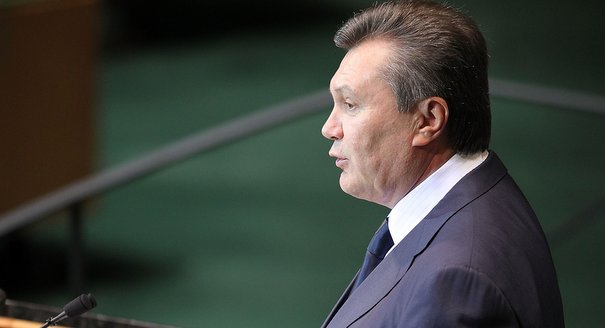
Source: Getty
It is important that the EU understands that Yanukovych’s real motivation is advancing his own position and that of his family, not reform.
When talking about Ukraine, much depends on which side of the fence you are sitting on. The picture is either black or white, with few people trying to look at the motivations behind the government’s actions. As a result, conclusions on where Ukraine is heading are often flawed.
At a recent Carnegie event we discussed the state of the Ukraine’s economy under President Yanukovych. The official line presented by Iryna Akimova, deputy head of the presidential administration, was very positive. She admitted that the economy faces challenges, but argued that it is picking up after the crisis, that many reforms—notably in the tax and pension systems—have been initiated, and that the business climate is improving.
Independent expert Nazar Kholod, who has just published a critical paper on the subject, paints a very different picture. His main message is that while reforms have indeed been started, they have been neither fully implemented, nor properly communicated to the public. He argues that their impact on peoples’ quality of life remains debatable and that the Ukrainian public will bear the brunt of expensive reforms while those in power will continue enjoying life. He concludes that the main challenges for reform are the government’s lack of transparency and accountability.
I would like to propose an alternative reading of Ukraine’s failure to reform. The main problem lies in the factors motivating the current president’s actions.
Yes, President Yanukovych came to power through free and fair elections. Yes, he looked like a person who could deliver. Yes, during his two years in office he has gained significantly more power. This in fact makes him the only person responsible for delivering reform. However, the president’s idea of a prosperous Ukraine centers around his own prosperity and that of his family.
To ensure his family’s prosperity the president needs Ukraine to remain in a grey zone between the East and the West. Closer ties with the EU would mean more transparency and accountability. This would be bad for his family’s interests. Rapprochement with Russia would mean less control over the country’s economy, which would also be bad for his family’s interests.
Ukraine’s economic assets are being divided by the country’s oligarchs. However, with Yanukovych’s family taking an ever larger slice of the pie, even that is likely to change. The president wants money from the West—the IMF and the EU—in order to maintain the status quo. He wants the population to pay for the systemic improvements that are needed to obtain that money. It is as simple as that.
It is therefore no surprise that the reforms Yanukovych has launched look patchy and attempts to communicate them to the public are failing.
One good example is the reform of the Customs Code. The draft code was adopted by the parliament. If the president signs it, the code will enter into force within a month. While Ukrainian and Western businesses agree on the need to adopt a new, modern code, they suggest that the new code contains amendments that will increase the chances of bias and harassment by customs authorities. Businesses will also have to make adjustments while going forward, which is difficult.
So what next? Ukraine is entering an electoral period, with parliamentary elections scheduled for October 28 of this year. The president’s grand plan, and that of his allies, is to win enough votes to form a constitutional majority. This would allow them to amend the constitution again and, among other things, to move presidential elections to the parliament.
This would perhaps be a good idea, if the president’s powers were dramatically curtailed. However, it is believed that Yanukovych wants both to remain in power for a long time, and to retain his vast powers.
For Ukraine’s economy this means there will be no structural reforms, at very least until after the elections. The likelihood of reforms that would benefit the entire country being implemented even after October 2012 is small. Yanukovych will continue borrowing on private markets and enjoying Russian financial support, while the EU’s concerns about Ukraine’s fiscal stability and business climate are likely to remain unsolved.
It is important that the EU understands that Yanukovych’s real motivation is advancing his own position and that of his family, not reform. The rules he plays by will be based on fulfilling that goal. A functioning Ukraine policy can only be based on the appreciation of this fact.

Former Nonresident Associate, Carnegie Europe
Shumylo-Tapiola is a nonresident associate at Carnegie Europe in Brussels, where her research focuses on Eastern Europe and Eurasia.
Recent Work
Olga Shumylo-Tapiola
Olga Shumylo-Tapiola
Carnegie does not take institutional positions on public policy issues; the views represented herein are those of the author(s) and do not necessarily reflect the views of Carnegie, its staff, or its trustees.

In supporting Europe’s far-right, MAGA and Russia both want the same thing: a weaker EU. Europe must defend itself without abandoning the openness these forces exploit.

Armida van Rij

As we close out another season of Strategic Europe, it is worth taking stock of the deep shifts underway.

Rym Momtaz
The EU had to compromise to adopt a twenty-first sanctions package against Russia, exposing growing cracks in the union’s resolve. Is this latest, weaker round worth it to keep pressure on Moscow?
Rym Momtaz, ed.

Trump is distracted and Ukraine wants Europe to step up. The continent’s leaders must find their voice and assert it in talks with Russia.

Alissa de Carbonnel

Mounting economic strain and battlefield losses will not necessarily make the Kremlin less dangerous. They could instead push Moscow toward a more aggressive hybrid campaign designed to test NATO’s Eastern flank, exploit allied hesitation, and fracture European resolve.

Maksym Beznosiuk