

Commentary
Nathalie Tocci, Jan Techau
{
  "authors": [
    "Jan Techau"
  ],
  "type": "commentary",
  "blog": "Strategic Europe",
  "centerAffiliationAll": "",
  "centers": [
    "Carnegie Endowment for International Peace",
    "Carnegie Europe"
  ],
  "collections": [],
  "englishNewsletterAll": "",
  "nonEnglishNewsletterAll": "",
  "primaryCenter": "Carnegie Europe",
  "programAffiliation": "",
  "programs": [],
  "projects": [],
  "regions": [
    "Asia"
  ],
  "topics": [
    "EU",
    "Security"
  ]
}
Source: Getty
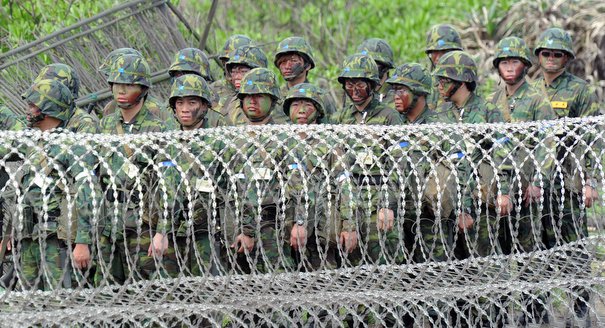
With traditional strategies rendered obsolete and its main ally relatively weaker, Taiwan has done a remarkable thing by reverting to soft power for its own protection.
In the world of international security few political experiments are more fascinating than the long-term strategy of the Republic of China, or Taiwan, to keep itself free from mainland Chinese rule. Taiwan, a small island the size of Belgium with a population of some 23 million, is the mother of all status quo powers. If ever there was a country more interested in preserving the conditions of the here and now, it is this one.
Taiwan is a vibrant, pluralistic democracy, with a highly educated population, a high-tech based economy, and an increasingly strong trade record. They are pitted against Beijing, where a revisionist Communist party is slowly turning the country it rules into an international behemoth. The leaders in Beijing are patient, but they have made it abundantly clear that they consider Taiwan to be theirs and that it must eventually fall back under their authority. For the Taiwanese, thus, the status quo means survival.
Over the last 60 years, Taiwan has relied on the protection of the United States for its security. But the United States, contrary to all talk about the "strategic pivot" to Asia, has in fact lost influence in the region, and support for unconditional solidarity with Taiwan in Washington is wobbly. China's successful buildup of denial-of-access forces has changed the strategic equation in the South and East China Sea. Defending Taiwan militarily would already be far more costly for Washington than it was only a decade ago. It was always doubtful whether the United States would be willing to go nuclear over Taiwan. It is even less likely today.
Another trend is equally worrisome for Taipei. As long as the mainland's People's Liberation Army was a low-tech, backwoods operation focused on securing stability at home, Taiwan could reasonably hope to fend off any mainland invasion with its own, more technologically advanced military capabilities. Today, as China has learned the lessons of the Revolution in Military Affairs, and is modernizing and expanding its armed forces at stellar speed, this is no longer an option. Neither is reverting to asymmetrical tactics, the traditional answer of powers outgunned by a far bigger opponent. Recent exercises in Taiwan have clearly demonstrated the limits of this approach.
With traditional strategies rendered obsolete and its main ally relatively weaker, Taiwan has done a remarkable, counter-intuitive thing. It has reverted to soft power for its own protection. It works roughly like this: do everything to make re-unification with mainland China as politically costly as possible for Beijing. Do this by becoming a strong example of democracy, the rule of law, globalized business, and exemplary international behavior. This way an attack on you would be considered such a massive breach of internationally accepted norms that it became a risk too unpredictable for anyone considering it. In other words: make it unbearable for the West and the international community to leave Taiwan behind. (Note to the Taiwanese government: stop underselling yourself. The world needs to realize that there is another China out there that is not at war with its own people.)
This is, of course, risky business. It relies on steady reforms and modernization at home, flawless diplomacy, and of course on the readiness of Beijing's elites to be impressed by Taiwanese soft power as a factor in their foreign policy calculations. But unlike in the military realm, in the world of soft power, time is playing in Taiwan's favor. With China itself being in increasing need of the kinds of reforms Taiwan has already completed, with Beijing desiring to portray itself as a responsible stakeholder in the emerging world order, and with values playing an ever more important role in international power calculations (see the responsibility to protect), Taiwan's strategy may well turn out to be successful in the long run. Time and patience are instrumental. The bigger mainland China gets, and the less stable it is internally, the more vulnerable it becomes to soft power strategies.
What does this mean for the EU? Both economically and in terms of the defense of its values, Europe has an interest in keeping the status quo intact. Nothing more, nothing less. But the Europeans are not strategic military players in the region, and so military guarantees are not an option (apart from the fact that Europeans would not give them, even if they could). Official recognition of the Taipei government is equally impossible. But Europe can demonstrate closeness to the free part of China by increasing trade relations, supporting Taiwan's bid to be granted status in international organizations, and by showing more presence, in whatever form, on the island.
This strategy should be very much after Europe's taste: increasing the hard security of a friend by supporting his soft power strategy. Playing hard ball by playing it soft. It would be good for Taiwan, good for Western values, good for Europe, and, in the long run, good for China too.

Director, Europe Team, Eurasia Group
Techau is director with Eurasia Group's Europe team, covering Germany and European security from Berlin. Previously, he was director of Carnegie Europe.
Recent Work

Nathalie Tocci, Jan Techau
Jan Techau
Trump is distracted and Ukraine wants Europe to step up. The continent’s leaders must find their voice and assert it in talks with Russia.

Alissa de Carbonnel

Mounting economic strain and battlefield losses will not necessarily make the Kremlin less dangerous. They could instead push Moscow toward a more aggressive hybrid campaign designed to test NATO’s Eastern flank, exploit allied hesitation, and fracture European resolve.

Maksym Beznosiuk

Over the past ten years, NATO has held almost as many summits as it did during the entirety of the Cold War. Are they still useful, or is it time to stop holding annual meetings?

Rym Momtaz, ed.
Nearly a year and a half after Europeans leaned into sucking up to Trump, the strategy has produced some benefits when it comes to Ukraine.
Rym Momtaz
Far-right leader Marine Le Pen can—and will—run in France’s next presidential election. What does the outcome of her appeal against a 2025 embezzlement conviction mean for the country’s political future?

Catherine Fieschi