

Commentary
Dmitri Trenin
{
  "authors": [
    "Dmitri Trenin"
  ],
  "type": "commentary",
  "blog": "Strategic Europe",
  "centerAffiliationAll": "",
  "centers": [
    "Carnegie Endowment for International Peace",
    "Carnegie Europe",
    "Carnegie Russia Eurasia Center"
  ],
  "collections": [],
  "englishNewsletterAll": "",
  "nonEnglishNewsletterAll": "",
  "primaryCenter": "Carnegie Russia Eurasia Center",
  "programAffiliation": "",
  "programs": [],
  "projects": [],
  "regions": [
    "Russia"
  ],
  "topics": [
    "EU"
  ]
}
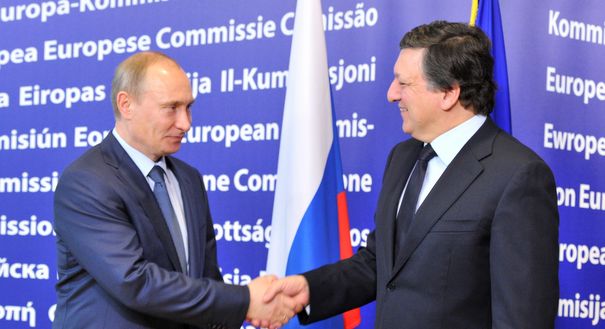
Source: Getty
In both Europe and Russia, things will probably need to get worse before they start getting better.
Throughout the 1990s and 2000s most Russians looked at the European Union with a lot of admiration. Even as the Soviet Union disintegrated, Germany, and then Europe outside the former USSR became united. Europe was the model for Russia in many things—economic, social, societal, political. Even though this model was not always followed, it was recognized as superior to Russia’s and perhaps supreme in the world.
This view has not vanished completely, but it has been saddled with important qualifications. In economic terms, the European model has come to be seen as too socialist, too bureaucratic, and too unfriendly to competitiveness and growth. In social terms, multiculturalism has been recognized as a failure even by its own proponents. In political terms, the rise of both right-wing nationalism and left-wing populism is eating away at the political center which has long provided the stability necessary for the implementation of the European project.
Europe’s present problems have many sources, but, as Russian commentators maintain, Europe’s difficulties in dealing with them points to the problem of leadership. In the past, the EU faced a number of crises, only to emerge stronger as a result of successfully overcoming them. This time, the European project itself appears to be at stake, and there is no certainty about the outcome. As to Europe’s nominal leaders, many of them look more like followers, eager to go with the prevailing popular mood—even to the brink of a disaster, as in Greece.
For the Kremlin, Europe’s current woes bespeak a crisis of democracy which “has gone too far”, and vindicate a more authoritarian form of government. Ironically, this very form of government is increasingly challenged in Russia itself on a range of counts: corruption, energy dependency, slow development, massive hemorrhage of talent and the like. Russia itself is witnessing a rise in both left-wing and right-wing populism, with a very weak political center to keep the country on an even keel. Rather than aiding Europe to deal with its problems, Russia is likely to add to them.
In both Europe and Russia, things will probably need to get worse before they start getting better. Within the next several years, both will be put up hard against the wall. Then, if the EU does not unravel, it will need to become much more integrated economically as well as politically. If Russia does not slide into chaos, it will have to start building institutions. When Mr. Putin said in his inauguration speech that the next six years will be crucial for the country, he was absolutely right, whatever he had in mind when he was saying this.
Former Director, Carnegie Moscow Center
Trenin was director of the Carnegie Moscow Center from 2008 to early 2022.
Recent Work
Dmitri Trenin
Dmitri Trenin

Before the next wave of EU enlargement takes place, the union needs to grapple with thorny questions of how power is distributed among its members.


Emil Sondaj Hansen, Ditte Brasso Sørensen

A summer of escalation in the Black Sea has hurt Ukraine economically and is exacerbating world food security. A truce is needed—as is a broader reframing of Europe’s Ukraine strategy.

Thomas de Waal

Are Germany’s economic, industrial, and political struggles becoming a liability for the EU’s ability to rise to the geopolitical moment?

Rym Momtaz, ed.

European Commission President Ursula von der Leyen is about to give her annual address on the state of the EU. Here’s what she won’t—but should—say.
Rym Momtaz

The aftermath of the Ceuta crisis shows Europe has drawn the wrong lessons. Rather than doubling down on failed migration policies, the EU needs to address the underlying roots of such episodes.

Richard Youngs