

Article
Marc Pierini
{
  "authors": [
    "Marc Pierini"
  ],
  "type": "commentary",
  "blog": "Strategic Europe",
  "centerAffiliationAll": "",
  "centers": [
    "Carnegie Endowment for International Peace",
    "Carnegie Europe"
  ],
  "collections": [],
  "englishNewsletterAll": "",
  "nonEnglishNewsletterAll": "",
  "primaryCenter": "Carnegie Europe",
  "programAffiliation": "",
  "programs": [],
  "projects": [],
  "regions": [
    "Southern, Eastern, and Western Africa"
  ],
  "topics": [
    "EU"
  ]
}
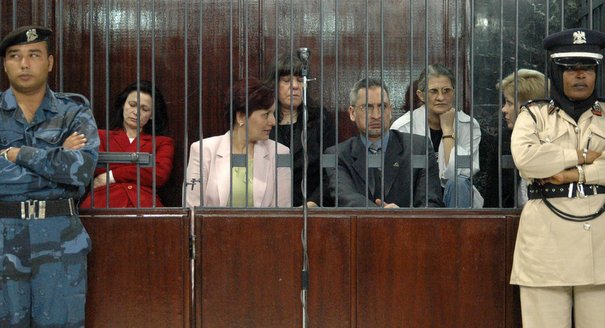
Source: Getty
Libya would win the praise of the international community if it offered both apology and compensation to the six formerly imprisoned Bulgarian medics charged with conspiring to infect children with HIV.
Five years ago today, five Bulgarian nurses and a Bulgarian-Palestinian doctor were repatriated, free, from Tripoli to Sofia. It was a day of relief, after thirty-three months of strenuous negotiations, three successive death sentences pronounced after fake trials, the scars of torture, many promises of liberation, and several failed attempts.
Five years is a long time in politics and Libya has certainly evolved a great deal since 2007. But in light of Libya’s new realities, this anniversary takes on a new significance.
Why? Because one person was in power then and still is now: Mustafa Abdul Jalil, who today heads the National Transitional Council of Libya and is, for all intents and purposes, today's Libyan Head of State, was the Libyan Minister of Justice back in 2007. In his previous position, he was the official who prevented at several times the liberation of the medics.
Let's remind ourselves of the key elements of the "Benghazi Case", as it was called, which ended up in dignity for all parties. Or, better said, in dignity except for one point:
Without going into the many intricacies of the negotiation (of which I happened to be the permanent member on the EU side), let me just say that one issue, one only, was left out of the final settlement: the moral and physical suffering of the six medics. At no point during this long negotiation was it possible for me and the other negotiators to entertain with the Gaddafi regime the issue of compensation for the medics. And indeed the absolute priority was their release.
In today’s context, there is a political meaning to this fifth anniversary: the way in which the new, democratic Libya will face its past will shape her image and her democratic credentials one way or the other.
My point here is a simple one: in order to close the Benghazi Case in dignity and completely, would it not be appropriate for today's Libya to erase this dark episode of its recent past and to apologize and compensate the six medics in the same way and amount the Benghazi families were compensated?
The case has amply demonstrated that the medics were for strictly nothing in the Benghazi infection. Yet, they stayed in prison for eight and a half years, were tortured many times, were condemned to death three times, and suffered an endless parody of justice. All of this has been well documented. For sure, they are free, but they never got one word of apology or any amount of compensation in the name of Libya or from any other source.
Today's Libya is back on the international stage, she has recovered huge frozen assets and relaunched oil and gas production, she is holding elections in dignity, and she is struggling to rebuild herself as an organized society. This Libya has the support of the international community.
This new Libya would win the praise of the international community if she also "officially" erased one of the darkest wrongdoings of the former regime and offered both apology and compensation to the six Bulgarian medics.
And the gesture would be all the more representative of the new Libya if it was decided and offered by Mustafa Abdul Jalil himself. Today is the day to think about this.
Marc Pierini, a former EU career diplomat, has served as the EU Ambassador to Turkey, Tunisia, Libya, Syria, and Morocco.

Senior Fellow, Carnegie Europe
Marc Pierini is a senior fellow at Carnegie Europe, where his research focuses on developments in the Middle East and Turkey from a European perspective.
Recent Work
Marc Pierini
Marc Pierini
Carnegie does not take institutional positions on public policy issues; the views represented herein are those of the author(s) and do not necessarily reflect the views of Carnegie, its staff, or its trustees.

Are Germany’s economic, industrial, and political struggles becoming a liability for the EU’s ability to rise to the geopolitical moment?

Rym Momtaz, ed.

European Commission President Ursula von der Leyen is about to give her annual address on the state of the EU. Here’s what she won’t—but should—say.
Rym Momtaz

The aftermath of the Ceuta crisis shows Europe has drawn the wrong lessons. Rather than doubling down on failed migration policies, the EU needs to address the underlying roots of such episodes.

Richard Youngs

An overwhelming victory by a far-right-wing party in a small state in eastern Germany will have major repercussions for Chancellor Friedrich Merz’s coalition.

Judy Dempsey

Canadian Prime Minister Mark Carney has twice inspired praise for standing up to U.S. President Donald Trump: at the 2026 World Economic Forum in Davos and on Canada-U.S. trade negotiations. Is Carney showing a third way better than the EU has in dealing with the Trump administration?
Rym Momtaz, ed.