

Commentary
Judy Dempsey
{
  "authors": [
    "Judy Dempsey"
  ],
  "type": "commentary",
  "blog": "Strategic Europe",
  "centerAffiliationAll": "",
  "centers": [
    "Carnegie Endowment for International Peace",
    "Carnegie Europe"
  ],
  "collections": [],
  "englishNewsletterAll": "",
  "nonEnglishNewsletterAll": "",
  "primaryCenter": "Carnegie Europe",
  "programAffiliation": "",
  "programs": [],
  "projects": [],
  "regions": [],
  "topics": [
    "EU"
  ]
}
Source: Getty
Every week leading experts answer a new question from Judy Dempsey on the international challenges shaping Europe’s role in the world.
Every week leading experts answer a new question from Judy Dempsey on the international challenges shaping Europe’s role in the world.
If you believe the American adage about “putting your money where your mouth is,” which is to say, placing resources and budget force behind something that you say is important to you, then for Europe, Africa matters as a recipient of Europe’s “soft power,” or its official development assistance (ODA). However, as European austerity challenges national budget priorities and as governments come under increasing domestic pressure to reduce foreign aid and spare domestic social safety net programs, Africa will matter less in the future.
There can be no doubt that Europe has put its euros where its mouth is over the past decade. The European Union spent €53 billion on aid in 2011, twice as much as what the United States, the world’s next largest donor, spent. But the 2011 €53 billion EU contribution was €500 million less than in 2010.
When it comes to providing urgently needed aid particularly to Africa, G8 leaders—Canada, France, Germany, Italy, Japan, Russia, the United Kingdom, and the United States (the European Union also attends summits with observer status)—at the 2005 Gleneagles Summit committed a total of $50 billion between 2005 and 2010 to official development assistance with approximately $25 billion targeted for sub-Saharan Africa. Each G8 member state, with the exception of Russia, committed itself to this “Gleneagles pledge” and promised to increase ODA levels to 0.7 percent of gross national income (GNI) by 2015.
Unfortunately, most European nations have fallen off-track to reach the 0.7 percent ODA/GNI mark by 2015. G8 leaders announced that member states would be $18 billion short of the total $50 billion in targeted aid stating that, “the [financial] crisis has jeopardized advancement towards meeting some of the 2015 targets.” For example, Italy decreased its ODA to sub-Saharan Africa by $331 million in 2009 and Ireland reduced its ODA budget by 24 percent in 2009, of which 80 percent is destined for sub-Saharan Africa. According to Oxfam, the EU aid cuts between 2010 and 2011 equaled the missed opportunity of vaccinating 600 million children and providing 500 million mosquito bed nets to those in need.
The trajectory for Europe’s overall official development assistance (ODA) is trending downward and will likely continue to do so for the next five years, particularly for those countries that are highly indebted and must immediately reduce government spending. ODA reductions will diminish European leadership globally. When it comes to assistance, Africa matters, but austerity may matter more.
Africa is mostly present in European popular imagery in the form of hunger, poverty, and conflicts.
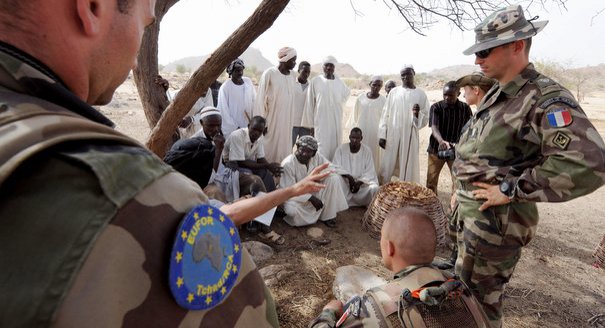
Fittingly, the African continent is where European development aid travels to and where two new European Security missions where announced this week: one of the coast of Somalia to fight pirates and another in Niger to fight terrorism.
Yet Africa can also be the continent of the future. All the hype is now about China and Asia. Yet China, like the West, is heading into economically difficult years and with an ageing population due to the one-child policy.
Instead, Africa has the youth bulge. China and other investors have shown that economic development beyond aid is possible in Africa. Africa is at the beginning of an over-looked growth tale. Several African countries are displaying large growth rates.
When we search the horizon for the big game-changers in 2050 it might be that Africa has succeeded Asia as the Continent of economic growth and with its geographically convenient location has become a hub also for the flourishing South-South trade and investment bypassing the old West.
That will make Africa matter far beyond its borders.

Nonresident Senior Fellow, Carnegie Europe
Judy Dempsey is a nonresident senior fellow at Carnegie Europe
Recent Work
Judy Dempsey
Judy Dempsey
Carnegie does not take institutional positions on public policy issues; the views represented herein are those of the author(s) and do not necessarily reflect the views of Carnegie, its staff, or its trustees.

Are Germany’s economic, industrial, and political struggles becoming a liability for the EU’s ability to rise to the geopolitical moment?

Rym Momtaz, ed.

European Commission President Ursula von der Leyen is about to give her annual address on the state of the EU. Here’s what she won’t—but should—say.
Rym Momtaz

The aftermath of the Ceuta crisis shows Europe has drawn the wrong lessons. Rather than doubling down on failed migration policies, the EU needs to address the underlying roots of such episodes.

Richard Youngs

An overwhelming victory by a far-right-wing party in a small state in eastern Germany will have major repercussions for Chancellor Friedrich Merz’s coalition.
Judy Dempsey

Canadian Prime Minister Mark Carney has twice inspired praise for standing up to U.S. President Donald Trump: at the 2026 World Economic Forum in Davos and on Canada-U.S. trade negotiations. Is Carney showing a third way better than the EU has in dealing with the Trump administration?
Rym Momtaz, ed.