

Commentary
Before the next wave of EU enlargement takes place, the union needs to grapple with thorny questions of how power is distributed among its members.
Emil Sondaj Hansen, Ditte Brasso Sørensen
{
  "authors": [
    "Ian Kearns"
  ],
  "type": "commentary",
  "blog": "Strategic Europe",
  "centerAffiliationAll": "",
  "centers": [
    "Carnegie Endowment for International Peace",
    "Carnegie Europe"
  ],
  "collections": [],
  "englishNewsletterAll": "",
  "nonEnglishNewsletterAll": "",
  "primaryCenter": "Carnegie Endowment for International Peace",
  "programAffiliation": "",
  "programs": [],
  "projects": [],
  "regions": [
    "Europe",
    "North America"
  ],
  "topics": [
    "EU",
    "Climate Change",
    "Security"
  ]
}
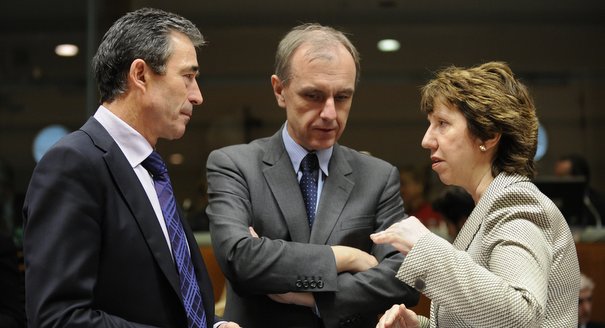
Source: Getty
The U.S. pivot to Asia, Europe’s failure to collaborate effectively on defense, and now the eurozone crisis are combining to leave Europe largely powerless to shape the international politics of the 21st century.
As the euro crisis rumbles on, it is becoming increasingly clear that there is more at stake than the future of the single currency. The U.S. pivot to Asia, Europe’s failure to collaborate effectively on defense, and now the economic crisis in the eurozone are combining to leave the North Atlantic Treaty Organization at risk of fracture and Europe largely powerless to shape the international politics of the 21st century.
To see the dangers, consider first the changes underway in the geopolitical environment. The most significant developments here are the rise of China and the instability still sweeping the Arab world. An additional subsidiary factor concerns the United States’ rapid progress toward energy independence. All three of these developments are of consequence not only for the United States and Asia, but also for Europe.
The United States is responding to the first with its pivot to the East. As a by-product, for the first time in over seventy years, Europe is ceasing to be at the center of the United States’ world view. At the same time, the turmoil in the Arab world is contributing to an arc of instability across North and East Africa, the Gulf, and Central Asia. This arc increasingly stands between Europe and the energy and raw materials it needs to import. The United States. underwrites what security there is in the Gulf in particular, but as it comes to rely less and less on Gulf energy supplies while Europe remains hooked, more Europeans need to ask for how long will it be willing to do so?
Second, consider the weakness of the European response to this wave of change. At the level of words the Europeans know what is required, namely more cooperation within Europe to deliver the kind of defense and security capability that no European country can provide alone. But progress is vanishingly small and painfully slow.
The problem, for once, is not money but jobs. The European countries of NATO alone still spend more on defense in purchasing power terms than do China, Russia, and India combined. Most of this defense expenditure goes into inefficient militaries that produce little by way of deployable capability to meet current threats. It also produces local, European, often highly-skilled jobs. Intensive European defense collaboration to achieve economies of scale would involve many of these jobs going, an understandably unattractive prospect to the workers concerned, and the trades unions and politicians that represent them.
Third, now play into this environment a scenario in which the euro collapses, and consider what kind of economics and politics we are likely to see in Europe in that eventuality.
Post-collapse, EU efforts to preserve the single market would come under immense domestic political pressure from Southern European countries perceiving the least benefit from it. It must be highly questionable as to whether the single market could survive. More likely is a series of competitive currency devaluations among states seeking relief from Depression-era levels of unemployment. Free movement of labor would probably go, given the intensity of debate on immigration already visible. And a further erosion of support for mainstream political parties is likely, since many of these introduced and have supported the euro. Italy’s Five Star Movement, and the French National Front will find fertile ground alongside Greece’s Golden Dawn as part of a fundamental shift to more extreme politics.
The idea that all or some of this could happen while leaving European defense and security structures unaffected is nonsense. There is no chance of Europe’s many political systems sustaining European defense collaboration in this political climate. The continent that could not deliver this in the good times will not deliver it in the bad. As a result, Europe will remain hopelessly ill-equipped to take more responsibility for its own security at just the point when the United States is preoccupied elsewhere. Transatlantic burden-sharing arrangements, already creaking, will be further and potentially fatally undermined by this continued European failure to deliver.
Europe would also be dead as a serious geopolitical actor on the world stage in this scenario, and the individual countries of Europe, including Germany, would largely be bystanders as the major powers elsewhere carved up the political, economic, and cultural landscape of the 21st century.
And expect consequences for NATO membership too. Syriza, the opposition grouping which came close to winning power in Athens just a few weeks ago, and which may still come to power has made clear its preference for pulling Greece out of NATO. Other new and growing political forces across Europe can be expected to make similar noises.
These potential security consequences of economic stress were well understood by the original drafters of the North Atlantic Treaty. In the aftermath of the 1930s and World War II, Article 2 of the Treaty committed the parties to work together to preserve the economic conditions necessary for peace.
How little our leaders seem to learn from history. Individually and collectively, they are failing to recognize that the euro crisis is a defining moment of challenge not only to the economic but also the security institutions upon which the West relies. By refusing to grasp the nettle on European defense and security collaboration moreover, the leaders of Europe in particular have laid bare a painful truth: that they find subsidizing the inefficient defense jobs of yesterday a preferable substitute to coming up with a compelling vision for the economic, political, and strategic future of Europe.
Dr. Ian Kearns is chief executive of the European Leadership Network and former adviser to the UK House of Commons/House of Lords Joint Committee on National Security Strategy.
This article was originally published by the European Leadership Network.
Ian Kearns
European Leadership Network
Carnegie does not take institutional positions on public policy issues; the views represented herein are those of the author(s) and do not necessarily reflect the views of Carnegie, its staff, or its trustees.

Before the next wave of EU enlargement takes place, the union needs to grapple with thorny questions of how power is distributed among its members.


Emil Sondaj Hansen, Ditte Brasso Sørensen

A summer of escalation in the Black Sea has hurt Ukraine economically and is exacerbating world food security. A truce is needed—as is a broader reframing of Europe’s Ukraine strategy.

Thomas de Waal

Are Germany’s economic, industrial, and political struggles becoming a liability for the EU’s ability to rise to the geopolitical moment?

Rym Momtaz, ed.

European Commission President Ursula von der Leyen is about to give her annual address on the state of the EU. Here’s what she won’t—but should—say.
Rym Momtaz

The aftermath of the Ceuta crisis shows Europe has drawn the wrong lessons. Rather than doubling down on failed migration policies, the EU needs to address the underlying roots of such episodes.

Richard Youngs