

Commentary
Judy Dempsey
{
  "authors": [
    "Judy Dempsey"
  ],
  "type": "commentary",
  "blog": "Strategic Europe",
  "centerAffiliationAll": "",
  "centers": [
    "Carnegie Endowment for International Peace",
    "Carnegie Europe"
  ],
  "collections": [],
  "englishNewsletterAll": "",
  "nonEnglishNewsletterAll": "",
  "primaryCenter": "Carnegie Europe",
  "programAffiliation": "",
  "programs": [],
  "projects": [],
  "regions": [
    "Europe"
  ],
  "topics": [
    "EU",
    "Security"
  ]
}
Source: Getty
Europe's soft power instruments are under scrutiny especially when Europe trains police forces in non-democratic countries.
There is not a single European Union government that does not know the truth about Belarus. It is an unpleasant, undemocratic regime in Europe’s backyard.
Yet for reasons that say much about Europe’s policy towards Belarus, Germany’s interior ministry confirmed this week that it had provided police training, surveillance equipment, and computers to the Belarusian security forces. The deliveries took place between 2008 and 2011.
Germany’s interior ministry spokesman said that during this time, the government had decided to intensify its dialogue with Belarus “because there were signs that Minsk was ready to implement democratic reforms and conform to the rule of law.”
Really?
President Alexander Lukashenko, who was re-elected in 2010 for a fourth consecutive term, introduced no democratic reforms during that period.
Even though he told his EU interlocutors that he wanted a closer relationship with Brussels, there were no real signs of him loosening his authoritarian grip.
The 2010 elections confirmed that. They were rigged, according to the OSCE and pro-democracy opposition movements.
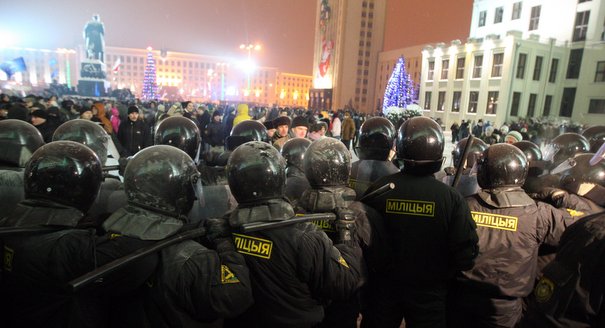
Belarusians took to the streets to protest against the fraudulent poll. The security forces cracked down and arrested hundreds of protesters. Only one year later, in 2011, did the German authorities stop their assistance to the Belarusian police.
When news of this leaked out this week, the German government was very embarrassed. But even beyond the critical headlines, this surprising bit of help for Lukashenka could have wider implications for Europe’s strategy towards Belarus.
The sale of such equipment could contravene the EU’s Code of Conduct that sets down criteria under which member states can export military equipment.
Such equipment, for example, may not be sold if it can be used to suppress freedom of expression or freedom of assembly.
In the German case, the Code of Conduct was either circumvented, or the German interior ministry believed it was not in breach of that code, or the regional police authorities were naïve enough not to be aware of the political implications.
Emotions generally run high in Europe when it comes to EU countries helping non-democratic regimes to train their police.
Europe has spent hundreds of millions of euros training the Palestinian police and security forces in the West Bank. The West Bank is not a shining democracy by any standards.
Yet the EU has taken up this task because the Palestinian police had a terrible reputation for torture, corruption, and incompetence.
If the EU can stop the torture and provide a more professional police force, surely, that’s all for the good. But if the EU, in turn, is helping the Palestinian police squash pro-democracy or pro-peace demonstrations, and often at Israeli’s biding, the issue looks very different.
Getting back to Belarus, you might make the case that training the police is not per se a bad thing.
After all, is it not better to teach the police how to contain riots and how to deescalate conflicts instead of beating demonstrators into pulp?
Yet the strength of that argument depends on the will of the regime to genuinely reform—and to set up an independent judiciary that can control the police. If there is a Western-trained police force that uses brutal methods against peaceful pro-democracy demonstrators, the EU will have ended up colluding with the regime in Minsk.
Germany is not alone in assisting the Lukashenko regime. Other member states, unwittingly or not, also provide him with all kinds of support.
Recall what happened over a year ago when Poland and Lithuania, the two countries that are the most vociferous and active supporters of the Belarusian opposition, committed a huge blunder.
The Belarusian authorities, claiming tax evasion, possibly even with terrorist intent, had asked neighboring Poland and Lithuania to provide details of Ales Bialiatski’s bank account. Bialiatski is head of the Viasna Human Rights Centre and vice president of the International Federation for Human Rights.
The Belarusian authorities had been trying for some time to find a pretext to arrest Bialiatski. Warsaw and Vilnius duly obliged by handing over the account details. Bialiatski was then arrested. Last November, he was sentenced to four and a half years of strict detention. His property was confiscated.
Why did Poland and Lithuanian do it? Certainly not out of bad will. It was sheer incompetence.
“There is a Russian proverb saying that the right hand does not always know what the left hand does. Ales Bialiatski’s story illustrates this saying”, wrote Tatsiana Chulitskaya, lecturer at the European Humanities University, Vilnius, Lithuania.
The foreign and interior ministries and prosecution officers in Poland and Lithuania did not communicate with each other. In the German case, the federal interior ministry perhaps did not know everything the regional police authorities were doing with Belarus.
Don’t think for a moment that the Belarusian regime does not know how democratic institutions function or how to make use of rivalries between those institutions.
Joerg Forbrig, Belarusian expert at the Berlin office of the German Marshall Fund of the United States, says the EU should have an automatic red light flashing across the national and regional ministries whenever authoritarian countries make requests or whenever any ministry or police authority deals with them.
“These recent examples damage the EU’s credibility in the eyes of the opposition in Belarus,” Forbrig said. It also sheds a very ambiguous light on police training, one of the EU’s important soft power instruments.

Nonresident Senior Fellow, Carnegie Europe
Judy Dempsey is a nonresident senior fellow at Carnegie Europe
Recent Work
Judy Dempsey
Judy Dempsey
Trump is distracted and Ukraine wants Europe to step up. The continent’s leaders must find their voice and assert it in talks with Russia.

Alissa de Carbonnel

Mounting economic strain and battlefield losses will not necessarily make the Kremlin less dangerous. They could instead push Moscow toward a more aggressive hybrid campaign designed to test NATO’s Eastern flank, exploit allied hesitation, and fracture European resolve.

Maksym Beznosiuk

Over the past ten years, NATO has held almost as many summits as it did during the entirety of the Cold War. Are they still useful, or is it time to stop holding annual meetings?

Rym Momtaz, ed.
Nearly a year and a half after Europeans leaned into sucking up to Trump, the strategy has produced some benefits when it comes to Ukraine.
Rym Momtaz
Far-right leader Marine Le Pen can—and will—run in France’s next presidential election. What does the outcome of her appeal against a 2025 embezzlement conviction mean for the country’s political future?

Catherine Fieschi