

Commentary
Judy Dempsey
{
  "authors": [
    "Judy Dempsey"
  ],
  "type": "commentary",
  "blog": "Strategic Europe",
  "centerAffiliationAll": "",
  "centers": [
    "Carnegie Endowment for International Peace",
    "Carnegie Europe"
  ],
  "collections": [],
  "englishNewsletterAll": "",
  "nonEnglishNewsletterAll": "",
  "primaryCenter": "Carnegie Europe",
  "programAffiliation": "",
  "programs": [],
  "projects": [],
  "regions": [
    "Russia"
  ],
  "topics": [
    "EU"
  ]
}
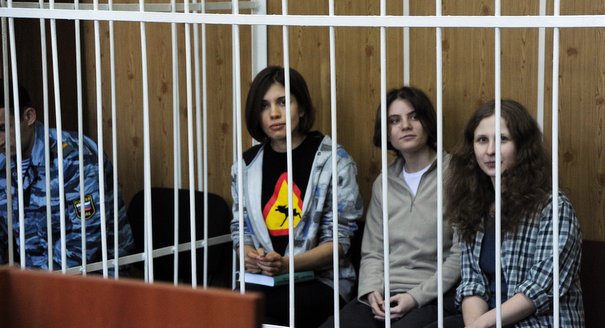
Source: Getty
The trial of three young women in Moscow demonstrates that, despite the trappings of power, Vladimir Putin seems to be highly insecure.
What is the European Union going to do about Russia?
It’s a question that keeps popping up because Brussels has no strategy about how to deal with President Vladimir Putin or react to the kind of political and economic system he has established.
This question is becoming more relevant in the light of the trial of three young women – Maria Alyokhina, Yekaterina Samutsevich and Nadezhda Tolokonnikova who belong to the Pussy Riot punk band.
Over the past few days, the women have been sitting in a glass and metal cage in a crowded and often raucous Moscow court.
The three are being charged with “hooliganism motivated by religious hatred” after they had gone into the Christ the Savior Cathedral in Moscow last February and sang a song urging the Virgin Mary to rid Russia of Putin.
The charges carry a maximum seven-year prison term. A Russian state prosecutor this week demanded a three-year sentence.
You would think that under normal circumstances, the song would have created a bit of a rumpus from the Russian Orthodox Church authorities and then been forgotten. But no. The authorities have chosen to go on the offensive by putting the three singers on trial.
It says a lot about Putin.
Despite the trappings of power, Putin seems to be highly insecure.
Neither his control over the internal security services, his success at clamping down on the media, his control over television nor his bid to control the foreign non-governmental organizations have changed that.
Putin could simply have ignored Pussy Riot. Instead, he made an example of the band, pandering to the sentiments of what is still a very conservative society.
He may also have reckoned that the band should be made an example of, given how more and more Russians are fed up with Putin, according to Levada, the respected Russian opinion pollsters. Russians are now prepared to take to the streets, as confirmed by huge demonstrations that took place earlier this year in Moscow and other cities.
Whatever Putin’s motive, the trial is one more example of how frightened leaders become when artists mock or challenge them. The wise course would nearly always be to ignore them. Instead, leaders resort to hounding their critics.
It is exactly what happened to the Plastic People of the Universe.
The rock band, inspired by Frank Zappa and others, was founded in what was then Czechoslovakia, just days after Soviet tanks had rolled into the country to crush the 1968 Prague Spring.
The band was forced to go underground when the regime began banning its concerts and arresting its members.
In 1976, several of the Plastic People were put on trial, charged with “organized disturbance of the peace”. They were given prison sentences of between 8 and 18 months (lenient compared to the three years being demanded for Pussy Riot).
Instead of silencing the Plastic People of the Universe, the trial and sentencing emboldened the band. It continued singing in the underground—in woods and barns—attracting thousands of supporters. It didn’t matter if the regime kept detaining it’s members and supporters. The Plastic People of the Universe became an alternative to the philistine state culture. Only after the 1989 Velvet Revolution could the band sing freely.
Over twenty years later, Alexander Lukashenko, Belarus’s president and dubbed Europe’s last dictator, is also taking few risks when it comes to popular music.
He keeps a firm grim on the country’s musical scene, especially on bands such as N.R.M.
N.R.M. went through a very bad patch in 2005 when it was banned from playing on state-controlled radio and television and from performing publicly. In Belarus there are, of course, hardly any private radio stations that they could have gone to.
Occasionally, the band changed its name so as to be heard on the state channels. The rest of the time, it played in private homes.
N.R.M. has a huge following, which may explain why the regime will now allow it give concerts again rather than create an underground of supporters. But its access to FM radio is unofficially banned.
Of course, the European Union deplores what is happening in Belarus, just as it is deeply concerned about events at Moscow’s Khamovnichesky court.
A spokesman for Catherine Ashton, the EU’s foreign policy chief, said the EU was worried about the irregularities of the case and the intimidation of lawyers and journalists.
But the truth is that there is not much that Ashton can do, given that there is no unity among the 27 member states about how to deal with Putin’s Russia. But disunity can always be used as an excuse not to ask tough questions about how Europe should deal with Putin’s Russia.
How did Nadezhda Tolokonnikova put it in her said closing defendant’s speech this Wednesday?
"This is a trial of the whole government system of Russia, which so likes to show its harshness toward the individual, its indifference to his honor and dignity,” she said. “If this political system throws itself against three girls … it shows this political system is afraid of truth."

Nonresident Senior Fellow, Carnegie Europe
Judy Dempsey is a nonresident senior fellow at Carnegie Europe
Recent Work
Judy Dempsey
Judy Dempsey

Are Germany’s economic, industrial, and political struggles becoming a liability for the EU’s ability to rise to the geopolitical moment?

Rym Momtaz, ed.

European Commission President Ursula von der Leyen is about to give her annual address on the state of the EU. Here’s what she won’t—but should—say.
Rym Momtaz

The aftermath of the Ceuta crisis shows Europe has drawn the wrong lessons. Rather than doubling down on failed migration policies, the EU needs to address the underlying roots of such episodes.

Richard Youngs

An overwhelming victory by a far-right-wing party in a small state in eastern Germany will have major repercussions for Chancellor Friedrich Merz’s coalition.
Judy Dempsey

Canadian Prime Minister Mark Carney has twice inspired praise for standing up to U.S. President Donald Trump: at the 2026 World Economic Forum in Davos and on Canada-U.S. trade negotiations. Is Carney showing a third way better than the EU has in dealing with the Trump administration?
Rym Momtaz, ed.