

Commentary
Judy Dempsey
{
  "authors": [
    "Judy Dempsey"
  ],
  "type": "commentary",
  "blog": "Strategic Europe",
  "centerAffiliationAll": "",
  "centers": [
    "Carnegie Endowment for International Peace",
    "Carnegie Europe"
  ],
  "collections": [],
  "englishNewsletterAll": "",
  "nonEnglishNewsletterAll": "",
  "primaryCenter": "Carnegie Europe",
  "programAffiliation": "",
  "programs": [],
  "projects": [],
  "regions": [
    "Europe"
  ],
  "topics": [
    "EU"
  ]
}
Source: Getty
Every week leading experts answer a new question from Judy Dempsey on the international challenges shaping Europe’s role in the world.
Every week leading experts answer a new question from Judy Dempsey on the international challenges shaping Europe’s role in the world.
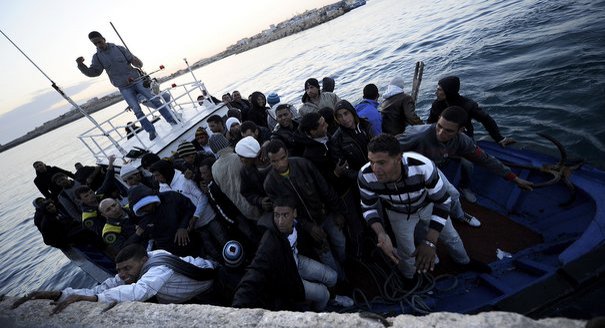
Who is an immigrant? Some years ago, amidst a raging debate on immigration, I needed to renew my resident visa in Germany. At the county offices, I half-jokingly allowed that I expected the civil servant in charge of my case to be particularly thorough in her evaluation of my extension request, given the anti-immigrant sentiment. “But Professor Davis, you’re not an immigrant, you are an American.” I have to admit, I don’t identify myself as an immigrant, but after 17 years in Europe, what am I? The ambiguity suggests an answer to this week’s question: Immigration doesn’t work in Europe because Europeans have an outdated conception of what it means to be an immigrant in a globalized world.
The question’s phrasing implies a comparison with countries such as the United States and Canada that have built societies on an active policy of attracting well-skilled immigration. Europe’s history with immigration is different and more haphazard.
In Europe, the historical partitioning into smaller nation-states carved up boundaries on national and linguistic grounds. This stood in contrast to Europe’s earlier multi-national empires like the Austro-Hungarian empire and further north, the Scandinavian triple monarchy of Sweden, Denmark, and Norway.
Yet even now, it is probably incorrect to write about Europe as having just one approach to immigration. Traditionally, France was the terre d’accueil, open to successive waves of immigrants and refugees flowing in (my own Catalan grandfather was part of more than 500,000 Spanish refugees who arrived at the French borders in 1939 following the defeat in the civil war). Still, in France the recent difficulty with integrating, particularly with the last wave of Muslim immigrants, show the strains also on that model. Classically, Germany was the opposite with a concept of statehood tied to ethnicity, but is now also haven to a large immigrant population.
Thus, Europe as a whole hasn’t really embarked on an immigration policy and in particular on how to attract high-skilled labor. We need such immigration for maintaining just a meager amount of growth. There was a missed opportunity with the Arab Spring last year. Much more emphasis could have been put on mobility in the package with the southern neighbors of Europe. Forward-looking politicians know that with Europe’s demographic evolution turning greyer and greyer, immigration has got to be part of the policy response. Nevertheless, European politicians probably fear a further backlash against immigration. In Europe, immigration isn’t perceived as an economic addition, in contrast to the United States or Canada, but instead as a strain on the social fabric and the state’s budget in a time of austerity.
Positively, immigrants are already actively part of shaping Europe. Here is where I have met true entrepreneurial pioneers of the internal market with family networks (Turks settled in Scandinavia and Germany) crisscrossing Europe with a keen sense of how to create cross-border business opportunities in small business ventures where other Europeans would stick to home markets for fear of red tape or moving beyond their linguistic comfort zone. That is the type of spirit that will bring Europe forward.
Europe managed to absorb huge waves of immigration, the United Kingdom from its former empire, France from North Africa, Germany from Turkey, and Italy from Europe’s Southern Neighborhood. Mass unemployment, detonated by new technology and globalization and coupled with cultural and religious issues, changed the equation.
Historically tolerant Amsterdam had to face Islamic fundamentalism, in "Londonistan" resentment exploded, from Hungary to Finland, populist movements voiced their frustrations in the political arena. Immigration is successful when the "new" and "old" cultures adapt and prosper. But Europe, hostage to the bitter financial crisis, fears innovation. NASA's mission to Mars is led by a scientist who is a Lebanese immigrant, a career impossible for any immigrant in Europe. Diffident to "quality" immigration, the European citizen is left to sneer at the poor worker stranded in the banlieu. This is not a moral issue: It is a fundamental gap in Europe’s emerging cultural, social, and political identity.

Nonresident Senior Fellow, Carnegie Europe
Judy Dempsey is a nonresident senior fellow at Carnegie Europe
Recent Work
Judy Dempsey
Judy Dempsey

As we close out another season of Strategic Europe, it is worth taking stock of the deep shifts underway.

Rym Momtaz
The EU had to compromise to adopt a twenty-first sanctions package against Russia, exposing growing cracks in the union’s resolve. Is this latest, weaker round worth it to keep pressure on Moscow?
Rym Momtaz, ed.

Trump is distracted and Ukraine wants Europe to step up. The continent’s leaders must find their voice and assert it in talks with Russia.

Alissa de Carbonnel

Mounting economic strain and battlefield losses will not necessarily make the Kremlin less dangerous. They could instead push Moscow toward a more aggressive hybrid campaign designed to test NATO’s Eastern flank, exploit allied hesitation, and fracture European resolve.

Maksym Beznosiuk

Over the past ten years, NATO has held almost as many summits as it did during the entirety of the Cold War. Are they still useful, or is it time to stop holding annual meetings?
Rym Momtaz, ed.