

Commentary
The European Commissioner for Trade is headed to China. But after President Xi’s bridge-building visit to Washington, can a more isolated EU overcome Beijing’s stranglehold on critical raw materials? Who will blink first?
Rym Momtaz, ed.
{
  "authors": [
    "Misha Glenny"
  ],
  "type": "commentary",
  "blog": "Strategic Europe",
  "centerAffiliationAll": "",
  "centers": [
    "Carnegie Endowment for International Peace",
    "Carnegie Europe"
  ],
  "collections": [],
  "englishNewsletterAll": "",
  "nonEnglishNewsletterAll": "",
  "primaryCenter": "Carnegie Europe",
  "programAffiliation": "",
  "programs": [],
  "projects": [],
  "regions": [
    "Europe"
  ],
  "topics": [
    "EU"
  ]
}
Source: Getty
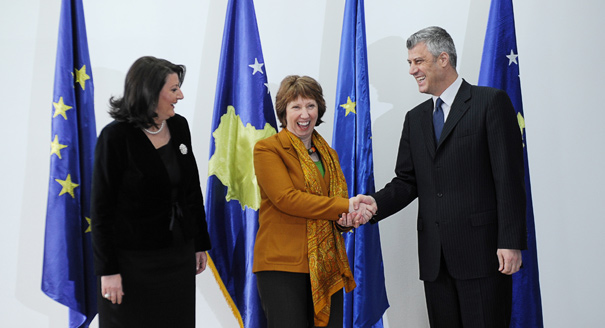
On April 2, the governments of Serbia and Kosovo could reach agreement on a constitutional modus vivendi. If it happens, this deal will mark a breakthrough for the entire region as well as for the EU’s Catherine Ashton.
As April 2 approaches, a few select politicians and civil servants in Brussels, Belgrade, and Pristina are biting their nails down to the skin. They are impatient to see whether on this day, we will finally witness an agreement between the governments of Serbia and Kosovo on a constitutional modus vivendi.
Such a deal would see Pristina’s authority conferred on the territory’s northern enclave of Mitrovica, which is currently administered de facto from Belgrade. What has appeared to be the most insuperable barrier to stability and progress in the former Yugoslavia will have been overcome. This, in turn, should transform the EU’s promise of accession talks for Serbia into a reality.
It is entirely possible that the anticipated agreement collapses at the last minute−hence, the nail-biting. Yet if the agreement is signed and then ratified, it will indicate three things.
First, it will demonstrate that the most senior politicians in Serbia and Kosovo possess a mature statecraft that almost all outside observers would have considered inconceivable; some might even have said congenitally so. By all accounts, the respective prime ministers, Ivica Dacic and Hashim Thaci, have far surpassed expectations of their abilities. Let it also be noted that two Serbian politicians, Tomislav Nikolic, president of Serbia, and Aleksandar Vucic, president of the Serbian Progressive Party, have been vital in allowing the dialogue to develop so fruitfully. Not so long ago, both were members of a political party led by Vojislav Šešelj, an extreme nationalist and war crimes indictee.
Second, the agreement would show that the EU wields an immense and positive influence when it addresses a critical foreign policy issue with a single voice. The primary− and, some would say, sole−mover of this initiative on the European side is Catherine Ashton.
As a consequence of Ashton’s clear guidance to the negotiating parties, we are−for once−not seeing Germans, French, British, Italians, Greeks, and others conspiring against each other in the Balkans to secure some ludicrous advantage or other. Furthermore, the quiet steadfastness and clarity with which Ashton has pursed this agreement has meant that the Americans have not exploited such divisions to further their own foreign policy goals. Until now, that was a persistent problem for Europe with regard to Kosovo in particular.
Third, it is a considerable personal victory for the EU’s High Representative for Foreign and Security Affairs. Even Carl Bildt, Sweden’s foreign minister, who boasts an unparalleled experience of the Balkans, had thought it unlikely that Ashton would be able to pull this one off.
And it wasn’t easy—she did not dictate terms, but persuaded the parties to come to an agreement which they themselves fashioned.
As Ashton stresses, it is not her agreement but theirs. Only when necessary did she step in to explain the parameters or the pros and cons of the tactics deployed by the Serbs and Kosovars. Mostly, she did this alone, but she could bring in other authorities as needed. In ensuring the full backing of Hillary Clinton and then John Kerry for the entire process, Cathy Ashton played a blinder. This has been a European solution to a European problem but with full American buy-in.
Following this achievement, I hope the army of politicians and bureaucrats in several chancelleries of Europe who have been conspiring against Lady Ashton over the years−often in a manner that betrays a sulphuric whiff of misogyny− will give her due recognition in public. It is time they cease the schoolboy sniggering behind her back. I’m not holding my breath on that last point, though.
If an agreement is reached on April 2, Lady Ashton—who was chosen in part because it was assumed that she could easily be manipulated and bullied—will have performed a diplomatic miracle. The implications of a deal go beyond the hitherto intractable issue of Serbia-Kosovo relations. In Bosnia, too, all sides are watching this process slack-jawed. No one in the region believed that such a deal was even a remote possibility. If it comes off, the Bosnians will look like they are dragging their feet intolerably on finding solutions to their own differences, which is exactly what they’re doing.
A Kosovo deal would tally nicely with the one hundredth anniversary of Archduke Franz Ferdinand’s assassination in June next year. If Serbs and Kosovars make peace, the Balkans might finally discard its role as the powder keg of Europe (although I have always maintained that the Balkans was only ever a fuse—the powder keg in 1914 was Europe itself). Then, we could all celebrate 2014 in Sarajevo as the year finally marking an end to the disaster which struck at the beginning of the twentieth century.
Of course, everything could fall through by Tuesday. Yet, even if it does, I just wish to note that Europe came very close to proving that it can alter the fundamental trajectory of an entire region. The EU is certainly far from being a diplomatic pygmy, when it acts with one calm authoritative voice. This is a welcome break from the slow painful process of necrosis that has been characterizing the eurozone crisis.
Misha Glenny is the author of The Balkans: Nationalism, War and the Great Powers, 1804-2012.
Misha Glenny
Journalist and Broadcaster
Misha Glenny is a journalist and broadcaster whose books include The Balkans: Nationalism, War and the Great Powers: 1804-2012, McMafia: A Journey through the Global Criminal Underworld, and DarkMarket: How Hackers Became the New Mafia.

The European Commissioner for Trade is headed to China. But after President Xi’s bridge-building visit to Washington, can a more isolated EU overcome Beijing’s stranglehold on critical raw materials? Who will blink first?

Rym Momtaz, ed.

The domestic impacts of how long it is taking to end the war in Ukraine have pushed the French electorate to the political extremes and compromised the country’s diplomatic capacity.
Rym Momtaz

Before the next wave of EU enlargement takes place, the union needs to grapple with thorny questions of how power is distributed among its members.


Emil Sondaj Hansen, Ditte Brasso Sørensen

Are Germany’s economic, industrial, and political struggles becoming a liability for the EU’s ability to rise to the geopolitical moment?
Rym Momtaz, ed.

European Commission President Ursula von der Leyen is about to give her annual address on the state of the EU. Here’s what she won’t—but should—say.
Rym Momtaz