

Commentary
Judy Dempsey
{
  "authors": [
    "Judy Dempsey"
  ],
  "type": "commentary",
  "blog": "Strategic Europe",
  "centerAffiliationAll": "",
  "centers": [
    "Carnegie Endowment for International Peace",
    "Carnegie Europe"
  ],
  "collections": [],
  "englishNewsletterAll": "",
  "nonEnglishNewsletterAll": "",
  "primaryCenter": "Carnegie Europe",
  "programAffiliation": "",
  "programs": [],
  "projects": [],
  "regions": [
    "Europe"
  ],
  "topics": [
    "Climate Change",
    "EU"
  ]
}
Source: Getty
Despite the constraints on its influence, Poland is fast becoming an important player in Europe, and one of the few countries with a strategic view of the EU’s future.
Poland last week pulled off a diplomatic coup.
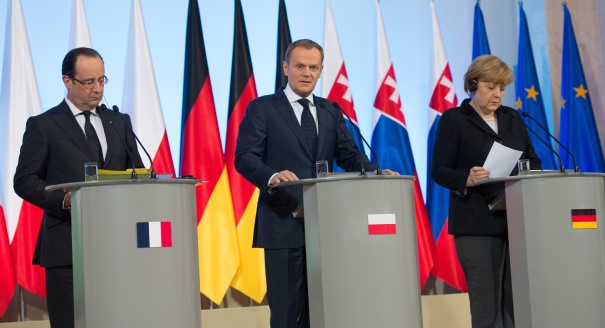
Prime Minister Donald Tusk hosted two summits simultaneously: the Visegrád Group, which consists of the Czech Republic, Hungary, Slovakia, and Poland; as well as the “Weimar Triangle,” made up of France, Germany, and Poland. Leaders from all six countries spent some time together discussing the euro crisis and defense cooperation.
Their meeting was much more than just a photo opportunity. At this double Warsaw summit, three important European alignments became tangible for the first time.
The first is that, since becoming president a year ago, François Hollande has begun reorienting France’s foreign policy. The second is that Germany’s Chancellor Angela Merkel says she wants Poland to be included in any future core group of EU countries, even though it has not yet adopted the euro. And the third is Poland’s increasing weight inside the EU.
Unlike his predecessor Nicolas Sarkozy, Hollande has not made the mistake of ignoring Poland, the sixth-largest EU member state.
Sarkozy was much more interested in schmoozing with big players such as Germany, the UK, the United States, and Russia. He also was staunchly opposed to Turkish membership of the EU, a policy that Hollande is now reversing. This could have important repercussions for Turkey’s stalled accession negotiations. As for Poland and the other Central and Eastern European countries, they rarely even appeared on Sarkozy’s radar screen.
Hollande, who last week made his second visit to Poland since taking office, recognizes that under Tusk’s center-right, pro-EU government, Poland has a substantial voice within the bloc.
He realizes, for example, that if France needs an ally to resist a radical overhaul of the expensive Common Agricultural Policy, he can call on Poland, which still has a large agricultural sector. And, just as important, if Hollande needs support for reviving the EU’s security and defense policy—which he will want to do after receiving so little EU military backing for France’s mission in Mali—he could not find a more willing partner than Poland. No doubt Poland will set a price for both.
But there are two fundamental differences between Paris and Warsaw. The first is over the notion of a “core Europe.” France believes in this because it can be certain to be part of it. Poland hates the idea because it fears being left out. It did not work hard to join the EU to become a second-class player.
The second difference concerns structural reforms, which Hollande has shown antipathy toward. Poland, which went through immense economic upheaval after 1989, wants Europe to be prosperous and competitive enough to become a strong global and security player. So far, Tusk has supported Merkel’s view that austerity and structural changes are essential for growth and competitiveness.
Merkel has a close relationship with Tusk, which has boosted economic, commercial, political, and cultural ties between the two countries. Germany’s chancellor has gone out of her way to reassure Poland that there will be no two-speed Europe with a core group based on eurozone membership. She wants to keep the door open for Poland, which is Germany’s most important EU ally vis-à-vis Russia.
Traditionally, the Franco-German axis was considered the motor of European integration. That is changing. France does not support much closer economic or political integration. Merkel pays lip service to it, which is a major shift in Germany’s stance on Europe. In contrast, Poland’s commitment to integration is intense. The notion of a Europe split into an old, integrationist part and a new, Atlanticist part is outdated.
But what can Poland’s role be in the EU? Tusk and his Foreign Minister Radek Sikorski long for more influence inside the EU. Their ambitions are limited by the fact that, so far, the Polish economy is not strong enough to adopt the euro. Neither Warsaw nor Brussels wants the EU to make the same mistakes it made with Greece.
Polish ambitions are also limited by the weakness of the other Visegrád countries. Hungary is sclerotic under Viktor Orbán. The Czech Republic is ambivalent about integration, and Slovakia—the only eurozone member among the four—concentrates on domestic affairs.
Poland is one of the few countries in the region, and in the EU more broadly (along with Sweden), that thinks and acts strategically. Look at how the country launched the European Endowment for Democracy, or how it has made the EU think about its Eastern Neighborhood Policy, or how it is pushing for a strong security and defense policy.
With last week’s summits, Poland has asserted its ambitions. Even though the constraints on its influence are real, it is fast becoming an important player in Europe, and one of the few with a strategic view of the EU’s future. If old Europe is over, we might come to be glad of the new one.

Nonresident Senior Fellow, Carnegie Europe
Judy Dempsey is a nonresident senior fellow at Carnegie Europe
Recent Work
Judy Dempsey
Judy Dempsey
Carnegie does not take institutional positions on public policy issues; the views represented herein are those of the author(s) and do not necessarily reflect the views of Carnegie, its staff, or its trustees.

With its public finances in shambles, the far right polling at 35 percent ahead of the 2027 presidential election, and a growing protest movement, is France’s crisis a threat to the EU’s geopolitical awakening?

Rym Momtaz, ed.

Ahead of a tough winter for Ukraine, Donald Trump’s swing back toward Russia bodes ill. But instead of panicking, Kyiv’s European allies are focusing on action.
Rym Momtaz

While the EU and European governments are embracing the much-lauded middle-power moment, this entails three difficult conundrums.

Richard Youngs

Much has been said of the changes Brussels is trying to make to the EU enlargement process. Here’s why gradual integration might—or might not—be the answer.

Dimitar Bechev

The European Commissioner for Trade is headed to China. But after President Xi’s bridge-building visit to Washington, can a more isolated EU overcome Beijing’s stranglehold on critical raw materials? Who will blink first?
Rym Momtaz, ed.