

Commentary
Dmitri Trenin
{
  "authors": [
    "Dmitri Trenin"
  ],
  "type": "commentary",
  "blog": "Strategic Europe",
  "centerAffiliationAll": "",
  "centers": [
    "Carnegie Endowment for International Peace",
    "Carnegie Europe",
    "Carnegie Russia Eurasia Center"
  ],
  "collections": [],
  "englishNewsletterAll": "",
  "nonEnglishNewsletterAll": "",
  "primaryCenter": "Carnegie Russia Eurasia Center",
  "programAffiliation": "",
  "programs": [],
  "projects": [],
  "regions": [
    "Russia",
    "Middle East",
    "North America"
  ],
  "topics": [
    "Security"
  ]
}
Source: Getty
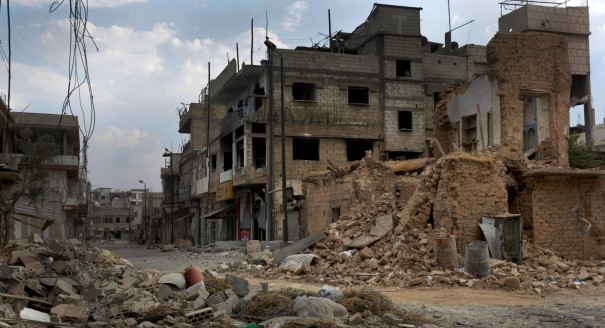
Two years into the Syrian conflict, the United States and Russia are realizing that it is unlikely to end with a clear victory for either side. They must now push for peace talks.
Now and then, there are reports suggesting that a U.S.-Russian deal on Syria might be imminent. The closure has not happened yet, but since the crisis in Syria first erupted two years ago, both the U.S. and the Russian positions have evolved. Russia no longer fears the United States leading a Libyan-style military intervention in Syria. Nor does Moscow believe that Syria’s President Bashar al-Assad will eventually prevail over his opponents.
Washington, by contrast, has tempered its initial expectations of Assad’s imminent downfall. The United States is also far less confident of a democratic transition once the present regime in Damascus is toppled.
The United States and Russia have not only grown wiser; they have come to share a common concern. Neither government wants a bloody chaos in Syria that would turn the country into what some analysts are already calling “Afghanistan on the Mediterranean.”
Presidents Barack Obama and Vladimir Putin have exchanged phone calls, and their representatives, Deputy Secretary of State Bill Burns and Deputy Foreign Minister Mikhail Bogdanov, have met jointly with UN–Arab League Special Envoy Lakhdar Brahimi in an effort to pave the way for a political settlement.
A negotiated solution remains the best hope for stopping the carnage in Syria, which has already claimed over 70,000 lives and turned every tenth Syrian into a refugee. International experts talk about following the example of the Dayton Agreement of 1995 to try and force the warring parties to the negotiating table.
Syrian opposition figures warn that, in the last two years, the country has already lost more than a third of its GDP, about as much as Iraq during the twelve years between the first and second Gulf Wars. Should the war continue through the current year, the loss could grow to almost half of GDP.
Yet the chances of a negotiated settlement are looking bleaker with every passing week. Assad has clearly dug in his heels; he has vowed to fight to the last. The opposition coalition leaders continue to demand Assad’s departure before they will agree to talk peace.
Even more importantly, the numerous field commanders appear to be acting independently, and do not defer to the coalition leadership. Opposition forces have different agendas and different foreign backers; they are united only by their hatred for the Assad family and the Alawite sect. So, even if the government and the opposition were to agree to a ceasefire and start a political dialogue, that agreement might not hold.
The Gulf states, particularly Saudi Arabia and Qatar, have never had much faith in a diplomatic solution. They have long supported their own client forces fighting in Syria, hoping that these forces will dominate post-Assad Syria and marginalize al-Qaeda and its allies.
The UK and France have recently taken a similar view, calling for an end to the EU embargo on weapons sales to all parties in Syria. London and Paris reckon that arming the moderate groups in Syria would help defeat Assad sooner, saving many lives. A number of influential U.S. voices are supporting this approach for the same reasons.
The Obama administration remains cautious about sending in arms. It fears they might end up in the wrong hands, as Stinger missiles did during the Soviet war in Afghanistan. Yet according to media reports, the United States is training opposition fighters.
The Kremlin strongly criticizes anyone arming the opposition, likening such moves to adding fuel to the fire and engaging in a war by proxy. Moscow itself, of course, continues to send weapons to Damascus, specifying that these deliveries are being made under contracts signed before the present crisis: hardly a convincing argument.
As the world’s powers talk peace and, at the same time, feed the war, they are headed toward an utterly undesirable outcome. Moscow’s and Washington’s early goals will probably be achieved. Russia will probably prevent a Western intervention in Syria, and the United States will probably see Assad overthrown.
But the price exacted may be the end of Syria as a state—at least temporarily—and continued fighting. U.S. allies, including Israel, will be affected by Syria’s Afghanization, and the same may be true for Russia’s near neighbors and borderlands.
It may now be too late for a diplomatic solution. But conceding defeat and letting the force of arms define the outcome of the crisis is not a good alternative. Those who believe that fire can only be fought with fire will share some of the responsibility for the continued killings and impoverishment of the Syrian people.
It is time that Russia, now freed from its fear of another U.S.-led invasion, and the United States, better informed today about the complexities of the Arab Spring, jointly identify and encourage the elements in Syria that are amenable to a political solution. Those factions in Syria hostile to negotiations should be cut off from support.
At the same time, the United States and Russia need to reach out to Syria’s neighbors—the Arab countries, Turkey, and Iran—and secure their support, or at least minimize their interference with the process. This undoubtedly looks difficult. In the early 1990s, Afghanistan also looked difficult—before it turned into a disaster.
Former Director, Carnegie Moscow Center
Trenin was director of the Carnegie Moscow Center from 2008 to early 2022.
Recent Work
Dmitri Trenin
Dmitri Trenin
Carnegie does not take institutional positions on public policy issues; the views represented herein are those of the author(s) and do not necessarily reflect the views of Carnegie, its staff, or its trustees.

A summer of escalation in the Black Sea has hurt Ukraine economically and is exacerbating world food security. A truce is needed—as is a broader reframing of Europe’s Ukraine strategy.

Thomas de Waal

Are Germany’s economic, industrial, and political struggles becoming a liability for the EU’s ability to rise to the geopolitical moment?

Rym Momtaz, ed.

European Commission President Ursula von der Leyen is about to give her annual address on the state of the EU. Here’s what she won’t—but should—say.
Rym Momtaz

The EU’s responses to two recent incidents expose the gulf between European perceptions and capabilities. Unless the union can bridge that gap, it will never become a real geostrategic power.
Rym Momtaz

In supporting Europe’s far-right, MAGA and Russia both want the same thing: a weaker EU. Europe must defend itself without abandoning the openness these forces exploit.

Armida van Rij