
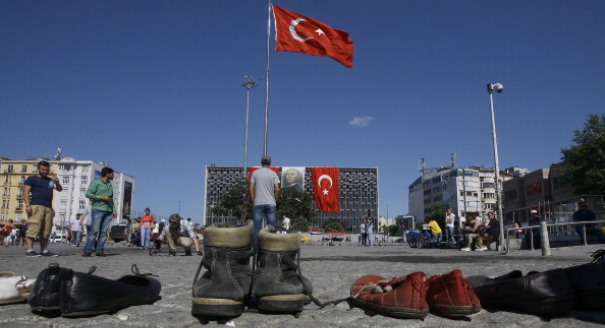
So far, much of the attention on Turkey’s Gezi Park protests has focused on domestic politics, on tactical errors by both sides, or on Prime Minister Recep Tayyip Erdoğan’s electoral motives.
As the cycle of protests and repression winds down, it is time to look at the international dimension of the demonstrations. That doesn’t mean the claim that Turkey is the victim of a foreign conspiracy, or the many statements by the UN and international NGOs, but the real impact of the crisis on Turkey’s relations with the United States and the EU.
The U.S. administration entertains a security-based relationship with the Erdoğan government. So it is not surprising that the words from Washington have been softer than those from Berlin, Brussels, or Stockholm. What matters most for the United States is ensuring that its main interests are served; these include the Incirlik air base, the U.S. missile defense shield, a normalization of Turkish-Israeli relations, and the NATO shield against Syria. The United States is also keen to dissuade Ankara from taking any autonomous initiatives on Syria.
Washington’s selective approach is to safeguard its essentials and turn a blind eye to domestic issues while expressing some concern at the excessive use of force. According to some Turkish analysts, Ankara interpreted Erdoğan’s recent visit to the White House as a blank check on domestic affairs as long as Washington’s international priorities are met.
Another dimension is the Turkey-EU relationship, which is based on tight economic links and accession negotiations. The Gezi protests have seriously dented this crucial relationship. As is customary in such circumstances, the European Parliament (EP) adopted a resolution criticizing the Turkish government, which in turn drew a harsh, dismissive reaction from Ankara. The key issue is not the legitimacy of the EP resolution but the tone of Ankara’s reaction. In effect, Turkey’s ruling Justice and Development Party (AKP) “does not recognize” the EP and called on it to “regain [its] reason as soon as possible.”
During and after the crisis, the Turkish authorities adopted a number of measures that clearly point to a clash of values with the EU. These include curbs on press freedom and the right to peaceful protest, the use of excessive force, the arrest of large numbers of protesters, lawyers, and doctors, stricter regulation of social media, and a lack of dialogue with civil society. Such steps are all in contradiction with the political criteria that underpin Turkey’s EU accession negotiations.
This relapse came at the very moment when accession talks were about to be relaunched after a three-year stalemate. The opening of a new chapter in the negotiations is scheduled for June 26, but there is currently no certainty that it will take place. Germany remains particularly opposed to opening further chapters, even though doing so would enable Europe to engage with its Turkish interlocutors.
Within EU circles, the greatest concern is Turkey’s underlying concept of democracy. For the Turkish leadership, legislative elections every four years are enough to legitimize the policies the government deems appropriate for the entire population. In addition, the government has reacted to the protests by cracking down on traditional and social media.
If such ideas are the true colors of the AKP’s “advanced democracy” and Turkey’s answer to both its citizens and the EU’s political criteria, then there is a huge problem in store. Fundamentally, the EU’s accession requirements have become an impediment to the AKP’s and the prime minister’s political ambitions for the next ten years.
A further issue is the development of Turkish civil society, which is at the center of the European concept of democracy. The Gezi protest movement has shown how vibrant and dedicated young liberals are, without any connection to political parties or trade unions. It is no surprise that EU civil society programs in Turkey have met with immense success since 2005.
In the medium and long term, Europe has a strategic interest in the development of a vibrant Turkish democracy based on the country’s rich social diversity. Beyond the EU’s harsh but justified criticisms of the Turkish authorities’ handling of recent protests, the creation of a robust civil society based on democratic principles, tolerance, and respect is a crucial objective for the EU—and for the West more generally.
EU ministers now have a delicate balancing act, not just the simplistic option of suspending accession negotiations with Turkey. The EU cannot afford to ignore the fact that a very large segment of Turkish society is fighting peacefully for the very values the EU is based on. Not only should the EU continue to vigorously engage with the Turkish authorities, but it should also urgently reaffirm its support for Turkish democracy through the accession negotiations and civil society projects.
As for Turkey, despite current temptations to abandon EU values, there remains a basic need to maintain an active relationship with the EU. That is necessary for economic reasons such as trade, investment, and technology, but also because EU values have taken deep root in Turkish society. These values are reflected not just in a few urban intellectuals’ leanings, but in the opinions of a very large part of the population.
Turkey’s conservative leadership is now confronted with a choice between sticking to a polarizing narrative—with all its adverse consequences at home and abroad—or governing a diverse society with more tolerance and wisdom.


